Data Centers
High-reliability MDB, PCC, ATS (STS), metering, APFC, BTS, DC distribution
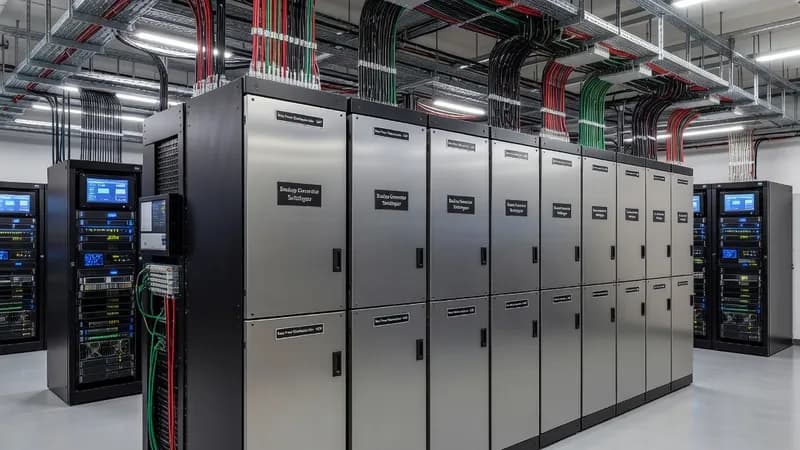
Data centers require low-voltage switchgear and controlgear assemblies engineered for continuous operation, selective coordination, and maintainability under Tier III and Tier IV availability strategies. The core architecture typically combines main distribution boards (MDBs), power control centers (PCCs), ATS systems, static transfer switches (STS), metering panels, power factor correction panels, DC distribution panels, and busbar trunking systems feeding UPS plants, chillers, CRAH units, IT halls, and auxiliary loads. In accordance with IEC 61439-1 and IEC 61439-2, assemblies must be designed, verified, and temperature-rise tested for the declared rated current, short-circuit withstand strength, and form of separation, often Form 3b or Form 4b where operational segregation and maintenance continuity are critical. Common incoming devices include ACBs up to 6300 A and high-rupturing-capacity MCCBs for feeders, with electronic trip units and communication interfaces for selective protection and remote monitoring. For critical IT loads, STS panels and dual-source ATS arrangements must support fast source transfer and avoid nuisance outages while maintaining compatibility with UPS topology, generator sets, and static bypass paths. Busbar trunking systems are widely used to distribute power to server rooms and white space because they reduce installation time, improve scalability, and support tap-off flexibility compared with fixed cabling. For DC-side applications, especially battery strings, rectifier outputs, and emerging 380 V DC architectures, dedicated DC distribution panels and suitably rated protection devices are required to manage polarity, fault interruption, and arc energy control. Protection relays, multifunction power analyzers, and revenue-grade meters enable power quality diagnostics, harmonic monitoring, and PUE optimization across the facility. Environmental design is equally important. Data centers may impose high internal heat loads, raised-floor airflow constraints, stringent ingress protection requirements, and limited maintenance access. Assemblies are therefore specified with forced ventilation, temperature monitoring, anti-condensation heaters where needed, and carefully managed cable entry to preserve IP degree and segregation. In seismically active regions, panels and busbar systems may require seismic qualification, anchoring, and mechanical bracing to maintain integrity during and after an event. For EMC-sensitive sites, compliance with IEC 61000 is essential to ensure immunity and emission control for metering, PLCs, relays, and networked automation systems. Where UPS rooms, battery areas, or fuel-handling zones present fire or explosion considerations, IEC 61641 arc-fault mitigation practices and IEC 60079 hazardous-area principles may be relevant to adjacent equipment selection and enclosure design. Patrion’s custom-engineered panel solutions for data centers are typically built to IEC 61439-2 with optional IEC 61439-3 sub-distribution sections and IEC 61439-6 busbar trunking interfaces, allowing integrated solutions from utility incomer to rack-level distribution. Designs may also be adapted to UL 891 and CSA requirements for projects requiring North American compliance. The result is a coordinated electrical infrastructure that supports expansion, minimizes downtime, and provides the monitoring and protection needed for modern hyperscale, colocation, enterprise, and edge data center operations.
Panel Types for This Industry
Main Distribution Board (MDB) assemblies engineered for Data Centers applications, addressing industry-specific requirements and compliance standards.
Power Control Center (PCC) assemblies engineered for Data Centers applications, addressing industry-specific requirements and compliance standards.
Automatic Transfer Switch (ATS) Panel assemblies engineered for Data Centers applications, addressing industry-specific requirements and compliance standards.
Power Factor Correction Panel (APFC) assemblies engineered for Data Centers applications, addressing industry-specific requirements and compliance standards.
Metering & Monitoring Panel assemblies engineered for Data Centers applications, addressing industry-specific requirements and compliance standards.
Busbar Trunking System (BTS) assemblies engineered for Data Centers applications, addressing industry-specific requirements and compliance standards.
DC Distribution Panel assemblies engineered for Data Centers applications, addressing industry-specific requirements and compliance standards.
Custom Engineered Panel assemblies engineered for Data Centers applications, addressing industry-specific requirements and compliance standards.
Frequently Asked Questions
Ready to Engineer Your Next Panel?
Our team of electrical engineers is ready to design, build, and deliver your custom panel solution — fully compliant with international standards.