Power Control Center (PCC)
High-capacity power distribution for industrial facilities. Controls and distributes incoming power to MCC, APFC, and downstream loads.
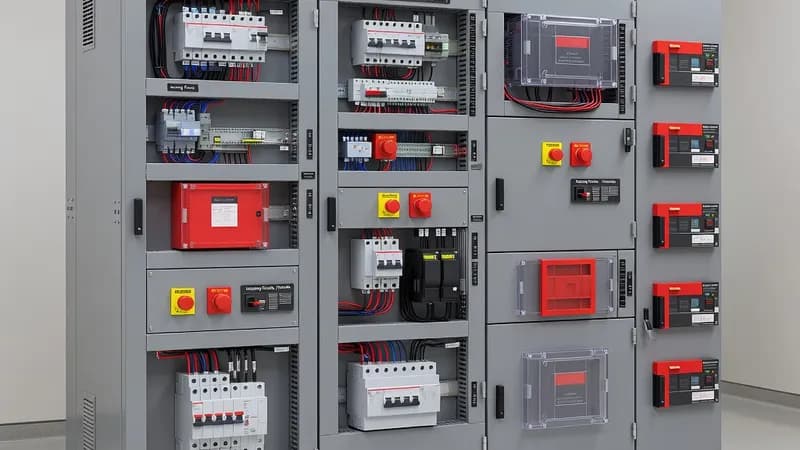
A Power Control Center (PCC) is the main low-voltage switchgear assembly used to receive, protect, meter, and distribute electrical power in industrial and infrastructure installations. Designed in accordance with IEC 61439-1 and IEC 61439-2, a PCC typically forms the interface between the utility transformer, generator sets, or MV/LV transformer secondary and the downstream distribution network. In practice, PCCs are engineered for rated operational currents from 800 A up to 6300 A, with busbar systems and enclosure construction verified for short-circuit withstand levels such as Icw 50 kA, 65 kA, or 100 kA for 1 s, depending on the application and fault study. The incoming section commonly uses one or more air circuit breakers (ACBs) with electronic trip units for LSIG protection, selective coordination, and energy monitoring. For smaller feeders or outgoing sub-distribution circuits, moulded-case circuit breakers (MCCBs) provide compact protection and isolation. PCCs may also integrate protection relays for transformer, generator, or feeder protection, metering power analyzers, current and voltage transformers, surge protection devices, and control equipment for automatic transfer or load shedding. Where the plant architecture requires motor control, the PCC often feeds MCCs, VFD panels, and soft starter sections, while power factor correction (APFC) panels are connected through dedicated feeder breakers and contactor steps. The internal architecture is defined by the form of separation. Depending on operational and maintenance requirements, manufacturers implement Form 2b, Form 3b, or Form 4b arrangements to segregate busbars, functional units, and terminals. Form 4b is often specified in critical facilities because it supports safer maintenance and improved continuity of service, especially where live operation is unavoidable. The enclosure, busbar chamber, and functional compartments are designed to meet thermal limits, dielectric clearances, creepage distances, and IP ratings appropriate to the site environment. PCCs are frequently deployed in industrial manufacturing plants, data centers, oil and gas facilities, mining operations, water and wastewater plants, and large commercial complexes. In data centers, PCCs are used for high-availability distribution, generator paralleling interfaces, and monitoring of critical loads. In oil and gas and mining sites, PCCs are selected for robust fault performance, corrosion resistance, and, when required, compliance with hazardous-area adjacent requirements such as IEC 60079 interface considerations. For facilities exposed to fire risk or severe overload conditions, arc containment performance may be assessed according to IEC 61641, and seismic qualification may be required for region-specific project specifications. A well-designed PCC is not only a collection of breakers and busbars; it is a coordinated power distribution system. Proper engineering includes short-circuit analysis, temperature rise verification, derating for ambient conditions, cable entry planning, protection selectivity studies, and communication integration with SCADA or BMS systems via Modbus, Ethernet, or other plant protocols. When specified and manufactured correctly, the PCC becomes the backbone of the plant electrical system, ensuring safe switching, reliable distribution, and maintainable operation over the full lifecycle of the installation.
Components for This Panel
Air Circuit Breakers (ACB) selection, integration, and best practices for Power Control Center (PCC) assemblies compliant with IEC 61439.
Moulded Case Circuit Breakers (MCCB) selection, integration, and best practices for Power Control Center (PCC) assemblies compliant with IEC 61439.
Busbar Systems selection, integration, and best practices for Power Control Center (PCC) assemblies compliant with IEC 61439.
Metering & Power Analyzers selection, integration, and best practices for Power Control Center (PCC) assemblies compliant with IEC 61439.
Protection Relays selection, integration, and best practices for Power Control Center (PCC) assemblies compliant with IEC 61439.
Surge Protection Devices (SPD) selection, integration, and best practices for Power Control Center (PCC) assemblies compliant with IEC 61439.
Applicable Standards
IEC 61439-2 (PSC) compliance requirements, testing procedures, and design considerations for Power Control Center (PCC) assemblies.
Arc Flash Protection (IEC 61641) compliance requirements, testing procedures, and design considerations for Power Control Center (PCC) assemblies.
Seismic Qualification (IEEE 693/IBC) compliance requirements, testing procedures, and design considerations for Power Control Center (PCC) assemblies.
UL 891 / CSA C22.2 compliance requirements, testing procedures, and design considerations for Power Control Center (PCC) assemblies.
EMC Compliance (IEC 61000) compliance requirements, testing procedures, and design considerations for Power Control Center (PCC) assemblies.
Industries Using This Panel
Power Control Center (PCC) assemblies engineered for Industrial Manufacturing applications, addressing industry-specific requirements and compliance standards.
Power Control Center (PCC) assemblies engineered for Data Centers applications, addressing industry-specific requirements and compliance standards.
Power Control Center (PCC) assemblies engineered for Oil & Gas applications, addressing industry-specific requirements and compliance standards.
Power Control Center (PCC) assemblies engineered for Mining & Metals applications, addressing industry-specific requirements and compliance standards.
Related Knowledge Articles
Comprehensive overview of all IEC 61439 parts, their scope, and how they apply to different panel types.
Achieving full selectivity between protection devices.
Comprehensive guide to busbar sizing, material selection, and installation.
Understanding and verifying short-circuit ratings.
Frequently Asked Questions
Ready to Engineer Your Next Panel?
Our team of electrical engineers is ready to design, build, and deliver your custom panel solution — fully compliant with international standards.