Motor Control Center (MCC)
Centralized motor control with starters, contactors, overloads, and VFDs in standardized withdrawable/fixed functional units.
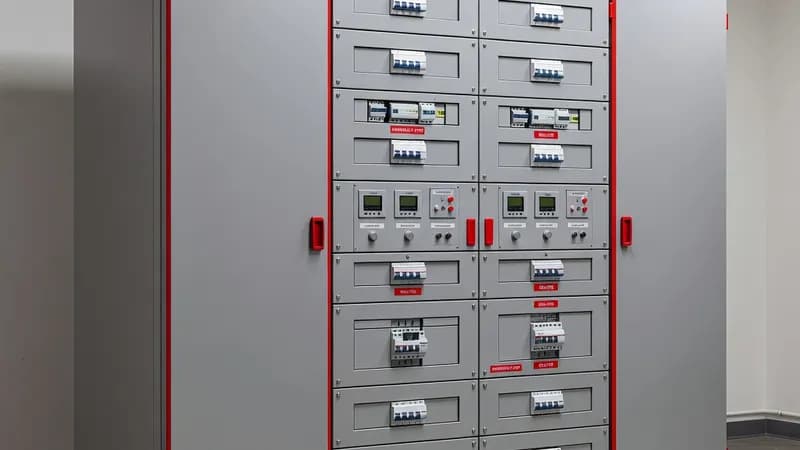
A Motor Control Center (MCC) is a standardized low-voltage switchgear and control assembly defined and type-tested as an IEC 61439-2 assembly for centralized distribution, protection, and automation of motor feeders. In modern industrial plants, MCCs integrate ACB incomers, MCCB feeders, fuse-switch disconnectors, contactors, overload relays, soft starters, and VFDs into coordinated functional units that can be fixed, plug-in, or fully withdrawable depending on the maintenance philosophy and process criticality. Typical main busbar ratings range from 400 A to 6300 A, with short-circuit withstand levels commonly specified from 25 kA to 100 kA for 1 s, subject to verified design, busbar bracing, and protective device coordination. Individual motor feeders may serve small pumps and fans from 0.37 kW upward, as well as high-inertia drives, compressors, crushers, conveyors, mixers, and process pumps well beyond 250 kW. For panel builders and EPC contractors, the key MCC design criteria are temperature rise, dielectric withstand, short-circuit performance, and internal separation. IEC 61439-1 and IEC 61439-2 govern general rules and power switchgear assemblies, while IEC 61439-3 applies when meter-out or distribution sections are incorporated, and IEC 61439-6 may be relevant where busbar trunking systems interface with the lineup. Internal separation is often specified as Form 1, Form 2a, Form 2b, Form 3a, Form 3b, or Form 4, with Form 4b offering the greatest segregation between busbars, functional units, and terminals to improve maintainability and limit fault propagation. In hazardous areas, MCCs may also need compliance strategies aligned with IEC 60079 and ATEX/IECEx, while marine and offshore projects often require classification society approval and enhanced corrosion resistance. A well-engineered MCC combines motor starting technology with protection and automation. Across the lineup, conventional DOL starters may use contactors and thermal overload relays, while reduced-voltage applications rely on soft starters to limit inrush current and mechanical stress. VFD-based feeders are selected for process control, energy savings, and torque optimization, often paired with line reactors, EMC filters, or harmonic mitigation solutions where the network requires it. Intelligent motor protection relays, electronic overload units, and PLC I/O modules enable remote diagnostics, predictive maintenance, and integration with SCADA or DCS platforms using Modbus TCP, PROFINET, EtherNet/IP, or Profibus. Type 1 or Type 2 coordination per IEC 60947 is essential to define post-fault operability and replacement requirements after a short circuit. MCCs are widely used in industrial-manufacturing, oil-and-gas, water-wastewater, mining-metals, marine-offshore, food-and-beverage, and pharmaceutical facilities where uptime, maintainability, and safe isolation are critical. In seismic regions, assemblies may be designed and tested for seismic qualification, while arc-risk mitigation is addressed through verified enclosure design, compartmentalization, and compliance testing in accordance with IEC 61641 for arc fault containment. For compact plants, MCC sections may be integrated with PLC panels, power distribution boards, or process skids, but the assembly must still satisfy IEC 61439 verification requirements for clearances, creepage distances, protective bonding, and rated diversity factor. Patrion manufactures MCC panels in Turkey for demanding projects, delivering engineered assemblies tailored to application duty, environmental severity, and lifecycle maintenance targets.
Components for This Panel
Moulded Case Circuit Breakers (MCCB) selection, integration, and best practices for Motor Control Center (MCC) assemblies compliant with IEC 61439.
Variable Frequency Drives (VFD) selection, integration, and best practices for Motor Control Center (MCC) assemblies compliant with IEC 61439.
Soft Starters selection, integration, and best practices for Motor Control Center (MCC) assemblies compliant with IEC 61439.
Contactors & Motor Starters selection, integration, and best practices for Motor Control Center (MCC) assemblies compliant with IEC 61439.
Protection Relays selection, integration, and best practices for Motor Control Center (MCC) assemblies compliant with IEC 61439.
Busbar Systems selection, integration, and best practices for Motor Control Center (MCC) assemblies compliant with IEC 61439.
PLCs & I/O Modules selection, integration, and best practices for Motor Control Center (MCC) assemblies compliant with IEC 61439.
Applicable Standards
IEC 61439-2 (PSC) compliance requirements, testing procedures, and design considerations for Motor Control Center (MCC) assemblies.
ATEX / IECEx Certification compliance requirements, testing procedures, and design considerations for Motor Control Center (MCC) assemblies.
Marine Classification (DNV/Lloyd's/BV) compliance requirements, testing procedures, and design considerations for Motor Control Center (MCC) assemblies.
Arc Flash Protection (IEC 61641) compliance requirements, testing procedures, and design considerations for Motor Control Center (MCC) assemblies.
Seismic Qualification (IEEE 693/IBC) compliance requirements, testing procedures, and design considerations for Motor Control Center (MCC) assemblies.
UL 891 / CSA C22.2 compliance requirements, testing procedures, and design considerations for Motor Control Center (MCC) assemblies.
Industries Using This Panel
Motor Control Center (MCC) assemblies engineered for Industrial Manufacturing applications, addressing industry-specific requirements and compliance standards.
Motor Control Center (MCC) assemblies engineered for Oil & Gas applications, addressing industry-specific requirements and compliance standards.
Motor Control Center (MCC) assemblies engineered for Water & Wastewater applications, addressing industry-specific requirements and compliance standards.
Motor Control Center (MCC) assemblies engineered for Mining & Metals applications, addressing industry-specific requirements and compliance standards.
Motor Control Center (MCC) assemblies engineered for Marine & Offshore applications, addressing industry-specific requirements and compliance standards.
Motor Control Center (MCC) assemblies engineered for Food & Beverage applications, addressing industry-specific requirements and compliance standards.
Motor Control Center (MCC) assemblies engineered for Pharmaceuticals applications, addressing industry-specific requirements and compliance standards.
Related Knowledge Articles
Comprehensive guide to MCC design and engineering.
Selecting coordinated MCCB-contactor-overload combinations.
Comprehensive overview of all IEC 61439 parts, their scope, and how they apply to different panel types.
Protecting personnel from arc flash hazards.
Frequently Asked Questions
Ready to Engineer Your Next Panel?
Our team of electrical engineers is ready to design, build, and deliver your custom panel solution — fully compliant with international standards.