Variable Frequency Drive (VFD) Panel
Enclosed VFD assemblies with input protection, line reactors, EMC filters, output reactors, and bypass options.
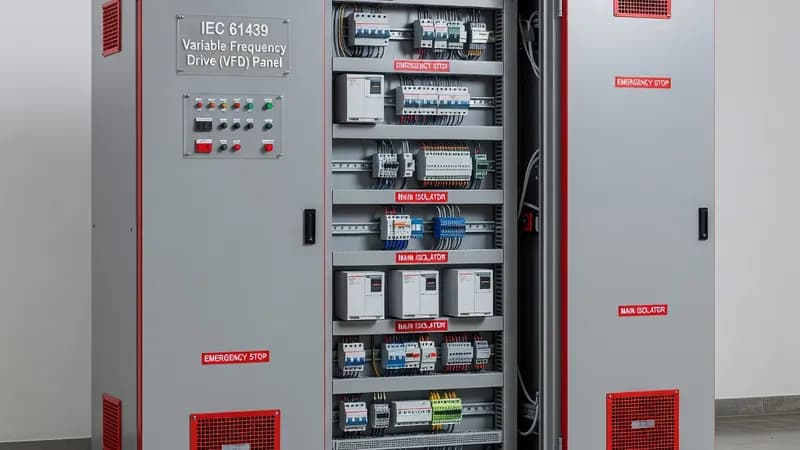
A Variable Frequency Drive (VFD) Panel is a purpose-built IEC 61439 low-voltage switchgear and controlgear assembly designed to provide adjustable speed control, torque regulation, and energy optimization for AC motors in demanding industrial and utility applications. In its typical form, the assembly contains one or more VFDs, a main incomer device such as an ACB or MCCB, busbar systems sized for the prospective short-circuit current, branch protection, motor isolation, control devices, and thermal management hardware within a coordinated enclosure. For many projects, the panel is engineered to IEC 61439-1 and IEC 61439-2, with application-specific considerations for industrial assemblies, while enclosure ingress protection may be specified to IP54, IP55, or higher depending on site conditions. Where the assembly is installed in hazardous locations or integrated into explosive atmospheres, the design interface may also require consideration of IEC 60079 and IECEx/ATEX requirements. Fire resilience and arc effects can be evaluated using IEC 61641 where applicable. A robust VFD panel design starts with the supply interface. Input protection may be provided by MCCBs, HRC fuses, or upstream ACBs with coordination to the drive manufacturer’s recommendations. Line reactors or DC link chokes reduce supply-side harmonics and improve nuisance-trip immunity, while EMC/RFI filters are selected to satisfy IEC 61000 compatibility and drive emission requirements under IEC 61800-3. On the output side, reactor or dV/dt filters are often used to protect motor insulation, mitigate reflected wave effects, and support long cable runs. For critical processes, a bypass arrangement using contactors and motor starters can maintain operation in the event of drive maintenance or fault, especially in water and wastewater pumping, HVAC, and process utility systems. Modern assemblies may also include surge protection devices, phase-loss monitoring, thermal sensors, space heaters, fan packs, and PLC or protection relay interfaces for automation integration. Typical VFD panel ratings range from compact single-drive assemblies at 0.75 kW to medium-voltage-equivalent low-voltage systems above 500 kW, with supply voltages commonly at 380-415 V, 480 V, or 690 V, and short-circuit withstand ratings coordinated from 25 kA up to 100 kA or more depending on the busbar and protective device selection. Internal separation can be configured as Form 1 through Form 4 to improve serviceability, limit fault propagation, and support maintenance without shutting down the entire lineup. In higher-density designs, segregating incoming power, drive compartments, and control wiring helps manage heat, electromagnetic interference, and personnel safety. VFD panels are routinely deployed in industrial manufacturing, oil and gas, mining and metals, food and beverage, pharmaceuticals, desalination, and municipal water infrastructure. They are often specified for pumps, fans, compressors, conveyors, mixers, crushers, and extruders where speed control improves process stability, reduces mechanical stress, and lowers lifecycle energy consumption. For EPC contractors and panel builders, the key engineering tasks are thermal derating, harmonic assessment, cable sizing, protective coordination, and verification of routine performance tests under IEC 61439. A well-designed VFD panel is not simply a drive in a cabinet; it is a coordinated power distribution and motor control assembly engineered for safety, EMC compliance, maintainability, and long-term reliability in real operating conditions.
Components for This Panel
Variable Frequency Drives (VFD) selection, integration, and best practices for Variable Frequency Drive (VFD) Panel assemblies compliant with IEC 61439.
Moulded Case Circuit Breakers (MCCB) selection, integration, and best practices for Variable Frequency Drive (VFD) Panel assemblies compliant with IEC 61439.
Contactors & Motor Starters selection, integration, and best practices for Variable Frequency Drive (VFD) Panel assemblies compliant with IEC 61439.
Surge Protection Devices (SPD) selection, integration, and best practices for Variable Frequency Drive (VFD) Panel assemblies compliant with IEC 61439.
Busbar Systems selection, integration, and best practices for Variable Frequency Drive (VFD) Panel assemblies compliant with IEC 61439.
Applicable Standards
IEC 61439-2 (PSC) compliance requirements, testing procedures, and design considerations for Variable Frequency Drive (VFD) Panel assemblies.
EMC Compliance (IEC 61000) compliance requirements, testing procedures, and design considerations for Variable Frequency Drive (VFD) Panel assemblies.
IP Protection Ratings compliance requirements, testing procedures, and design considerations for Variable Frequency Drive (VFD) Panel assemblies.
ATEX / IECEx Certification compliance requirements, testing procedures, and design considerations for Variable Frequency Drive (VFD) Panel assemblies.
Industries Using This Panel
Variable Frequency Drive (VFD) Panel assemblies engineered for Industrial Manufacturing applications, addressing industry-specific requirements and compliance standards.
Variable Frequency Drive (VFD) Panel assemblies engineered for Oil & Gas applications, addressing industry-specific requirements and compliance standards.
Variable Frequency Drive (VFD) Panel assemblies engineered for Water & Wastewater applications, addressing industry-specific requirements and compliance standards.
Variable Frequency Drive (VFD) Panel assemblies engineered for Mining & Metals applications, addressing industry-specific requirements and compliance standards.
Variable Frequency Drive (VFD) Panel assemblies engineered for Food & Beverage applications, addressing industry-specific requirements and compliance standards.
Variable Frequency Drive (VFD) Panel assemblies engineered for Pharmaceuticals applications, addressing industry-specific requirements and compliance standards.
Related Knowledge Articles
Engineering VFD panels for reliable motor speed control.
How to size and select VFDs for panel integration.
Thermal management strategies for panel enclosures.
Designing panels to minimize electrical losses.
Frequently Asked Questions
Ready to Engineer Your Next Panel?
Our team of electrical engineers is ready to design, build, and deliver your custom panel solution — fully compliant with international standards.