Automatic Transfer Switch (ATS) Panel
Automatic changeover between mains and generator/UPS. Open or closed transition, with or without bypass.
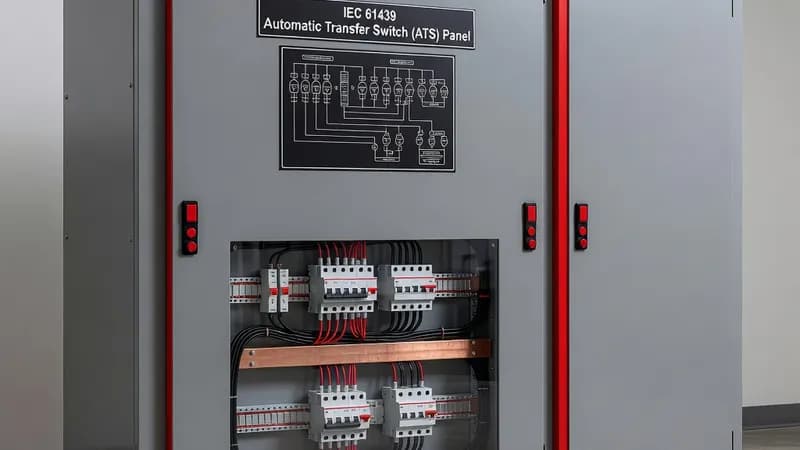
An Automatic Transfer Switch (ATS) Panel is a low-voltage power distribution assembly designed to automatically transfer critical loads between two or more power sources, typically utility mains, diesel generator sets, and in some applications UPS-backed emergency feeders. Built as an IEC 61439 panel assembly, the ATS is engineered, verified, and routine-tested to maintain continuity of supply while protecting personnel, equipment, and upstream sources. In practice, ATS panels are used in commercial buildings, hospitals, airports, data centers, industrial plants, utilities, marine/offshore installations, and renewable-energy sites where loss of power is unacceptable or tightly controlled. Depending on application duty, ATS panels may be constructed with motorized changeover switches, paired MCCBs, ACB incomers, contactor-based transfer schemes, or bypass/isolation arrangements. Typical rated operational currents range from 63 A for small essential loads to 6300 A or higher in large building and infrastructure systems, with short-circuit withstand ratings commonly coordinated from 25 kA to 100 kA or more at 400/415 V, subject to the selected device and busbar design. For higher-power systems, air circuit breakers with electronic trip units are often preferred because they provide adjustable LSI/LSIG protection, communication, and high endurance. For smaller systems, moulded-case circuit breakers or power contactors with mechanical and electrical interlocking are common. The control logic continuously supervises voltage, frequency, phase sequence, phase loss, reverse power, and undervoltage/overvoltage conditions through protection relays or multifunction power meters. When the preferred source fails or drifts outside set limits, the ATS initiates an open transition (break-before-make) or closed transition (make-before-break) transfer, depending on utility rules and load sensitivity. In open transition systems, interruption time is typically controlled from a few hundred milliseconds to several seconds. Closed transition systems require synchronized sources and careful interlocking, often used where process continuity is critical. For maintenance-critical installations, bypass/isolation ATS arrangements allow the transfer mechanism to be withdrawn or isolated without interrupting the load. IEC 61439-1 and IEC 61439-2 govern the design verification and assembly requirements, including temperature rise, dielectric properties, short-circuit performance, clearances, creepage, and protection against electric shock. Where ATS panels serve public or building distribution functions, IEC 61439-3 or IEC 61439-6 may also be relevant for specific final distribution or busbar trunking interfaces. Component selection must also align with IEC 60947 series requirements for switchgear and controlgear, especially IEC 60947-2 for circuit breakers, IEC 60947-4-1 for contactors and motor starters, and IEC 60947-6-1 for transfer switching equipment. In harsh or classified areas, enclosure and installation considerations may involve IEC 60079 for explosive atmospheres, while arc-containment testing and internal arc risk mitigation may reference IEC 61641 where applicable. Modern ATS panels frequently include metering power analyzers, event logs, communications via Modbus TCP, BACnet, or Ethernet/IP, and integration with building management systems or SCADA platforms. As a result, they are not only transfer devices but also power continuity nodes that support predictive maintenance, source quality monitoring, and load prioritization across mission-critical infrastructures.
Components for This Panel
Moulded Case Circuit Breakers (MCCB) selection, integration, and best practices for Automatic Transfer Switch (ATS) Panel assemblies compliant with IEC 61439.
Air Circuit Breakers (ACB) selection, integration, and best practices for Automatic Transfer Switch (ATS) Panel assemblies compliant with IEC 61439.
Contactors & Motor Starters selection, integration, and best practices for Automatic Transfer Switch (ATS) Panel assemblies compliant with IEC 61439.
Protection Relays selection, integration, and best practices for Automatic Transfer Switch (ATS) Panel assemblies compliant with IEC 61439.
Metering & Power Analyzers selection, integration, and best practices for Automatic Transfer Switch (ATS) Panel assemblies compliant with IEC 61439.
Applicable Standards
IEC 61439-2 (PSC) compliance requirements, testing procedures, and design considerations for Automatic Transfer Switch (ATS) Panel assemblies.
Seismic Qualification (IEEE 693/IBC) compliance requirements, testing procedures, and design considerations for Automatic Transfer Switch (ATS) Panel assemblies.
Arc Flash Protection (IEC 61641) compliance requirements, testing procedures, and design considerations for Automatic Transfer Switch (ATS) Panel assemblies.
UL 891 / CSA C22.2 compliance requirements, testing procedures, and design considerations for Automatic Transfer Switch (ATS) Panel assemblies.
Industries Using This Panel
Automatic Transfer Switch (ATS) Panel assemblies engineered for Commercial Buildings applications, addressing industry-specific requirements and compliance standards.
Automatic Transfer Switch (ATS) Panel assemblies engineered for Data Centers applications, addressing industry-specific requirements and compliance standards.
Automatic Transfer Switch (ATS) Panel assemblies engineered for Healthcare & Hospitals applications, addressing industry-specific requirements and compliance standards.
Automatic Transfer Switch (ATS) Panel assemblies engineered for Renewable Energy applications, addressing industry-specific requirements and compliance standards.
Automatic Transfer Switch (ATS) Panel assemblies engineered for Marine & Offshore applications, addressing industry-specific requirements and compliance standards.
Automatic Transfer Switch (ATS) Panel assemblies engineered for Infrastructure & Utilities applications, addressing industry-specific requirements and compliance standards.
Related Knowledge Articles
Designing ATS systems for reliable power changeover.
Comprehensive overview of all IEC 61439 parts, their scope, and how they apply to different panel types.
Achieving full selectivity between protection devices.
Frequently Asked Questions
Ready to Engineer Your Next Panel?
Our team of electrical engineers is ready to design, build, and deliver your custom panel solution — fully compliant with international standards.