Main Distribution Board (MDB)
Primary power distribution from transformer to sub-circuits. Rated up to 6300A. Houses main incoming breaker, bus-section, and outgoing feeders.
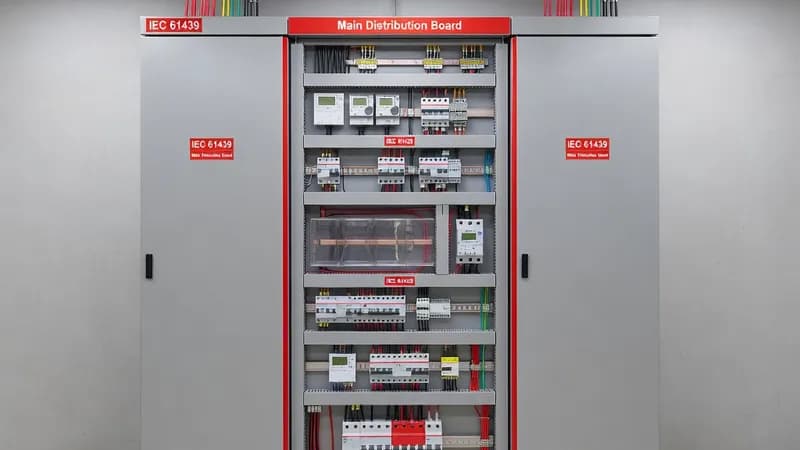
The Main Distribution Board (MDB) is the primary low-voltage power distribution assembly in a facility, receiving energy from a transformer, generator incomer, or utility service and routing it to MCCs, final distribution boards, essential loads, and large process feeders. For IEC-based projects, MDBs are typically designed and verified in accordance with IEC 61439-1 and IEC 61439-2, with documentation covering temperature rise limits, dielectric properties, short-circuit performance, clearances and creepage distances, and protective conductor continuity. In practice, MDBs are built from segregated cubicles or modular sections containing air circuit breakers (ACBs) as incomers and bus couplers, moulded-case circuit breakers (MCCBs) for outgoing feeders, and sometimes fused switch-disconnectors where high selectivity is required. Typical current ratings range from 630A to 6300A, with busbar systems engineered in copper or aluminum to match operational duty and declared short-circuit withstand ratings, often 50kA, 65kA, 80kA, or 100kA for 1 second depending on system studies. A properly engineered MDB may include metering power analyzers, multifunction protection relays, digital communication gateways, surge protection devices (Type 1 or Type 2 as required by the installation), residual current monitoring, and integration with SCADA or BMS via Modbus, Profibus, Ethernet/IP, or IEC 61850. For generator-backed or critical installations, the MDB may also coordinate with ATS/AMF systems and synchronizing controls. Form of internal separation is selected to balance maintainability, uptime, and arc containment; common implementations range from Form 2b for simpler commercial boards to Form 4b for industrial plants, hospitals, and data centers where feeder isolation and touch-safe maintenance are essential. In high-risk environments, arc fault mitigation and arc-flash design are addressed in accordance with IEC 61641, while protective device coordination follows IEC 60947-2 requirements for circuit-breaker performance. MDBs are widely applied in commercial buildings, manufacturing plants, water and wastewater facilities, oil and gas plants, mining operations, hospitals, data centers, renewable-energy plants, ports, and infrastructure substations. In marine, offshore, or hazardous-area-adjacent projects, enclosure selection and installation practices may also consider IEC 60079 requirements and elevated corrosion protection. Environmental performance may include IP31, IP42, IP54, or higher depending on location, and some projects require seismic qualification for rack, frame, and busbar supports. Patrion, based in Turkey, engineers MDB assemblies to project-specific load profiles, diversity factors, future expansion margins, and maintenance strategies, ensuring the board is not only compliant with IEC 61439 but also suitable for real-world operation, commissioning, and long-term serviceability.
Components for This Panel
Air Circuit Breakers (ACB) selection, integration, and best practices for Main Distribution Board (MDB) assemblies compliant with IEC 61439.
Moulded Case Circuit Breakers (MCCB) selection, integration, and best practices for Main Distribution Board (MDB) assemblies compliant with IEC 61439.
Busbar Systems selection, integration, and best practices for Main Distribution Board (MDB) assemblies compliant with IEC 61439.
Metering & Power Analyzers selection, integration, and best practices for Main Distribution Board (MDB) assemblies compliant with IEC 61439.
Surge Protection Devices (SPD) selection, integration, and best practices for Main Distribution Board (MDB) assemblies compliant with IEC 61439.
Protection Relays selection, integration, and best practices for Main Distribution Board (MDB) assemblies compliant with IEC 61439.
Applicable Standards
IEC 61439-2 (PSC) compliance requirements, testing procedures, and design considerations for Main Distribution Board (MDB) assemblies.
UL 891 / CSA C22.2 compliance requirements, testing procedures, and design considerations for Main Distribution Board (MDB) assemblies.
IP Protection Ratings compliance requirements, testing procedures, and design considerations for Main Distribution Board (MDB) assemblies.
Arc Flash Protection (IEC 61641) compliance requirements, testing procedures, and design considerations for Main Distribution Board (MDB) assemblies.
Seismic Qualification (IEEE 693/IBC) compliance requirements, testing procedures, and design considerations for Main Distribution Board (MDB) assemblies.
Industries Using This Panel
Main Distribution Board (MDB) assemblies engineered for Commercial Buildings applications, addressing industry-specific requirements and compliance standards.
Main Distribution Board (MDB) assemblies engineered for Industrial Manufacturing applications, addressing industry-specific requirements and compliance standards.
Main Distribution Board (MDB) assemblies engineered for Data Centers applications, addressing industry-specific requirements and compliance standards.
Main Distribution Board (MDB) assemblies engineered for Healthcare & Hospitals applications, addressing industry-specific requirements and compliance standards.
Main Distribution Board (MDB) assemblies engineered for Oil & Gas applications, addressing industry-specific requirements and compliance standards.
Main Distribution Board (MDB) assemblies engineered for Water & Wastewater applications, addressing industry-specific requirements and compliance standards.
Main Distribution Board (MDB) assemblies engineered for Mining & Metals applications, addressing industry-specific requirements and compliance standards.
Main Distribution Board (MDB) assemblies engineered for Renewable Energy applications, addressing industry-specific requirements and compliance standards.
Main Distribution Board (MDB) assemblies engineered for Marine & Offshore applications, addressing industry-specific requirements and compliance standards.
Main Distribution Board (MDB) assemblies engineered for Infrastructure & Utilities applications, addressing industry-specific requirements and compliance standards.
Main Distribution Board (MDB) assemblies engineered for Food & Beverage applications, addressing industry-specific requirements and compliance standards.
Main Distribution Board (MDB) assemblies engineered for Pharmaceuticals applications, addressing industry-specific requirements and compliance standards.
Related Knowledge Articles
Comprehensive overview of all IEC 61439 parts, their scope, and how they apply to different panel types.
Comprehensive guide to busbar sizing, material selection, and installation.
Understanding and verifying short-circuit ratings.
Complete guide to forms of separation in panel assemblies.
Frequently Asked Questions
Ready to Engineer Your Next Panel?
Our team of electrical engineers is ready to design, build, and deliver your custom panel solution — fully compliant with international standards.