Healthcare & Hospitals
ATS (critical power), MDB, generator control, lighting, metering, APFC
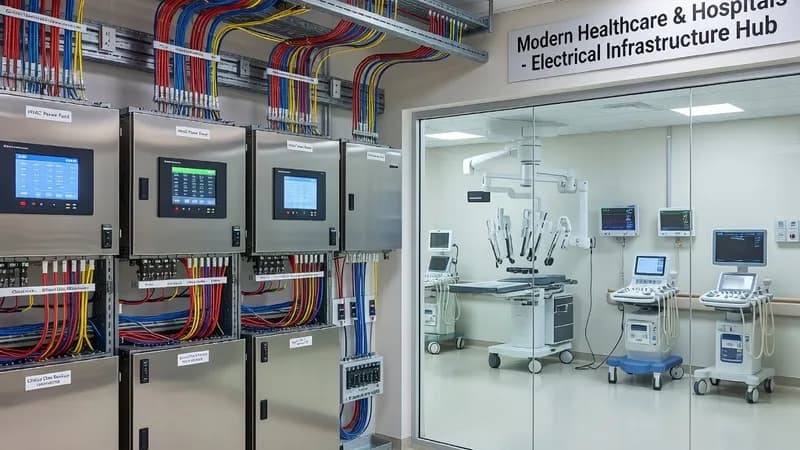
Healthcare and hospital electrical systems demand uninterrupted continuity, strict selectivity, and high personnel safety across critical, essential, and non-essential loads. In modern facilities, the electrical architecture typically includes an IEC 61439-2 main distribution board fed from utility and generator sources, an ATS or AMF system for life-safety transfer, emergency distribution boards, and sub-distribution panels for wards, laboratories, imaging suites, pharmacy areas, and building services. Where non-technical staff access the equipment, IEC 61439-3 distribution boards are preferred for final circuit protection and maintainability. For operating theaters, ICUs, neonatal care, and cath labs, isolated power systems and medical IT networks are used to improve continuity and reduce the risk of first-fault interruption, with monitoring aligned to IEC 61557-8 and hospital installation practices defined by IEC 60364-7-710. Panel assemblies in healthcare must be engineered for high short-circuit withstand levels, commonly 25 kA, 36 kA, 50 kA, or higher depending on the prospective fault current at the point of installation. Incoming and outgoing protection is typically implemented with ACBs for main incomers and bus couplers, MCCBs for feeders and downstream sections, and selective coordination to ensure that a local fault does not disconnect an entire ward or critical service. For motor-driven services such as HVAC, chilled water pumps, medical gas compressors, and fire pumps, VFDs and soft starters are often integrated into dedicated MCC panels or process control panels. Protection relays, metering power analyzers, surge protection devices, and remote I/O are frequently added to support power quality, monitoring, and generator supervision. Hospital environments impose additional constraints on enclosure selection and thermal management. Panels may require IP31, IP42, or IP54 ingress protection depending on location, with anti-corrosion finishes, removable gland plates, segregated cable chambers, and provisions for hygienic cleaning in sensitive areas. In seismic regions, assemblies may need seismic qualification and robust anchoring to meet project specifications and local codes. In areas with flammable anesthetic gases or oxygen-enriched environments, equipment selection must also consider IEC 60079 hazardous-area principles where applicable, while arc fault containment and internal separation are addressed through IEC 61641 testing and appropriate forms of separation under IEC 61439-2, such as Form 2, Form 3b, or Form 4b. Typical healthcare applications include main LV switchboards, automatic transfer switch panels, emergency generator control panels, bedhead and department distribution boards, lighting distribution boards, capacitor banks or APFC panels for energy efficiency, and metering panels for utility subbilling and BMS integration. Reliable integration with UPS systems, fire alarm interfaces, nurse call, and building management systems is essential. Patrion designs and manufactures hospital-grade panel assemblies in Turkey for EPC contractors and facility owners, delivering IEC-compliant solutions tailored to operational resilience, maintainability, and patient safety. All assemblies are engineered to comply with IEC 61439-1 and the relevant product part, including IEC 61439-2 for power switchgear and controlgear assemblies and IEC 61439-3 for distribution boards intended for ordinary persons. Depending on the project, UL 891 and CSA requirements may also be supported for export or multinational specifications. The result is a coordinated low-voltage distribution system that can sustain critical healthcare operations during utility disturbances, support planned maintenance without outage escalation, and provide the monitoring and fault performance expected in modern hospitals and medical campuses.
Panel Types for This Industry
Main Distribution Board (MDB) assemblies engineered for Healthcare & Hospitals applications, addressing industry-specific requirements and compliance standards.
Automatic Transfer Switch (ATS) Panel assemblies engineered for Healthcare & Hospitals applications, addressing industry-specific requirements and compliance standards.
Metering & Monitoring Panel assemblies engineered for Healthcare & Hospitals applications, addressing industry-specific requirements and compliance standards.
Lighting Distribution Board assemblies engineered for Healthcare & Hospitals applications, addressing industry-specific requirements and compliance standards.
Power Factor Correction Panel (APFC) assemblies engineered for Healthcare & Hospitals applications, addressing industry-specific requirements and compliance standards.
Generator Control Panel assemblies engineered for Healthcare & Hospitals applications, addressing industry-specific requirements and compliance standards.
Custom Engineered Panel assemblies engineered for Healthcare & Hospitals applications, addressing industry-specific requirements and compliance standards.
Frequently Asked Questions
Ready to Engineer Your Next Panel?
Our team of electrical engineers is ready to design, build, and deliver your custom panel solution — fully compliant with international standards.