Infrastructure & Utilities
MDB, ATS, metering, BTS, lighting distribution, DC distribution
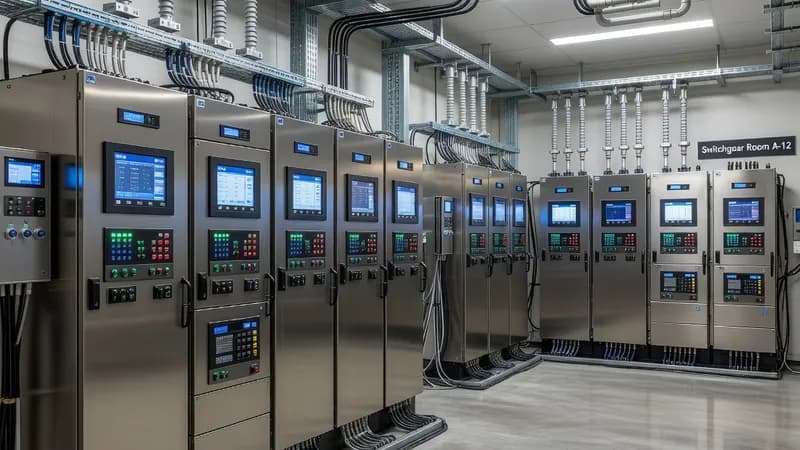
Infrastructure and utilities panel assemblies must support highly critical, continuously operating networks such as airports, rail stations, tunnels, water and wastewater plants, district energy systems, substations, street lighting networks, and municipal distribution infrastructure. In these environments, low-voltage switchgear and controlgear assemblies are typically designed and verified to IEC 61439-1 and IEC 61439-2 for power distribution boards, with IEC 61439-3 applied to final distribution boards and IEC 61439-6 to busbar trunking systems. Typical rated currents range from 160 A for auxiliary and lighting boards up to 6300 A for main distribution boards and busduct interfaces, with short-circuit withstand ratings commonly specified from 25 kA to 100 kA or higher depending on upstream fault levels and network topology. A modern infrastructure package may include main distribution boards (MDBs) with air circuit breakers (ACBs), moulded-case circuit breakers (MCCBs), and motorized incomers for remote transfer and load shedding. Automatic transfer switch panels (ATS) are used to maintain power continuity between normal and emergency sources, often coordinated with diesel generator sets and UPS systems. Metering panels incorporate multifunction power analyzers, current transformers, energy meters, and communication gateways for SCADA or BMS integration, while lighting distribution boards support tunnel ventilation zones, platform lighting, apron lighting, and road lighting circuits. DC distribution panels are widely used for telecom systems, protection relays, SCADA I/O, battery chargers, emergency lighting, and signaling equipment. In transportation and utility facilities, selective coordination, arc-flash mitigation, maintainability, and compartmentalization are central design concerns. Forms of internal separation such as Form 2b, Form 3b, and Form 4 are often selected to limit downtime and improve service continuity during inspection or maintenance. For harsh sites, enclosure selection must consider IP ratings, corrosion resistance, condensation control, anti-vibration construction, and temperature rise performance. In tunnels, substations, and coastal installations, panels may require enhanced protection against dust, water ingress, salt mist, and mechanical shock, while IEC 61641 internal arc containment may be applied where operator safety and fault energy management are critical. Where hazardous zones exist, associated equipment may also need alignment with IEC 60079 requirements. The panel architecture commonly integrates busbar systems, copper or aluminum distribution bars, surge protection devices, shunt trip devices, protection relays, soft starters, and variable frequency drives (VFDs) for pumps, fans, and conveyor auxiliaries. For utility pumping stations and water networks, MCCB feeders and VFD-based pump controls improve energy efficiency and pressure regulation. Seismic qualification is frequently required for critical public infrastructure, particularly in earthquake-prone regions, alongside mechanical endurance and transport withstand verification. For EPC contractors and facility managers, the key value of compliant IEC 61439 assemblies is predictable performance, type-tested design verification, simplified maintenance, and lifecycle resilience. Properly engineered infrastructure panels reduce outage risk, support remote monitoring, and ensure that essential services remain available during faults, maintenance windows, and utility disturbances.
Panel Types for This Industry
Main Distribution Board (MDB) assemblies engineered for Infrastructure & Utilities applications, addressing industry-specific requirements and compliance standards.
Automatic Transfer Switch (ATS) Panel assemblies engineered for Infrastructure & Utilities applications, addressing industry-specific requirements and compliance standards.
Metering & Monitoring Panel assemblies engineered for Infrastructure & Utilities applications, addressing industry-specific requirements and compliance standards.
Busbar Trunking System (BTS) assemblies engineered for Infrastructure & Utilities applications, addressing industry-specific requirements and compliance standards.
Lighting Distribution Board assemblies engineered for Infrastructure & Utilities applications, addressing industry-specific requirements and compliance standards.
DC Distribution Panel assemblies engineered for Infrastructure & Utilities applications, addressing industry-specific requirements and compliance standards.
Custom Engineered Panel assemblies engineered for Infrastructure & Utilities applications, addressing industry-specific requirements and compliance standards.
Frequently Asked Questions
Ready to Engineer Your Next Panel?
Our team of electrical engineers is ready to design, build, and deliver your custom panel solution — fully compliant with international standards.