Marine & Offshore
Marine-certified panels, MCC, generator sync, ATS, PLC, classification society compliance
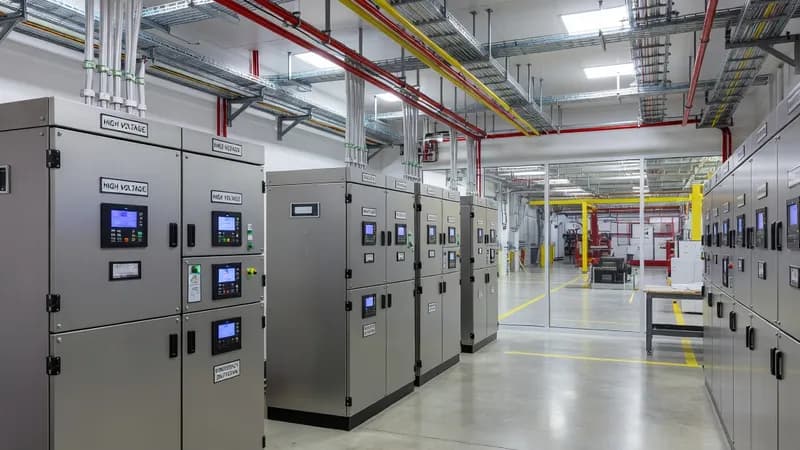
Marine and offshore switchgear and control panels must be engineered for continuous operation in one of the most demanding electrical environments in industry. Patrion designs IEC 61439-compliant assemblies for ships, offshore platforms, FPSOs, drilling rigs, port facilities, and marine auxiliary systems, where vibration, salt-laden air, humidity, temperature cycling, and vessel inclination directly affect electrical performance and safety. Depending on the application, we manufacture main distribution boards, generator synchronizing switchboards, motor control centers, automatic transfer switches, PLC automation panels, and custom-engineered control cabinets with rated currents from 125 A up to 6300 A, and short-circuit withstand ratings typically verified up to 100 kA or higher when required by the project specification. Marine assemblies are commonly built with air circuit breakers, moulded case circuit breakers, motor protection circuit breakers, protection relays, soft starters, VFDs, contactors, overload relays, metering devices, and PLC I/O modules. Generator control panels and paralleling switchboards use synchronizing relays, load sharing controllers, breaker interlocks, and power management logic to manage multiple diesel generator sets, shore supply changeover, black-start sequences, and emergency power transfer. Motor control centers are applied to propulsion auxiliaries, thrusters, ballast pumps, bilge systems, fire pumps, compressors, windlasses, winches, cranes, and HVAC units. For critical automation, PLC-based systems integrate alarm monitoring, remote I/O, fail-safe shutdown, and communication via Modbus, Profinet, or Ethernet/IP. Compliance is governed not only by IEC 61439-1 and IEC 61439-2 for power switchgear assemblies, but also by application-specific requirements in IEC 61439-3 for distribution boards intended for ordinary persons and IEC 61439-6 for busbar trunking systems where used onboard. Equipment selection must align with IEC 60947 for low-voltage switching devices, IEC 60092 for electrical installations in ships, IEC 60079 for hazardous-area equipment where explosive atmospheres may exist, and IEC 61641 for internal arcing considerations in enclosed assemblies. In practice, classification society approval from DNV, Lloyd’s Register, Bureau Veritas, ABS, RINA, or ClassNK is often mandatory, and component certificates must be traceable to the class requirements and vessel register. Mechanical design is equally critical. Enclosures are typically specified with IP54, IP55, IP56, or higher, marine-grade corrosion protection, stainless-steel hardware, anti-condensation heaters, thermostats, space heaters, drip shields, vibration-resistant mounting, and copper busbars sized for ambient derating and thermal endurance. Form of internal separation, such as Form 2, Form 3b, or Form 4, is selected to balance maintainability, operational continuity, and arc-flash risk segregation. For offshore projects, additional attention is given to EMC, cable gland selection, flame-retardant materials, salt mist resistance, and installation clearances for maintenance in confined spaces. Patrion supplies engineered marine and offshore panels from Turkey for EPC contractors, shipyards, and vessel owners requiring type-tested, class-ready, and application-specific low-voltage solutions. Whether the scope is a single ATS panel or a complete main switchboard with generator synchronization and PMS functions, each assembly is designed for reliable operation, documentation traceability, and fast commissioning in accordance with the relevant IEC and classification society requirements.
Panel Types for This Industry
Main Distribution Board (MDB) assemblies engineered for Marine & Offshore applications, addressing industry-specific requirements and compliance standards.
Motor Control Center (MCC) assemblies engineered for Marine & Offshore applications, addressing industry-specific requirements and compliance standards.
Generator Control Panel assemblies engineered for Marine & Offshore applications, addressing industry-specific requirements and compliance standards.
Automatic Transfer Switch (ATS) Panel assemblies engineered for Marine & Offshore applications, addressing industry-specific requirements and compliance standards.
PLC & Automation Control Panel assemblies engineered for Marine & Offshore applications, addressing industry-specific requirements and compliance standards.
Custom Engineered Panel assemblies engineered for Marine & Offshore applications, addressing industry-specific requirements and compliance standards.
Frequently Asked Questions
Ready to Engineer Your Next Panel?
Our team of electrical engineers is ready to design, build, and deliver your custom panel solution — fully compliant with international standards.