Mining & Metals
Rugged MCC, PCC, VFD panels, generator panels, soft starters, harmonic filters
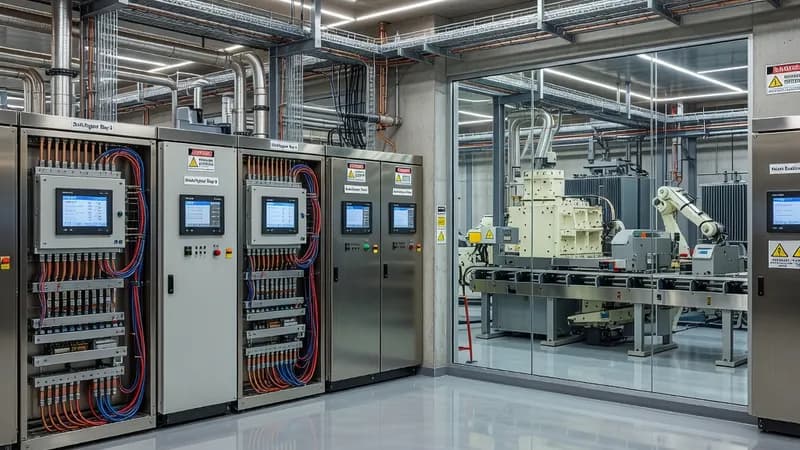
Mining & Metals facilities demand low-voltage switchgear and controlgear assemblies that can survive severe mechanical stress, continuous high-load duty, and electrically aggressive operating conditions. Crushing plants, ore conveyors, mills, flotation circuits, smelters, pelletizing lines, and refinery auxiliaries typically require MCCs, PCCs, generator synchronizing panels, VFD panels, soft starter panels, and harmonic filter cabinets designed and verified to IEC 61439-1 and IEC 61439-2. In hazardous areas such as dust-exposed zones around coal handling, grinding, and conveying systems, enclosure selection must also consider IEC 60079 requirements, while arc-resistant design and internal fault protection should be evaluated in line with IEC 61641. Depending on application, panels may be built with IP54, IP55, IP65, or higher enclosures, anti-corrosion coatings, stainless-steel or galvanized constructions, and segregated internal arrangements to maintain reliability in dusty, humid, or washdown environments. Typical Mining & Metals assemblies use air circuit breakers up to 6300 A for incomers and bus couplers, MCCBs for feeder protection, motor feeders with DOL starters, reversing contactors, soft starters, and VFDs ranging from a few kilowatts to multi-megawatt drive systems. Protection relays with metering, earth-fault, overload, under/over-voltage, and communication functions are common in PCC and generator panels, especially where standby generators, utility incomers, and load shedding schemes must support uninterrupted production. Form of internal separation according to IEC 61439-2, such as Form 2, Form 3, or Form 4, is often specified to limit maintenance outage and improve fault containment between feeders, busbars, and functional units. Short-circuit withstand ratings may be required from 50 kA up to 100 kA or more, depending on transformer size, available fault level, and network topology. Power quality is a major concern in mining and mineral processing because large VFD populations, hoists, crushers, and conveyor drives generate harmonics, voltage dips, and reactive power demand. As a result, harmonic filter panels, line reactors, detuned capacitor banks, and active front-end solutions are often integrated to meet plant performance targets and utility compliance. For large motors driving SAG mills, ball mills, pumps, fans, and compressors, soft starters reduce inrush current and mechanical shock, while VFD panels provide precise speed control, energy optimization, and process stability. Generator control panels used on remote sites must support synchronization, load sharing, automatic transfer, and black-start functions, particularly where grid supply is weak or absent. Patrion designs custom-engineered panel systems for Mining & Metals applications with attention to thermal management, ventilation, vibration resistance, maintainability, and cable entry arrangement. Assemblies are typically type-tested or design-verified to IEC 61439 and coordinated with component standards such as IEC 60947 for breakers, contactors, overloads, and switch-disconnectors. For EPC contractors and plant operators, the result is a robust, serviceable, and safety-oriented electrical architecture that supports high availability, reduced downtime, and compliance with modern industrial safety expectations.
Panel Types for This Industry
Main Distribution Board (MDB) assemblies engineered for Mining & Metals applications, addressing industry-specific requirements and compliance standards.
Power Control Center (PCC) assemblies engineered for Mining & Metals applications, addressing industry-specific requirements and compliance standards.
Motor Control Center (MCC) assemblies engineered for Mining & Metals applications, addressing industry-specific requirements and compliance standards.
Variable Frequency Drive (VFD) Panel assemblies engineered for Mining & Metals applications, addressing industry-specific requirements and compliance standards.
Generator Control Panel assemblies engineered for Mining & Metals applications, addressing industry-specific requirements and compliance standards.
Soft Starter Panel assemblies engineered for Mining & Metals applications, addressing industry-specific requirements and compliance standards.
Harmonic Filter Panel assemblies engineered for Mining & Metals applications, addressing industry-specific requirements and compliance standards.
Custom Engineered Panel assemblies engineered for Mining & Metals applications, addressing industry-specific requirements and compliance standards.
Frequently Asked Questions
Ready to Engineer Your Next Panel?
Our team of electrical engineers is ready to design, build, and deliver your custom panel solution — fully compliant with international standards.