MCC Panels

Pharmaceuticals

Cleanroom-compatible panels, MCC, VFD, APFC, PLC, soft starters, harmonic filters
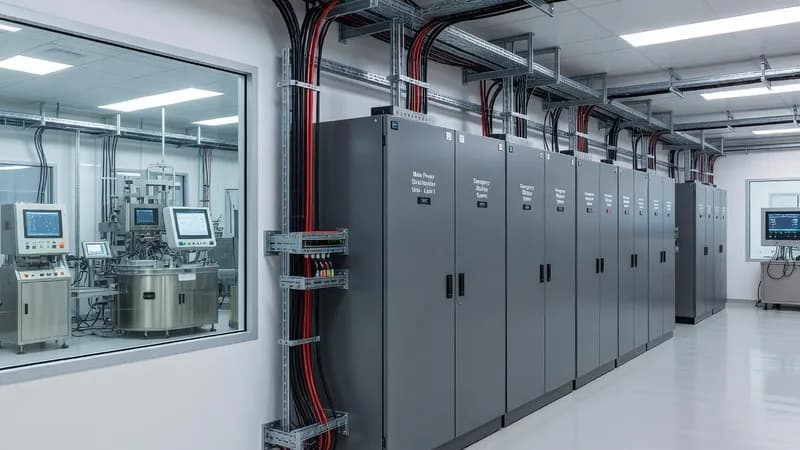
Pharmaceuticals

Pharmaceutical manufacturing requires low-voltage switchgear and controlgear assemblies that combine electrical safety, hygiene, and process reliability in a highly regulated environment. For cleanroom-adjacent areas, the panel design must support GMP-compliant operation while also meeting IEC 61439-1 and IEC 61439-2 for LV switchgear assemblies, with documentation, temperature-rise verification, dielectric withstand, and short-circuit performance declared for the complete assembly. Depending on application, incoming sections may use ACBs up to 6300 A for main distribution, while MCCB-based feeders typically cover 16 A to 1600 A with breaking capacities selected to match prospective short-circuit current, often 25 kA, 36 kA, 50 kA, or higher at 400/415 V. Motor-control-center sections commonly incorporate contactors, overload relays, soft starters, and VFDs for AHUs, chilled-water pumps, purified water systems, dosing skids, compressors, and process mixers. In validated production zones, PLC automation panels with remote I/O, HMI/SCADA interfaces, interposing relays, and protection relays enable batch sequencing, alarm management, and traceable parameter control aligned with ISA-88 and GAMP 5 practices. Pharmaceutical facilities impose strict environmental constraints on enclosures and internal layout. Panels installed in washdown or utility corridors may require IP54, IP55, or IP66 protection, corrosion-resistant powder coating, stainless-steel door hardware, and smooth internal surfaces that reduce dust retention and simplify cleaning. In classified or volatile solvent areas, IEC 60079 requirements may apply to associated equipment, while harmonic mitigation and EMC performance are essential under IEC 61000 to protect sensitive instrumentation, weighing systems, and lab analyzers from drive-generated disturbances. For standby and emergency loads, changeover and ATS arrangements are often integrated with UPS-backed control power to maintain HVAC, BMS, cold rooms, and critical utilities during supply interruptions. Where leakage current, nuisance tripping, or power quality issues are present, APFC panels and harmonic filter panels help stabilize bus voltage, improve power factor, and reduce THDi from VFD-driven loads. Typical pharmaceutical panel architectures include main distribution boards, motor control centers, VFD panels, soft-starter panels, APFC panels, metering panels, PLC automation panels, and custom engineered panels for clean utilities, purified water loops, WFI skids, CIP/SIP systems, tablet presses, packaging lines, and HVAC air-handling units. Form of internal separation per IEC 61439-2 is often specified as Form 2b, Form 3b, or Form 4b to improve maintainability and reduce fault propagation between incoming, busbar, and outgoing functional units. Critical systems may require segregated control compartments, segregated cable ducts, and PLC sections isolated from power sections to reduce electromagnetic interference and simplify validation. Continuous monitoring via multifunction meters, protection relays, and communication gateways supports energy auditing, preventive maintenance, and regulatory traceability across the plant. For pharmaceuticals, the best-performing assemblies are not only electrically robust but also validation-friendly. Patrion designs and manufactures IEC 61439-compliant panel assemblies with documented short-circuit ratings, thermal management, component traceability, and factory testing suitable for EPC contractors, OEMs, and facility teams. Whether the requirement is a hygienic MCC, a cleanroom-compatible VFD cabinet, or a fully integrated process automation panel, the solution must deliver safe operation, low emissions, stable control, and dependable uptime across sterile production and utility systems.

Panel Types for This Industry

Main Distribution Board (MDB)

Main Distribution Board (MDB) assemblies engineered for Pharmaceuticals applications, addressing industry-specific requirements and compliance standards.

Motor Control Center (MCC)

Motor Control Center (MCC) assemblies engineered for Pharmaceuticals applications, addressing industry-specific requirements and compliance standards.

Variable Frequency Drive (VFD) Panel

Variable Frequency Drive (VFD) Panel assemblies engineered for Pharmaceuticals applications, addressing industry-specific requirements and compliance standards.

Power Factor Correction Panel (APFC)

Power Factor Correction Panel (APFC) assemblies engineered for Pharmaceuticals applications, addressing industry-specific requirements and compliance standards.

PLC & Automation Control Panel

PLC & Automation Control Panel assemblies engineered for Pharmaceuticals applications, addressing industry-specific requirements and compliance standards.

Metering & Monitoring Panel

Metering & Monitoring Panel assemblies engineered for Pharmaceuticals applications, addressing industry-specific requirements and compliance standards.

Soft Starter Panel

Soft Starter Panel assemblies engineered for Pharmaceuticals applications, addressing industry-specific requirements and compliance standards.

Harmonic Filter Panel

Harmonic Filter Panel assemblies engineered for Pharmaceuticals applications, addressing industry-specific requirements and compliance standards.

Custom Engineered Panel

Custom Engineered Panel assemblies engineered for Pharmaceuticals applications, addressing industry-specific requirements and compliance standards.

Frequently Asked Questions

Pharmaceutical facilities typically require LV switchgear assemblies designed and verified to IEC 61439-1 and IEC 61439-2. The assembly must be assessed as a complete system, including temperature-rise limits, dielectric properties, clearances, creepage distances, and short-circuit withstand capability. For main distribution boards and MCCs, designers should declare rated operational current, rated diversity, and prospective short-circuit current at the point of installation. In practice, this means specifying ACBs, MCCBs, busbar systems, and enclosures with tested combinations rather than relying on component ratings alone. For validated environments, the panel documentation should also support traceability, labeling, wiring schedules, and test records suitable for IQ/OQ activities and GMP audits. Patrion supplies IEC 61439-based assemblies for MCC, MDB, and automation applications in pharmaceutical plants.
The most common panel types include main distribution boards, motor control centers, variable-frequency-drive panels, soft-starter panels, APFC panels, PLC automation panels, metering panels, harmonic filter panels, and custom-engineered utility panels. MDBs typically feed HVAC, process utilities, and production lines, while MCCs distribute power to pumps, compressors, mixers, and packaging machinery. VFD panels are widely used for air handling units, chilled water pumps, and purified water circulation to improve process control and energy efficiency. PLC panels and HMI/SCADA stations handle batching, alarms, interlocks, and recipe management. In many facilities, these panels are integrated with protection relays, multifunction meters, and communication gateways to support monitoring and compliance. IEC 61439-2 is the key assembly standard for these low-voltage panel types.
Cleanroom-compatible panel design focuses on minimizing particle release, simplifying cleaning, and preventing contamination from heat, dust, or vibration. This usually means smooth external surfaces, sealed or gasketed doors, corrosion-resistant materials, and internal layouts that reduce dust traps and exposed wiring. Depending on location, IP54, IP55, or IP66 enclosures may be specified, especially near washdown or cleaning zones. Heat management is also critical because excessive internal temperature can shorten component life and compromise operation in environmentally controlled spaces. For that reason, engineering often uses filtered ventilation, heat exchangers, or properly sized air-conditioned cabinets. In pharmaceutical settings, the panel must also support validation documentation and stable operation for HVAC, process controls, and clean utilities. IEC 61439 design verification and EMC considerations under IEC 61000 are particularly important.
VFDs are essential in pharmaceutical plants because they provide precise control of airflow, pressure, flow, and speed for AHUs, chilled-water pumps, process pumps, and compressors. This improves energy efficiency and helps maintain tight environmental conditions in cleanrooms and utilities. However, VFDs can introduce harmonics, voltage distortion, and electromagnetic interference that may affect PLCs, weighing systems, sensors, and laboratory instruments. Harmonic filter panels and line reactors are therefore commonly used to reduce THDi and improve system reliability. In some facilities, APFC panels are also deployed to maintain power factor and reduce penalties from the utility supply. The relevant standards include IEC 61000 for EMC and compatibility, while the overall assembly should remain compliant with IEC 61439. Proper segregation of power and control wiring further reduces nuisance faults.
Short-circuit ratings depend on the facility fault level, transformer size, and cable length, but pharmaceutical plant panels commonly require ratings such as 25 kA, 36 kA, 50 kA, or higher at 400/415 V. Main incomers may use ACBs up to 6300 A, while feeder sections often use MCCBs with breaking capacities matched to the calculated prospective short-circuit current. The key point is that the complete IEC 61439 assembly must be verified for the declared short-circuit withstand and protective device coordination. In MCC applications, starter feeders, VFD feeders, and control circuits must also be protected against downstream faults without unnecessary disconnection of critical utilities. Proper busbar sizing, mechanical bracing, and enclosure design are essential to ensure safe performance during fault conditions.
Yes. Pharmaceutical plants often contain sensitive instrumentation, PLCs, analyzers, BMS systems, and process weighing equipment that can be disturbed by electrical noise from VFDs, soft starters, and switching devices. IEC 61000 addresses EMC immunity and emission requirements, making it highly relevant for panel design in these facilities. Engineers typically apply segregated cable routing, shield termination practices, ferrite solutions where needed, and separate control power supplies to improve compatibility. Harmonic mitigation may require passive harmonic filters, line reactors, or active filtering depending on the load profile and utility limits. These measures help maintain process stability, reduce nuisance trips, and protect validation-critical control systems. For pharmaceutical sites, EMC design should be considered alongside IEC 61439 construction rules and the specific equipment manufacturer recommendations.
IEC 60079 becomes relevant when a pharmaceutical facility includes hazardous areas, such as rooms or zones where flammable solvents, alcohol vapors, or process gases may be present. In those locations, electrical equipment may need to comply with explosion-protection requirements depending on the zone classification and the installation design. Panels may need to be located outside the hazardous area, or if installed within it, they must use suitable protection concepts and certified components. This is especially important for solvent blending rooms, certain pilot plants, and areas connected to chemical processing or cleaning systems. Even when IEC 60079 is not directly applied, good segregation between hazardous and non-hazardous zones remains essential. Patrion can engineer panel assemblies and control systems to suit the project’s area classification strategy and site-specific compliance needs.
Yes. Pharmaceutical automation panels often support batch processing, clean utilities, HVAC, CIP/SIP, and packaging systems with PLCs, remote I/O, HMI/SCADA, and industrial networking. These panels are typically designed to support validation workflows aligned with GAMP 5 and ISA-88, including clear I/O lists, device tagging, alarm philosophy, and test documentation. For regulated production, the panel must also provide reliable segregation of control and power circuits, secure power supplies, and maintainable architecture for future changes. Common hardware includes PLC I/O modules, safety relays, contactors, variable-frequency drives, soft starters, and communication gateways. When combined with IEC 61439-compliant construction and proper documentation, these panels provide the traceability and repeatability needed for FDA- and EMA-oriented project delivery.

Ready to Engineer Your Next Panel?

Our team of electrical engineers is ready to design, build, and deliver your custom panel solution — fully compliant with international standards.