Renewable Energy
MDB, metering, APFC, ATS, PLC, DC distribution, capacitor banks
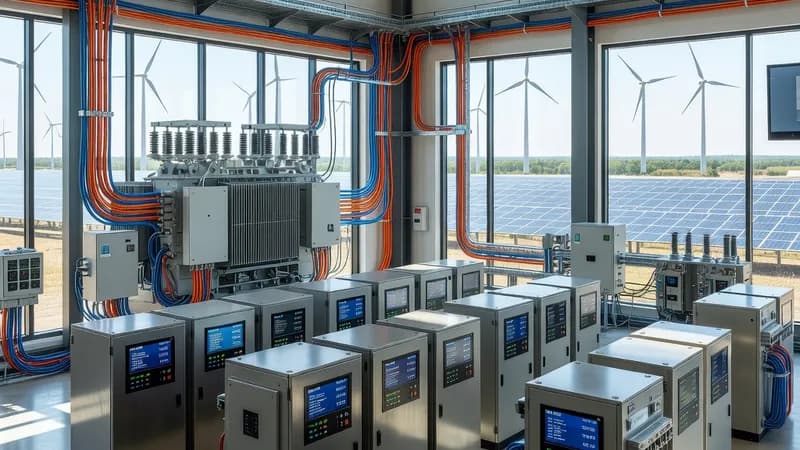
Renewable energy plants place unusually demanding requirements on low-voltage switchgear and controlgear assemblies because they must operate in outdoor, high-variation, and grid-interactive environments while maintaining safe, compliant, and reliable performance. Solar PV plants typically require DC distribution and string combiner panels, AC collection boards, main distribution boards, metering panels, and plant controller panels. Wind farms add auxiliary distribution, UPS-backed control panels, and protection relay cubicles for turbine and substation interfaces. Battery energy storage systems (BESS) introduce bidirectional power flow, DC protection, isolation, pre-charge, and battery management interfacing, often integrated with PLC-based automation and SCADA gateways. These assemblies are generally designed and verified to IEC 61439-1 and IEC 61439-2 for power switchgear assemblies, with functional extension to IEC 61439-3 for distribution boards where applicable and IEC 61439-6 for busbar trunking interfaces in large plants or collector systems. Devices within the panels commonly conform to IEC 60947, including MCCBs for feeder protection, ACBs for incomers and bus couplers in larger inverter stations, contactors for capacitor bank stages, VFDs or soft starters for pumps and cooling systems, and protection relays for transformer, feeder, and grid-tie supervision. Metering power analyzers are used for energy yield tracking, power quality monitoring, and export/import compliance, while surge protection devices are essential for lightning-prone solar fields and exposed wind sites. In environments with combustible gases or dust, or near battery rooms and certain process zones, enclosures and internal arrangements may also need consideration against IEC 60079. Where arc events are a concern in large inverter or BESS rooms, design verification and mitigation practices may reference IEC 61641. Typical renewable-energy assemblies are engineered with appropriate forms of internal separation, often Form 2, Form 3b, or Form 4 where maintainability and operational segregation are required between incomer, feeder, metering, and auxiliary sections. Short-circuit withstand ratings must be matched to site fault levels, transformer impedance, and inverter contribution, with common assembly ratings ranging from 25 kA to 65 kA or higher depending on plant architecture. Rated currents vary widely, from compact 125 A string combiner and auxiliary boards to 1600 A, 3200 A, or even 4000 A main AC distribution boards and collector panels. Environmental considerations are central to renewable installations. Outdoor panels may require IP54, IP55, or IP65 enclosure protection, anti-condensation heaters, filtered ventilation, stainless steel or powder-coated galvanized construction, and UV-resistant gasketing. Thermal management is critical in inverter stations and battery enclosures because high ambient temperatures reduce component life and can affect protection settings. EMC performance under IEC 61000 is also important because VFDs, inverters, relays, and PLC I/O modules can all introduce or suffer from conducted and radiated disturbances. Proper segregation of DC and AC wiring, shielded cable termination, and bonding/earthing strategy are necessary to ensure stable operation. In practice, these panels support real-world applications such as solar farm feeder summation, grid-code compliant reactive power compensation through APFC capacitor banks and harmonic filtering, automatic transfer between grid and standby sources using ATS systems, plant-wide monitoring through PLC automation panels, and controlled DC distribution for battery storage and auxiliary loads. For EPC contractors, electrical engineers, and facility managers, the key objective is an IEC 61439-verified assembly that safely integrates protection, metering, control, and communication while minimizing downtime and supporting long-term asset performance.
Panel Types for This Industry
Main Distribution Board (MDB) assemblies engineered for Renewable Energy applications, addressing industry-specific requirements and compliance standards.
Metering & Monitoring Panel assemblies engineered for Renewable Energy applications, addressing industry-specific requirements and compliance standards.
Power Factor Correction Panel (APFC) assemblies engineered for Renewable Energy applications, addressing industry-specific requirements and compliance standards.
Automatic Transfer Switch (ATS) Panel assemblies engineered for Renewable Energy applications, addressing industry-specific requirements and compliance standards.
PLC & Automation Control Panel assemblies engineered for Renewable Energy applications, addressing industry-specific requirements and compliance standards.
DC Distribution Panel assemblies engineered for Renewable Energy applications, addressing industry-specific requirements and compliance standards.
Capacitor Bank Panel assemblies engineered for Renewable Energy applications, addressing industry-specific requirements and compliance standards.
Custom Engineered Panel assemblies engineered for Renewable Energy applications, addressing industry-specific requirements and compliance standards.
Frequently Asked Questions
Ready to Engineer Your Next Panel?
Our team of electrical engineers is ready to design, build, and deliver your custom panel solution — fully compliant with international standards.