Water & Wastewater
MCC, VFD panels, PLC automation, APFC, generator control, soft starters
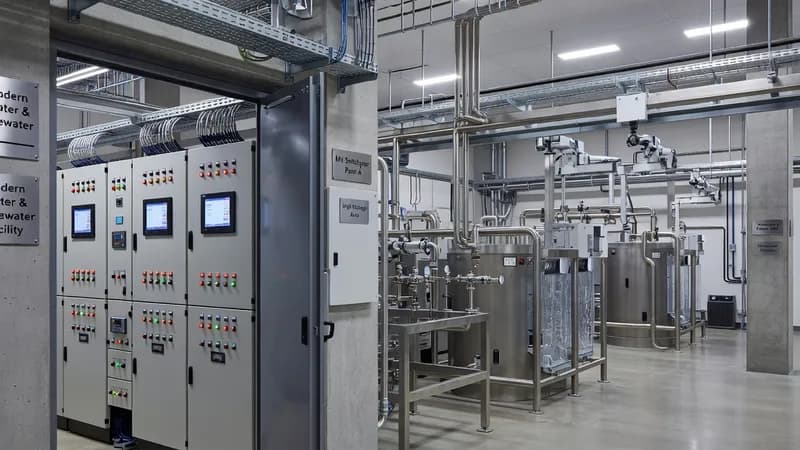
Water and wastewater treatment facilities depend on robust low-voltage switchgear and control assemblies to keep pumps, blowers, screens, mixers, clarifiers, sludge handling systems, and chemical dosing skids operating continuously. In this sector, panel architecture typically combines an incoming main distribution board or MCCB/ACB-based main panel with motor control centers, VFD panels, soft-starter panels, PLC automation panels, power factor correction units, metering panels, and generator control panels for backup operation. For plant loads ranging from a few hundred amperes to several thousand amperes, assemblies are commonly designed to IEC 61439-1 and IEC 61439-2, with functional unit arrangements and forms of internal separation selected to improve maintainability, thermal performance, and service continuity. Forms 1 through 4 remain relevant depending on whether the owner requires simple segregation or higher availability for critical process trains. Motor control is the core of the sector. Pumps and blowers are typically controlled by VFDs for flow matching, energy optimization, and soft starting; large fixed-speed drives may still use MCCBs with contactors, overload relays, and soft starters where process inertia is high. A well-engineered VFD panel includes line reactors, EMC filters, output dV/dt or sine filters where cable runs are long, panel ventilation or air conditioning, and careful segregation of control wiring from power circuits to meet EMC requirements under IEC 61000. For critical pumping stations, control logic often includes automatic alternation, lead-lag sequencing, dry-run protection, level-based interlocks, and remote telemetry via Modbus, Profibus, Profinet, or Ethernet/IP. PLCs with remote I/O modules and protection relays are used to integrate process instrumentation, fault diagnostics, and SCADA reporting. Environmental conditions are severe. Panels may face high humidity, condensation, corrosive gases, H2S exposure in wastewater halls, dust, vibration, and outdoor installation. Enclosures are therefore specified with appropriate IP protection ratings, anti-corrosion coatings, stainless steel or galvanized construction where needed, gland plates, anti-condensation heaters, thermostatic fans, and filtered or pressurized cabinets. Where installations are in hazardous atmospheres such as biogas areas, equipment selection may also need consideration of IEC 60079 requirements in addition to the standard industrial panel requirements. For power system behavior, short-circuit withstand ratings, internal arc considerations where applicable, and coordinated protection settings are essential because utility feeders and standby generators can produce high fault levels and transfer transients. Power quality is another major design factor. Large VFD fleets, harmonics from rectifier front ends, and cyclic starting of large motors can reduce system efficiency and disturb instrumentation. APFC panels, harmonic filters, and properly rated capacitor banks support stable bus voltage and help utilities reduce penalties. Metering panels provide energy, demand, and process KPI visibility, while generator control panels maintain pumping continuity during grid failures and support automatic transfer schemes. In practice, IEC 61439-3 concepts may be used for distribution boards supplying auxiliary loads, while IEC 61439-6 is relevant where busbar trunking is used for long plant runs. For EPC contractors and plant owners, the critical design objectives are uptime, maintainability, energy efficiency, and compliance. Patrion designs and manufactures water and wastewater MCC panels, VFD panels, PLC automation panels, APFC panels, soft-starter panels, and generator control panels in Turkey, with engineering support aligned to IEC 61439, IEC 60947, IEC 61000, and sector-specific environmental requirements. The result is a panel suite sized for real plant duty, from compact package treatment plants to large municipal and industrial wastewater works.
Panel Types for This Industry
Main Distribution Board (MDB) assemblies engineered for Water & Wastewater applications, addressing industry-specific requirements and compliance standards.
Motor Control Center (MCC) assemblies engineered for Water & Wastewater applications, addressing industry-specific requirements and compliance standards.
Variable Frequency Drive (VFD) Panel assemblies engineered for Water & Wastewater applications, addressing industry-specific requirements and compliance standards.
PLC & Automation Control Panel assemblies engineered for Water & Wastewater applications, addressing industry-specific requirements and compliance standards.
Power Factor Correction Panel (APFC) assemblies engineered for Water & Wastewater applications, addressing industry-specific requirements and compliance standards.
Generator Control Panel assemblies engineered for Water & Wastewater applications, addressing industry-specific requirements and compliance standards.
Metering & Monitoring Panel assemblies engineered for Water & Wastewater applications, addressing industry-specific requirements and compliance standards.
Soft Starter Panel assemblies engineered for Water & Wastewater applications, addressing industry-specific requirements and compliance standards.
Frequently Asked Questions
Ready to Engineer Your Next Panel?
Our team of electrical engineers is ready to design, build, and deliver your custom panel solution — fully compliant with international standards.