Cable Management Best Practices in Panel Assemblies
Organizing power and control cables inside panels.
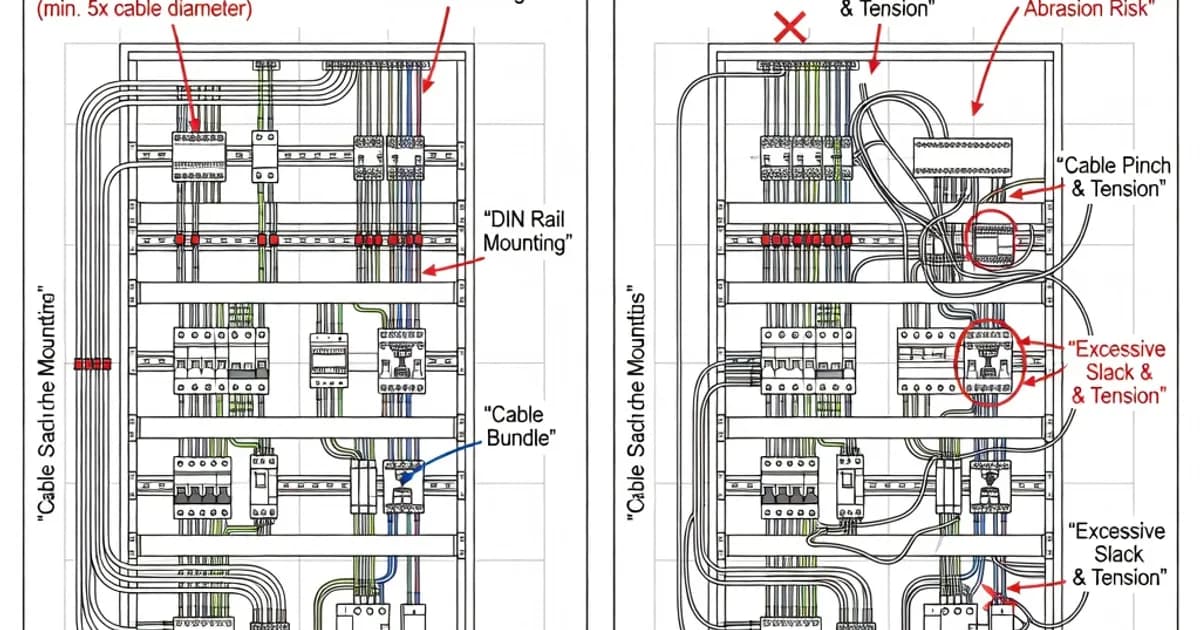
Cable Management Best Practices in Panel Assemblies
Effective cable management is not a cosmetic detail in a low-voltage panel assembly; it is a design discipline that directly affects safety, thermal performance, electromagnetic compatibility, maintainability, and compliance with IEC 61439. In a properly engineered assembly, cable routing supports the verified design rather than working against it. Poorly managed conductors can obstruct airflow, increase hot spots, complicate maintenance, and create avoidable risk at terminations and bend points. As documented in Schneider Electric’s panel builder guidance and ABB’s IEC 61439 application paper, cable management must be treated as part of the assembly’s construction and verification strategy, not as an afterthought.
For IEC 61439-compliant assemblies, cable management influences multiple verification outcomes: dielectric strength, protection against electric shock, temperature rise, mechanical strength, and degree of protection. In practice, this means the arrangement of power, control, and communication wiring must be intentional from the earliest layout stage. The goal is to build a panel that is electrically robust, thermally stable, easy to inspect, and serviceable over its operating life.
Core Technical Requirements
Separation of Power and Control Circuits
The most fundamental rule in panel cable management is physical separation between power conductors and auxiliary or control circuits. Schneider Electric’s guidance for panel builders emphasizes that power cables should be routed separately from control and monitoring wiring, and communication cabling should be segregated from control cabling to reduce electromagnetic interference and signal instability. This separation is especially important in assemblies that include variable speed drives, switching power supplies, PLC networks, or other noise-sensitive components.
From a practical standpoint, separation reduces the coupling of high-frequency switching noise into low-level circuits. It also simplifies troubleshooting because fault paths are easier to isolate when wiring families are grouped logically. In mixed-signal panels, a disciplined cable layout often determines whether an installation performs reliably in the field or requires repeated service visits.
Power conductors must also be sized and routed according to electrical, thermal, and environmental conditions. The research notes that power conductors exceeding 6 mm² require careful selection based on thermal stress, ambient conditions, and the enclosure’s IP protection degree. That aligns with IEC 61439’s performance-based approach: the assembly manufacturer must ensure the internal arrangement supports the verified current-carrying capacity and temperature-rise limits of the completed system.
Cable Routing and Mechanical Protection
Cables should always be routed to avoid sharp edges, moving parts, and areas where insulation could be damaged. A technically sound layout preserves bend radius, prevents abrasion, and leaves adequate access for inspection and re-termination. In industrial control panels, one practical rule is to maintain a minimum cable spacing of approximately 1 inch where possible, especially around bundles that run parallel to heat-producing equipment. This spacing improves airflow and reduces localized heating.
Mechanical support is equally important. Research-based best practice recommends supporting cable runs at roughly 24-inch intervals using appropriate brackets or ties, which limits sagging and reduces tensile loading on terminations. Cable management systems should guide conductors through 90-degree routing transitions where possible, especially at conduit entries and cable duct intersections, to minimize strain and preserve the integrity of insulation.
Strain relief at panel entries and termination points is not optional. It prevents external pulling forces from being transmitted to terminals, ferrules, or connectors. This is particularly critical on door-mounted devices, vibration-prone installations, and cabinets exposed to transport or frequent maintenance access. IEC 61439 verification includes mechanical considerations, and cable support is part of demonstrating that the assembly can withstand normal service conditions without loss of function.
Thermal Management Through Cable Organization
Cable routing has a direct impact on thermal behavior inside the enclosure. Conductors should not block ventilation paths or lie across major heat sources such as contactors, transformers, braking resistors, or power electronics. Cable trays and wire ducts should be arranged so that cables are elevated above heat-generating components and routed in a manner that supports natural or forced airflow.
Where possible, cable routes should be perpendicular to cooling airflow rather than parallel to it. This helps reduce long obstructions across the cabinet and minimizes the formation of stagnant hot-air pockets. Thermal barriers or physical separation between high-temperature devices and sensitive control circuits are also useful in extending insulation life and protecting signal integrity.
The research indicates that proper thermal management can prevent a large share of premature wire failures. In practical terms, cable organization is part of the panel’s thermal design, not merely its assembly convenience. If heat build-up is reduced at the wiring level, the panel can better maintain compliance with its designed temperature rise and long-term reliability targets.
Relevant IEC Standards
IEC 61439 for Low-Voltage Switchgear and Controlgear Assemblies
IEC 61439 is the central standard governing low-voltage assemblies. It defines the responsibilities of the original manufacturer and the assembly manufacturer, and it requires systematic verification of the completed assembly. According to Hager’s IEC 61439 overview, the standard addresses nine major objectives: operational continuity, current-carrying capacity, short-circuit resistance, electromagnetic compatibility, personnel protection, fire protection, mechanical and climatic resistance, surge protection, and maintainability.
These requirements matter to cable management because the internal arrangement of conductors affects almost every one of those objectives. For example, poor bundling can increase conductor temperature, reduce current-carrying margin, and compromise the effectiveness of protective separation. Inadequate routing can also affect short-circuit withstand performance if cables are not properly restrained during fault conditions.
IEC 61439 verification also includes routine checks such as degree of protection of covers, clearance and creepage distances, protection against electric shock, and wiring and electrical operation including power-frequency withstand voltage testing. Cable management directly influences the ability to pass these checks because conductor placement affects spacing, insulation integrity, and the accessibility of live parts.
IEC 60445 and IEC 60446 for Conductor Identification
Reliable conductor identification is a core part of maintainable panel construction. Conductors must be labeled and identified according to IEC 60445 and IEC 60446 conventions. Standard color identification supports safe installation, commissioning, and fault finding. The research identifies the common color convention as brown for phase, blue for neutral, and green-yellow for protective earth.
Clear identification reduces installation errors, speeds up testing, and supports safe maintenance. In multi-circuit assemblies, consistent labeling across terminals, ferrules, and documentation is essential. Cable markers, terminal numbers, and schematic references should match exactly so that technicians can trace circuits without ambiguity. Good identification practice is one of the simplest ways to reduce human error in dense panel environments.
IEC 60332-1 and Cable Flame Performance
Cable flame performance is also part of a robust panel design. Flexible bars used in power connections should comply with IEC 60332-1 where applicable, and conductor selection must reflect the installation’s required behavior under fire exposure. In a panel assembly, the use of cables with appropriate flame-retardant characteristics supports overall fire protection objectives under IEC 61439.
This is especially important in compact enclosures where multiple cables are bundled together. The selection of cable insulation and sheath materials should be based on the enclosure’s environmental demands, the expected thermal load, and the fire performance expectations of the application.
Complementary Standards Affecting Internal Cable Layout
Although they are not cable management standards in the narrow sense, IEC 60529 and IEC 60947 influence cable organization through enclosure protection requirements and device selection. IEC 60529 addresses the IP degree of protection, which affects how cables enter the enclosure and how well openings must be sealed. IEC 60947 governs low-voltage switchgear and controlgear, shaping terminal, device, and protective coordination requirements that must be reflected in wiring practice.
In short, cable management is governed by a network of standards, not a single rule set. The panel builder must coordinate conductor layout, enclosure protection, device mounting, and verification in a unified design process.
| Aspect | Best Practice | Technical Benefit |
|---|---|---|
| Power vs. control separation | Route power conductors away from auxiliary, control, and communication circuits | Reduces EMI, noise coupling, and diagnostic complexity |
| Cable support | Support runs at about 24-inch intervals | Prevents sagging and reduces terminal stress |
| Routing geometry | Use 90-degree transitions where practical | Minimizes strain and preserves insulation integrity |
| Thermal layout | Keep wiring clear of heat sources and airflow paths | Supports temperature-rise compliance and reliability |
| Identification | Label conductors and devices consistently to IEC 60445/60446 | Improves safety, testing, and maintenance efficiency |
Practical Installation Guidelines
Power Connection Methods
Low-voltage panel assemblies typically use one of three power connection methods: rigid busbars, insulated flexible bars, or cables. Each method has different implications for routing, heat dissipation, and mechanical restraint. Schneider Electric notes that when rigid busbars are used, calibrated and certified torque tools are essential to achieve uniform contact pressure. Incorrect torque can lead to poor contact resistance, localized heating, and temperature spikes under load.
Insulated flexible bars can offer higher current-carrying performance than cables of equivalent cross-section in certain applications, especially where compact layout and low impedance are desirable. However, they still require proper support, bend control, and termination discipline. Cables remain the most flexible option, particularly for door wiring, auxiliary circuits, and device interconnections, but they demand the most careful management to avoid congestion and thermal interference.
When determining conductor size and route, the assembly manufacturer should evaluate current, installation conditions, derating factors, enclosure ventilation, and terminal compatibility. The final arrangement must not compromise verified performance under IEC 61439.
Cable Management Infrastructure
Cable trays, wire ducts, and routing channels are the foundation of a maintainable panel interior. They keep conductors organized, reduce crossing, and separate power wiring from control wiring. They also create predictable access paths for inspection and modification. In densely populated enclosures, disciplined infrastructure can reduce maintenance time by as much as 30 to 40 percent according to the research findings, largely because technicians spend less time tracing circuits and working around poorly routed bundles.
Infrastructure selection should match the cabinet size and wiring density. Narrow control ducts can be suitable for signal wiring, while wider trays may be needed for power distribution or mixed bundles. The important point is not the brand or shape of the duct, but the consistency of routing logic: each circuit family should have a defined path from entry point to termination.
Labeling and Identification
According to IEC 61439, switchboards must be identified in a durable, visible, and legible manner, and the front panel should indicate the function of each device and control device. Internal wiring must be identified to match the drawings and terminal schedule. This includes wire numbers, terminal designations, and where appropriate, cable origin and destination information.
Good labeling is more than administrative convenience. It improves commissioning speed, reduces the risk of miswiring, and simplifies future maintenance. In multi-compartment assemblies or systems with repeated functional units, consistent labeling prevents interchange errors and helps ensure that modifications do not undermine the verified configuration.
Practical Routing Sequence
A reliable cable management strategy begins at the enclosure entry point and proceeds inward in layers. Incoming power should be separated immediately from control and communication cabling. High-current conductors should be routed along the shortest safe path to their termination points, while low-level circuits should be kept within dedicated ducts or harness paths. Crossovers should be minimized and, when unavoidable, arranged at right angles rather than long parallel runs.
Cables should be terminated with adequate slack for service access, but not so much slack that loops obstruct airflow or create service hazards. Any free length should be bundled and anchored in a way that preserves traceability and avoids stress at the terminal.
Design Verification and Quality Control
Cable management is validated during design verification and routine testing. Under IEC 61439, the assembly must prove that its construction supports clearance and creepage distances, protection against electric shock, and electrical operation. In practice, this means the installer must confirm that wire routing has not introduced pinch points, insulation damage, or unwanted proximity to live parts.
Before commissioning, panels should undergo systematic continuity checks and power-frequency withstand testing where applicable. Visual inspection remains essential: cable ties, supports, and ducts should be checked for secure fixing; conductor identification must be readable; and no cable should be in contact with sharp metal edges or hot surfaces. The verification process should also confirm that entry seals and grommets maintain the intended IP rating of the enclosure.
ABB’s IEC 61439 application paper emphasizes that systematic verification covers dielectric properties, installation distances, and in-service operation. That broader perspective is important: cable management cannot be judged only by appearance. It must be assessed in relation to temperature rise, resilience to vibration, and the assembly’s ability to remain serviceable throughout its life cycle.
Common Cable Management Errors to Avoid
- Running power and control conductors in the same duct without separation.
- Allowing cables to pass over sharp edges, unprotected cutouts, or unfinished metalwork.
- Leaving unsupported spans that place tension on terminals or connectors.
- Blocking ventilation openings or routing bundles across heat-producing components.
- Using inconsistent wire markers or mismatched documentation references.
- Overtightening cable ties so that insulation is deformed or conductors are pinched.
- Using uncalibrated torque tools on busbar or terminal connections.
- Failing to maintain strain relief at cabinet entries, especially on door wiring.
These mistakes are avoidable with a disciplined design process and a clear wiring standard. The most reliable panels are typically the ones where cable management was defined before installation began, not improvised after components were already mounted.
Why Cable Management Matters for Lifecycle Performance
Well-executed cable management reduces installation time, lowers fault rates, and makes future modifications safer. It also supports predictable thermal behavior, which is increasingly important as enclosures become more compact and include more electronic devices. In an assembly intended for long-term service, cable arrangement must preserve not only first-pass compliance but also maintainability after years of inspection, replacement, and upgrades.
From the perspective of IEC 61439, this is exactly the right approach. The standard is concerned with the performance of the complete assembly, not just isolated components. Cable management affects how current flows, how heat is dissipated, how faults are contained, and how safely a technician can work inside the panel. That makes it a core engineering task, not a finishing detail.
References and Further Reading
- Schneider Electric: Guidelines for panel builders on power connections, auxiliary circuits, and labeling
- ABB Technical Application Papers No. 11: Guidelines to the construction of a low-voltage assembly complying with IEC 61439 Part 1 and Part 2
- UL Solutions: Overview of IEC 61439-1 and IEC 61439-6
- Hager: IEC 61439 standard overview and compliance objectives
- Arch Energy: Control panel wiring best practices
Frequently Asked Questions
Ready to Engineer Your Next Panel?
Our team of electrical engineers is ready to design, build, and deliver your custom panel solution — fully compliant with international standards.