Energy Efficiency in Panel Design
Designing panels to minimize electrical losses.
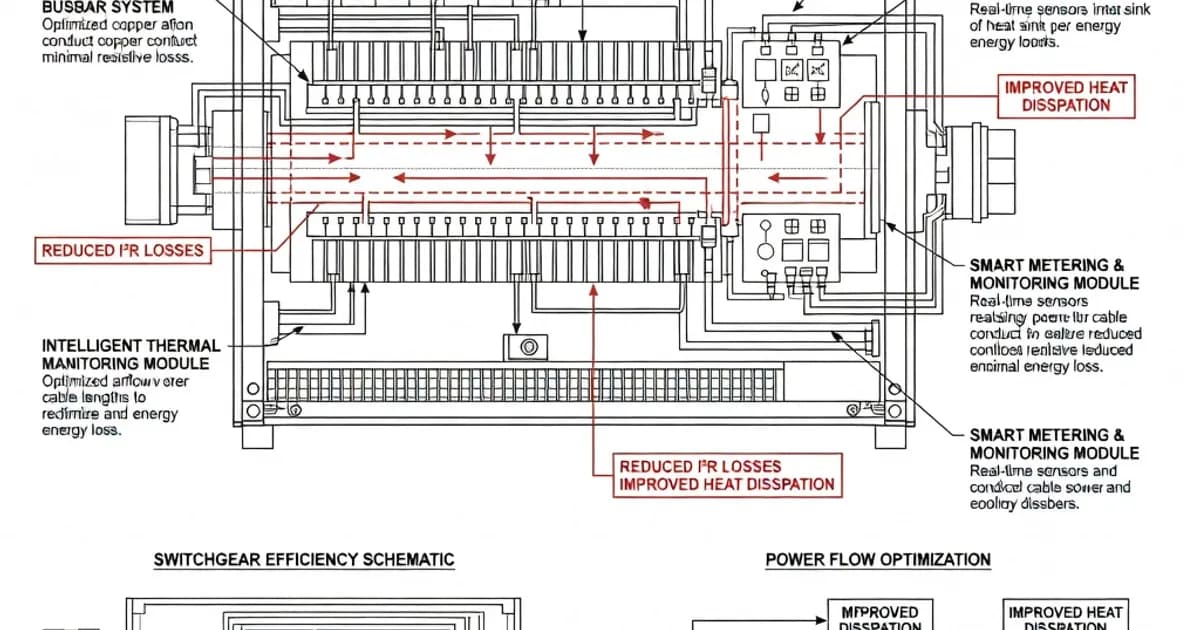
Energy Efficiency in Panel Design
Energy efficiency in low-voltage panel design is not only a sustainability objective; under IEC 61439 it is a direct consequence of how the assembly is engineered, verified, and operated. In practice, the most efficient panel is the one that keeps electrical losses low while remaining within permissible temperature rise, insulation limits, and short-circuit withstand ratings. Per IEC 61439-1 Clause 10.10, temperature rise verification is central because excessive heat is the most visible indicator of wasted power and stressed components. When a panel runs cooler, busbar and conductor losses are lower, insulation ages more slowly, and component reliability improves over time.
IEC 61439 replaced the older IEC 60439 approach with a more rigorous responsibility model: the panel builder, not just the component manufacturer, must verify the assembly design. As explained in the IEC 61439 guidance from multiple technical sources, design verification may be carried out by testing, calculation, or comparison against a verified reference design. This framework allows the builder to optimize efficiency without compromising compliance, provided the verified design rules are followed carefully.1,2,3
Why efficiency matters in low-voltage assemblies
Every ampere that flows through a panel creates heat. That heat comes primarily from I²R losses in busbars, conductors, terminals, and switching devices. If resistance is reduced, losses fall sharply; if current rises, losses increase quadratically. That is why a panel designed for efficiency typically uses short conductor paths, high-conductivity busbars, well-proportioned cross-sections, and internal layouts that reduce hotspots. The efficiency advantage is not limited to operating cost. Lower heat also supports higher component life expectancy, improved dielectric performance, and more stable protection device behavior.
In real installations, these gains are significant. Industry commentary on IEC 61439-compliant assemblies reports that well-executed panel designs can reduce lifecycle losses by 20% to 30% compared with older legacy layouts, especially where poor routing, oversized temperature margins, or inefficient enclosure ventilation previously increased dissipation.5
Core IEC 61439 Principles that Affect Energy Efficiency
IEC 61439 does not present “energy efficiency” as a standalone clause, but it embeds the subject through temperature rise, current-carrying capability, dielectric performance, and short-circuit strength. These clauses define the boundaries within which a low-loss panel can be built safely.
Temperature rise verification under Clause 10.10
Clause 10.10 is the most important efficiency-related verification in IEC 61439. The panel must be demonstrated to operate without exceeding permissible temperature rise limits at its rated current, or at the applicable rated diversity factor (RDF), under defined ambient conditions. Typical verification methods include:
- Testing the complete assembly at full rated current or the relevant load condition.
- Calculation using recognized methods, such as IEC/EN 60890 for assemblies up to 630 A, or design-rule-based methods allowed by IEC 61439.
- Comparison with a reference design that has the same or lower power losses, similar dimensions, and comparable outgoing circuits.
According to the ABB workbook on IEC 61439 practice, temperature rise verification may be performed with calculation methods that incorporate safety margins, commonly including a 20% derating allowance in design verification workflows. For multi-compartment assemblies, such calculations are typically limited in scope and require careful application of the standard’s design rules and boundary conditions.4
Ambient temperature is also critical. The reference ambient for verification is normally 35°C average, and designs must ensure that internal temperature rise does not create unacceptable stress on insulation, terminals, or electronic devices. In a well-designed panel, lower losses directly translate into a lower internal temperature rise and a more reliable assembly.
Current-carrying capability and rated diversity factor
Current-carrying capability is not simply a matter of selecting a large busbar. IEC 61439 requires the assembly to carry its rated current, or the current multiplied by the rated diversity factor where applicable, without exceeding thermal limits. The RDF reflects realistic partial loading of outgoing circuits and is especially important in distribution panels serving mixed loads such as lighting, HVAC, and motor starters.
In practical terms, RDF helps panel builders avoid overdesign. A panel that is verified at full simultaneous load when the actual demand is much lower may be mechanically and electrically safe, but it will be unnecessarily large, costly, and sometimes less efficient in terms of material use and enclosure heat management. Proper RDF-based design reduces copper usage and can lower standing losses, provided the assumptions are documented and the assembly is verified accordingly.2,4
Dielectric properties and leakage-related losses
Clause 10.9 addresses dielectric properties, including clearances, creepage distances, and impulse withstand behavior. These are often discussed as safety requirements, but they also influence efficiency. Poor insulation coordination can increase leakage currents, surface tracking, and unwanted thermal stress, all of which contribute to energy waste and reduced long-term performance.
Well-controlled creepage and clearance distances help maintain stable insulation performance, particularly in humid, dusty, or industrial environments. This is why selection of enclosure materials, pollution degree assumptions, and ingress protection ratings all contribute indirectly to the electrical efficiency of the panel.
How Panel Design Reduces Electrical Losses
Energy-efficient panel design is achieved through several practical engineering choices. Each choice addresses a different loss mechanism, and the cumulative effect can be substantial.
Busbar selection and layout
Busbars are the backbone of the assembly, and they are also one of the main sources of thermal loss. Copper remains the preferred material where low resistance is essential, although aluminum may also be used where the design accommodates its characteristics. The key is not only material choice, but also geometry, joint quality, surface treatment, and spacing.
Lower-resistance busbars reduce I²R losses, but the design must also ensure acceptable short-circuit withstand capability. A busbar system rated, for example, at 40 kA for 1 second can survive severe fault events without distortion or insulation breakdown, preserving both safety and operational integrity. This matters for efficiency because a damaged busbar system typically develops additional resistance, hotter joints, and lower long-term performance.
Short conductor runs and compact topology
Keeping unprotected conductor lengths short is one of the simplest and most effective ways to reduce losses. Technical guidance aligned with IEC 61439 practice recommends maintaining conductor lengths within the standard’s prescribed limits, including the well-known table-based requirements for unprotected conductors. Shorter runs mean lower resistance, reduced electromagnetic exposure, and lower heat generation.
A compact panel topology also improves thermal behavior. When high-loss components are spread too far apart, heat is harder to manage and fans must work harder, increasing auxiliary energy use. A compact, logically zoned layout keeps power devices, control electronics, and protective devices thermally coordinated.
Efficient switching and protective devices
IEC 61439 assemblies rely on IEC 60947 components for many functional devices, including circuit-breakers, contactors, disconnectors, and motor starters. Device selection affects both electrical loss and thermal balance. Low-loss switching devices, well-rated terminals, and appropriately sized protective devices all reduce heat generation at load current.
It is good practice to choose devices with published power dissipation data and to include those values in the thermal design model. Even modest reductions per device become important in large assemblies with many outgoing feeders.
Ventilation and enclosure heat management
Ventilation does not eliminate losses, but it can help dissipate them without forcing unnecessary oversizing of the assembly. IEC 61439 verification recognizes natural convection first; forced ventilation is used only when natural airflow is insufficient to satisfy temperature rise limits. If fans are employed, the design should ensure that their auxiliary power draw does not offset the gains from improved heat removal.
Enclosure selection also matters. Higher ingress protection, such as IP31 or IP54, may be required in dusty or humid environments, but tighter sealing reduces natural airflow. Designers must balance protection against the increased thermal burden. IEC 60529 governs the IP code, and the enclosure choice should align with both environmental exposure and the thermal verification strategy.
Verification Methods and Their Impact on Efficiency
IEC 61439 gives panel builders multiple ways to verify an assembly. From an efficiency standpoint, the choice of verification route influences how aggressively the design can be optimized and how much engineering evidence is required.
| Verification Method | How It Supports Energy Efficiency | Typical Use | Key Limitation |
|---|---|---|---|
| Testing | Confirms real thermal performance at rated load and validates low-loss design choices | High-criticality or novel assemblies | Costly and time-consuming |
| Calculation | Allows thermal optimization using established loss data and verified methods such as IEC/EN 60890 | Repeatable designs up to applicable current limits | Requires conservative assumptions and documented inputs |
| Comparison with reference design | Enables efficient reuse of an already verified low-loss architecture | Variant assemblies with similar construction | New design must have same or lower losses and equivalent dimensions/routing assumptions |
As documented in ABB’s IEC 61439 workbook, comparison-based verification is only acceptable when the new assembly has the same or reduced power losses relative to the reference design, along with equivalent or compatible dimensions and outgoing-circuit arrangement.4 This is important for energy efficiency because it rewards a disciplined design library approach: once a low-loss reference panel has been validated, subsequent variants can be produced with similar performance.
Calculation-based verification is particularly useful in panels up to 630 A, where IEC/EN 60890 provides an established method for temperature-rise estimation. For higher-current assemblies, or where the design is highly compact, testing may remain the most robust path to verify that a low-loss design still satisfies thermal limits.
Practical Design Best Practices for Lower Losses
Efficient panel design is a discipline, not an isolated feature. The best results come from combining electrical, thermal, mechanical, and documentation practices from the beginning of the project.
Use high-conductivity materials where justified
Copper busbars and conductors offer excellent conductivity and remain the standard choice where compactness and low loss are required. Aluminum can be effective for large main busbar systems when cross-sectional area and connection technology are designed carefully. The decision should be made on lifecycle performance, not only first cost.
Keep internal power paths short and direct
Route feeders and links so that current flows through the minimum practical length of conductor. Avoid unnecessary bends, adapters, and stacked interfaces. Each additional contact surface contributes some resistance, and each milliohm of added resistance can create measurable heat at operating current.
Use rated diversity factor realistically
RDF is one of the most important tools for balancing efficiency and compliance. For example, a distribution section serving mostly lighting may justify a higher diversity factor than a section serving intermittent process loads. A motor section may show a lower simultaneous demand than nameplate totals suggest. Realistic RDF values reduce unnecessary copper and improve the match between thermal design and actual operation.2,4
Avoid overreliance on forced cooling
Fans, filters, and heat exchangers have a role, but they are not substitutes for low-loss design. Forced airflow adds maintenance burden, introduces auxiliary consumption, and may be compromised by dust or blocked filters. If natural convection can satisfy Clause 10.10, it is often the better efficiency choice.
Coordinate protection, short-circuit strength, and heat rise
Short-circuit withstand ratings, such as Icw, are often viewed as purely protective parameters, but they also preserve efficiency. A robust panel is less likely to suffer joint deformation, insulation damage, or hidden resistance increases after a fault. That means the assembly retains its designed loss profile over its service life.
Specify ingress protection appropriate to the environment
Selecting the right IP rating supports efficiency by preventing contamination that raises resistance and degrades heat transfer surfaces. However, the IP level should not be higher than necessary, because excessive sealing can complicate thermal design. The best solution is one that balances cleanliness, safety, and heat dissipation.
Manufacturer Approaches and Product Examples
Major manufacturers now treat thermal and electrical efficiency as part of compliance strategy. Their product families typically combine standardized enclosures, tested busbar systems, and software-assisted thermal verification.
| Manufacturer | Example Platform | Efficiency-Oriented Features |
|---|---|---|
| Siemens | SIVACON-based low-voltage systems | Low-loss busbar arrangements, modular verified designs, and thermal coordination aligned with IEC 61439 design rules |
| ABB | UniGear and related LV systems | Temperature-rise verification workflows, reference-design comparison, and high short-circuit withstand options4 |
| Schneider Electric | Blokset / OKKEN | Compact low-loss busbar systems, modularity, and enclosure choices that support thermal compliance |
| Eaton | Power Xpert UX and related assemblies | IEC 61439-oriented architecture with attention to arc safety, thermal performance, and verified component integration6 |
| Rittal | TS 8 / enclosure-based solutions | Enclosure and airflow optimization that supports thermal management in LV assemblies |
| Lauritz Knudsen | Custom LV IEC panels | Customizable panel platforms aimed at energy management and standardized compliance workflows8 |
These product families show a consistent pattern: energy efficiency is achieved by standardized low-loss architectures, not by a single “green” component. The best-performing systems combine verified busbar layouts, predictable thermal behavior, and controlled enclosure design.
Common Design and Compliance Pitfalls
Even experienced panel builders can lose efficiency when compliance is treated as a paperwork exercise rather than an engineering method. Common mistakes include:
- Oversizing conductors without reducing thermal stress elsewhere in the panel.
- Using long internal links when a more direct busbar topology is possible.
- Ignoring the actual loading profile and designing as if every outgoing feeder runs at full current simultaneously.
- Adding filters, fans, or air conditioners before optimizing busbar and component losses.
- Using a reference design for comparison without proving that the new assembly has the same or lower power losses.
- Neglecting the effect of enclosure sealing and ingress protection on thermal performance.
IEC 61439 places responsibility on the assembly designer to ensure that the final panel, not just the individual components, meets the standard. That means efficiency claims must be backed by documented verification. As noted in industry guidance, clause-based verification is a major improvement over the older type-test mindset because it forces the builder to account for the actual configuration of the panel.3,5,7
How to Specify an Efficient IEC 61439 Panel
When specifying an energy-efficient panel, the goal is to define performance, not just equipment brand names. A good specification should include the following:
- Rated current, system voltage, and frequency.
- Ambient temperature assumption and installation location.
- Required temperature rise verification method under IEC 61439-1 Clause 10.10.
- RDF values for outgoing circuits where applicable.
- Busbar material, arrangement, and short-circuit withstand rating.
- Ingress protection level in accordance with IEC 60529.
- Internal arc requirements, if applicable, to reduce fault escalation and preserve assembly integrity.
- Documentation of design verification by test, calculation, or comparison.
Including these items early helps ensure that the final assembly is both compliant and efficient. It also allows the panel builder to make informed tradeoffs between cost, thermal performance, maintainability, and footprint.
Conclusion
Energy efficiency in panel design is fundamentally about controlling losses. Under IEC 61439, that means designing the assembly so it stays within allowable temperature rise, maintains dielectric integrity, survives short-circuit conditions, and operates at a current profile that reflects real demand. The best results come from low-resistance busbars, short internal conductors, realistic diversity assumptions, and disciplined verification.
For panel builders and specifiers, the practical message is clear: efficient panels are not achieved by adding more cooling after the fact. They are achieved by reducing loss at the source, verifying the assembly properly, and designing for the real operating conditions of the installation. When done correctly, the result is a panel that runs cooler, lasts longer, and consumes less energy over its entire service life.
References and Further Reading
Ready to Engineer Your Next Panel?
Our team of electrical engineers is ready to design, build, and deliver your custom panel solution — fully compliant with international standards.