IEC 61439-4: Construction Site Assemblies
Requirements for temporary power distribution on construction sites.
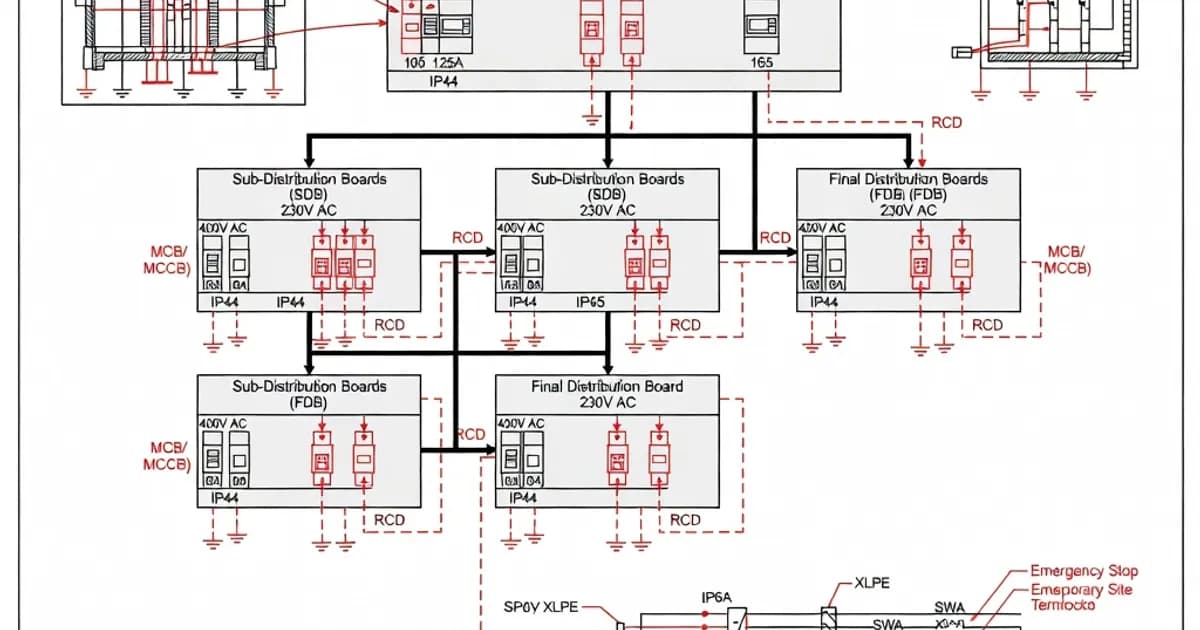
IEC 61439-4: Construction Site Assemblies
IEC 61439-4 defines the specific requirements for assemblies for construction sites (ACS): transportable or mobile low-voltage assemblies used for temporary power distribution in building construction, civil engineering, excavation, and similar temporary workplaces where public access is restricted. The standard applies to assemblies with rated voltages up to 1,000 V AC or 1,500 V DC, including assemblies that incorporate transformers within those limits, as set out in IEC 61439-4:2023 and the general rules of IEC 61439-1:2020.
This part of the IEC 61439 series matters because construction environments are unusually harsh. Assemblies may be moved repeatedly, exposed to rain, dust, vibration, impact, and rough handling, and connected by non-specialist users under changing site conditions. IEC 61439-4 therefore adds particular requirements for mobility, mechanical strength, protection against ingress, and verification of short-circuit performance beyond the general rules for low-voltage switchgear and controlgear assemblies.
What IEC 61439-4 covers
Per Clause 1 of IEC 61439-4, the standard applies to ACS intended for temporary use on construction sites and related activities. The assemblies may be indoor or outdoor, semi-fixed or mobile, and may include socket-outlet boards, distribution boards, feeder pillars, or compact integrated units with protective devices and transformer arrangements. The key distinction is that these are not permanent building distribution boards; they are intended for transport, relocation, and repeated installation on temporary worksites.
The current edition, IEC 61439-4:2023, is Edition 2.0 and supersedes IEC 61439-4:2012, which itself replaced IEC 60439-4:2004. The 2023 revision aligns the part 4 requirements with the 2020 structure of IEC 61439-1 and updates references, verification concepts, and construction-site specific provisions.
Relationship with IEC 61439-1 and other standards
IEC 61439-4 does not stand alone. It is built on the general framework of IEC 61439-1:2020, which defines the common rules for low-voltage assemblies, including design verification, protection against electric shock, clearances and creepage distances, temperature rise, dielectric properties, and provisions for internal separation. For ACS compliance, the general requirements of IEC 61439-1 remain mandatory unless IEC 61439-4 provides a specific deviation or additional rule.
In practice, ACS design also depends on related standards for component selection and environmental protection. Circuit-breakers, switches, and contactors are typically selected from the IEC 60947 series. Degrees of protection are assessed using IEC 60529. If the assembly interfaces with machinery, IEC 60204 may become relevant. If the site includes higher-voltage upstream equipment, coordination with the IEC 62271 series may also be needed.
| Standard | Role in ACS design |
|---|---|
| IEC 61439-1:2020 | General rules for low-voltage assemblies: design verification, insulation, temperature rise, protection, construction |
| IEC 61439-4:2023 | Particular requirements for construction site assemblies, including mobility and mechanical robustness |
| IEC 60947 series | Component standards for circuit-breakers, switches, and controlgear integrated in ACS |
| IEC 60529 | IP code ratings for ingress protection against dust and water |
| IEC 60204 series | Electrical equipment of machinery, relevant when ACS forms part of a machine installation |
| IEC 62271 series | High-voltage switchgear, relevant where ACS interfaces with transformer-fed upstream systems |
Why construction site assemblies need special requirements
Construction sites are dynamic, electrically demanding environments. Loads change frequently, temporary cables are extended and reconfigured, and enclosures are often exposed to rain, mud, concrete dust, tools, forklift movement, and accidental impact. For that reason, IEC 61439-4 emphasizes practical resilience, not only electrical performance.
As documented in the IEC 61439-4:2023 text, special service conditions include transport, storage, installation, and site handling. Clause 7.3 addresses the additional stresses that arise when assemblies are lifted, rolled, repositioned, or stored between work phases. Clause 8.1.6 requires lifting provisions where necessary, reflecting the fact that ACS must remain safe and maintain performance after repeated movement.
Rated voltage, site use, and typical configurations
IEC 61439-4 covers assemblies with rated voltages up to 1,000 V AC or 1,500 V DC. This makes the standard suitable for most temporary low-voltage site distribution systems, including three-phase 400 V supplies, socket-outlet distribution, lighting distribution, and transformer-fed subdistribution.
Typical ACS configurations include:
- socket-outlet distribution boards for hand tools and portable equipment;
- feeder pillars distributing supply to multiple site zones;
- main distribution boards with MCCBs, RCDs, and metering;
- transformer-integrated units supplying reduced-voltage or isolated circuits;
- mobile enclosures on skids, castors, or lifting frames.
These assemblies are often prewired and delivered ready for plug-and-play connection. That approach reduces on-site wiring time and helps keep the verification responsibility concentrated on the assembled product rather than on improvised field modifications.
Design and construction requirements
Mechanical strength and impact resistance
Construction site assemblies must survive more severe mechanical stresses than ordinary indoor panels. IEC 61439-4 addresses this through requirements for mechanical strength, impact withstand, and loading. Clause 8.2.1 references the IK code concept and the use of a striking element for impact testing, while Clause 8.1.5 specifies assumed loading values in Table 101. These provisions recognize that site equipment may be struck by tools, carts, debris, or handling equipment.
In practical design terms, manufacturers commonly specify robust sheet steel, reinforced polymer enclosures, protected corners, recessed devices, and covers that minimize direct access to live parts. Where assemblies are frequently transported, the frame and base must also prevent distortion that could compromise door alignment, gasket compression, or protective clearances.
Ingress protection for outdoor and dusty conditions
IEC 61439-4 relies on the IP code system from IEC 60529 to define protection against solid objects and water. The exact rating depends on the environment and user agreement, but construction-site assemblies commonly target at least IP44, with many outdoor or severe-duty units designed to IP54, IP55, or higher.
Higher IP ratings are valuable because site assemblies are often exposed to wind-driven rain, wash-down conditions, wet ground, and airborne dust. However, higher IP performance must be achieved without compromising cable entry, heat dissipation, or service access. Designers therefore need to balance environmental protection against temperature rise and maintainability.
Short-circuit withstand and verification
Short-circuit withstand capability is a core safety requirement in IEC 61439-4. The standard allows verification of busbar structures by comparison with tested reference designs, and Annex P M provides the normative basis for this approach. This is important for modular ACS, where busbar arrangements may be repeated across a product family or adapted to different current ratings.
As with the rest of the IEC 61439 series, verification is not a single test but a set of checks that demonstrate the assembly can withstand expected electrical and thermal stresses. In practice, this means the designer must confirm the rated short-circuit current, the protection device coordination, and the integrity of the assembly layout under fault conditions.
Protection against electric shock
Protection against electric shock remains governed primarily by IEC 61439-1, including the general rules for basic protection and fault protection. For construction sites, this requirement becomes especially important because temporary users may connect portable loads with varying skill levels. Socket circuits are commonly protected by residual current devices, and site practices frequently require 30 mA RCD protection for personnel protection on final socket-outlet circuits.
Good ACS design also includes clearly segregated terminals, touch-safe fronts, secure earthing, and well-defined cable routing. These features reduce the chance of accidental contact and support safe commissioning after each relocation.
Lifting, handling, and transport
Because ACS are mobile or transportable, the enclosure and frame must be suitable for repeated handling. IEC 61439-4 Clause 8.1.6 requires lifting provisions where relevant. In engineering terms, that means lifting eyes, fork pockets, pallet bases, or other dedicated handling features should be integrated into the structure rather than added informally later.
Transport and storage are not peripheral concerns; they are part of the intended service life. Misalignment, cracked glands, damaged seals, and loosened busbar supports often begin as handling problems rather than electrical design faults. For that reason, assembly design should consider vibration, shock, stacking, and storage orientation from the outset.
Verification and compliance
Design verification under IEC 61439
IEC 61439 uses the concept of design verification to demonstrate that an assembly meets its claimed performance. For ACS, verification is based on the general requirements of IEC 61439-1 and the additional provisions of IEC 61439-4. The verification methods typically include testing, comparison with a reference design, calculation, and assessment of construction details depending on the characteristic being verified.
For construction site assemblies, the most relevant verifications usually include:
- temperature rise limits;
- dielectric properties;
- short-circuit withstand;
- clearances and creepage distances;
- protective circuit integrity;
- mechanical strength and impact resistance;
- degree of protection;
- lifting and transport suitability.
User agreements and installation details
IEC 61439-4 includes informative guidance in Annex CC, including Table C.1, for matters that may require agreement between the assembly manufacturer and the user, such as installation distances and site-specific conditions. This reflects a practical reality: construction sites vary widely, so not every installation parameter can be fixed by a single universal rule.
Where user agreements are used, they should be recorded clearly in the technical documentation. This is especially important for items such as ventilation clearances, orientation of use, connection method, ambient temperature assumptions, and the intended IP performance after cable entry.
Documentation expected for compliant ACS
A compliant construction site assembly should be supplied with a technical file that identifies the standard basis, rated characteristics, verification evidence, and any site-use limitations. This typically includes:
- rated operational voltage, current, frequency, and short-circuit rating;
- degree of protection;
- wiring diagrams and component schedules;
- protective device settings or ratings;
- lifting and handling instructions;
- maintenance and inspection requirements;
- conditions of use and any user agreements per Annex CC.
Typical product features and manufacturer practice
Major manufacturers offer ACS-oriented solutions that reflect the requirements of IEC 61439-4, often combining robust enclosures with modular devices from IEC 60947 and site-ready socket systems. Examples in the market include mobile distribution boards, compact feeder pillars, and larger transformer-fed assemblies.
Common features include weatherproof enclosures, recessed handles, lockable doors, color-coded socket-outlets, RCD protection on socket circuits, and busbar systems verified by tested designs. As documented in manufacturer guidance such as ABB’s IEC 61439 technical manual, practical ACS design also pays attention to installation distances, handling logistics, and inspection access.
| Typical ACS feature | Purpose on construction sites | Common design practice |
|---|---|---|
| IP44 to IP65 enclosure | Resists dust and water ingress | Use gasketed doors, sealed cable entries, and protected vents |
| IK-rated construction | Withstands impact and rough handling | Reinforced steel or impact-resistant polymer housing |
| RCD-protected socket circuits | Personnel protection for portable tools | 30 mA residual current protection for final circuits |
| Lifting and transport provisions | Safe relocation across the site | Fork pockets, lifting eyes, castors with brakes, or skid bases |
| Modular device layout | Easy maintenance and expansion | Use standardized component rows and clear labeling |
| Verified busbar system | Short-circuit robustness | Reference design comparison or testing per Annex P M |
Current and voltage ranges in practice
Although IEC 61439-4 allows rated voltages up to 1,000 V AC or 1,500 V DC, many site assemblies operate at 400/230 V AC and are designed around practical load groups rather than maximum voltage. Current ratings vary widely, from small socket-outlet units to main boards in the hundreds of amperes. Industry examples commonly range from compact distribution boxes to larger assemblies rated at 630 A or more, depending on application and enclosure type.
That flexibility is one reason ACS are widely used for modular site electrification. The same product family can often be configured for lighting, power tools, site cabins, pumping equipment, or temporary workshops, provided the verification scope covers the intended configuration.
Best practices for specification and use
Specify the environment first
The most important ACS design decision is not the device list; it is the operating environment. A panel intended for a dry internal fit-out floor has very different requirements from one placed outdoors near excavation, concrete cutting, or frequent wash-down. Engineers should define the exposure level, mobility requirement, cable entry method, and maintenance regime before selecting the enclosure and protective devices.
Use robust protection coordination
Construction site loads are frequently mixed and intermittent, so protection coordination should be simple, selective where necessary, and easy to reset. MCCBs or MCBs should be selected for the available fault level and the downstream cable sizes. RCDs should be applied where personnel protection is required, especially on socket circuits. The short-circuit rating of the assembly must be compatible with the prospective fault current at the point of installation.
Design for inspection and maintenance
ACS should be easy to inspect after transport and before energization. Clear labeling, accessible test points, visible protective device positions, and simple confirmation of earthing condition reduce commissioning errors. Many site operators adopt routine checks before each move and periodic formal inspections during the project. This is good practice because vibration and repeated connection cycles can loosen terminals, degrade seals, or damage cables over time.
Avoid common failures
The most common problems on construction site assemblies are not exotic electrical faults. They are basic failures of environmental and mechanical design: inadequate IP rating, insufficient impact resistance, poor cable gland sealing, overloading of socket groups, and damage caused by lifting or transit. These failures are preventable when the ACS is specified and verified against the actual site conditions rather than only against nominal electrical ratings.
How IEC 61439-4 differs from general indoor assemblies
Compared with standard indoor low-voltage assemblies, ACS must account for frequent movement, temporary installation, and harsher environmental exposure. The electrical architecture may be similar, but the construction, enclosure, and verification burden is greater. That is why IEC 61439-4 adds specific mechanical and handling requirements, while still relying on the core IEC 61439-1 framework for electrical safety.
In short, IEC 61439-4 shifts the design focus from “can the panel perform electrically?” to “can the panel perform electrically after being carried, installed, exposed, and reused on a construction site?” That distinction is central to safe temporary power distribution.
Conclusion
IEC 61439-4:2023 provides the technical basis for safe, durable, and verifiable construction site assemblies. It defines how ACS should be built, protected, transported, and verified so that temporary low-voltage distribution remains safe in demanding site conditions. When combined with IEC 61439-1 and the relevant component and enclosure standards, it gives manufacturers and specifiers a clear route to compliant, robust site power systems.
For engineers, the practical takeaway is straightforward: treat mobility, ingress protection, impact resistance, and short-circuit performance as core design requirements, not optional extras. A well-designed ACS reduces downtime, improves safety, and withstands the realities of construction work far better than a generic assembly adapted for temporary use.
References and Further Reading
Ready to Engineer Your Next Panel?
Our team of electrical engineers is ready to design, build, and deliver your custom panel solution — fully compliant with international standards.