Panel Retrofit and Modernization Strategies
Upgrading aging panels without full replacement.
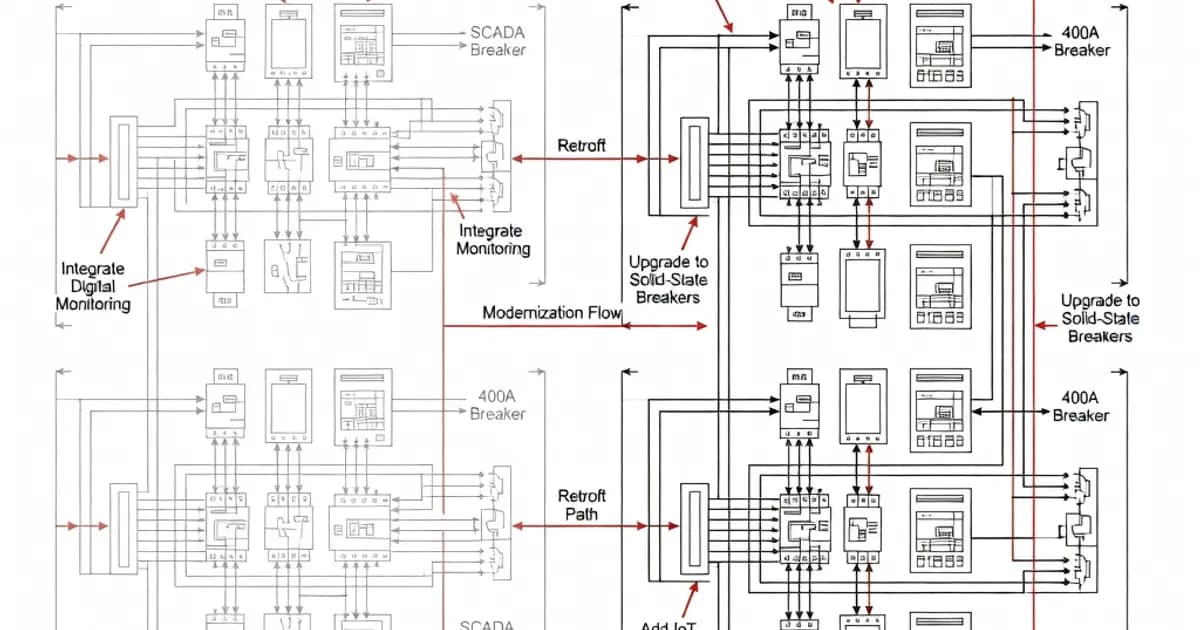
Panel Retrofit and Modernization Strategies
Panel retrofit and modernization under IEC 61439 is not a simple like-for-like component swap. It is a structured engineering process that re-establishes the safety and performance of an existing low-voltage assembly through design verification, routine verification, and documented responsibility for the finished assembly. This is a major shift from the older IEC 60439 approach. As Schneider Electric explains, IEC 61439 introduced “a whole new approach” by placing the burden of compliance on the assembly manufacturer and by requiring evidence that the complete assembly performs safely in real operating conditions, not just that individual parts are certified separately. [1]
For modernization projects, this matters because many aging panels can be upgraded without total replacement, provided the retrofit preserves or re-establishes compliance with the relevant IEC 61439 clauses. In practice, that means verifying thermal performance, dielectric strength, short-circuit withstand, protective circuits, clearances and creepage distances, enclosure integrity, and routine functional performance after the work is complete. [3] [5]
Why retrofit instead of replace?
Full replacement is often the safest technical option when a panel is badly degraded, undersized, or undocumented. However, retrofit is attractive when the enclosure is structurally sound and the owner needs to extend asset life, reduce downtime, or add new functions such as digital metering, communication gateways, improved protection relays, or higher-performing circuit-breakers. Modernization also helps address obsolescence: older IEC 60439-era panels often lack the verified margins now expected for temperature rise, pollution degree, or short-circuit withstand. [2] [4]
In industrial environments, retrofits are especially valuable when production loss from a prolonged shutdown would exceed the cost of engineering the upgrade. A phased retrofit can replace breakers, relays, meters, protection devices, and internal wiring first, while preserving the enclosure and main busbar system if they can still satisfy the verified design basis. This staged approach is widely recommended because it reduces downtime and allows the most critical risks to be addressed earliest. [10]
How IEC 61439 governs retrofit work
IEC 61439 does not treat a retrofit as a casual modification. The assembly must still satisfy the standard’s design verification requirements in IEC 61439-1, Clause 10, and the completed assembly must pass routine verification in Clause 11 before being returned to service. The standard defines 12 characteristics that must be verified for an assembly, covering both construction and performance. These include strength of materials and parts, degree of protection, clearances and creepage distances, protection against electric shock, incorporation of switching devices, internal electrical circuits and connections, terminals for external conductors, dielectric properties, temperature rise, short-circuit withstand strength, electromagnetic compatibility, and mechanical operation. [3] [9]
For retrofit projects, design verification is typically achieved by a combination of:
- Testing of representative configurations, where practical.
- Calculation, especially for thermal and short-circuit performance.
- Comparison with a verified design, where the new arrangement remains sufficiently similar to an already verified assembly. [5] [3]
This is why retrofit engineering is fundamentally a documentation discipline as much as a hardware discipline. The installer must be able to prove that the modified assembly still conforms to the original or revised design basis. ABB’s guidance emphasizes that compliance requires a complete design dossier and an orderly verification strategy, not merely the use of branded components. [3]
Core Verification Requirements for Modernization
Thermal performance and temperature rise
Temperature rise is one of the most common retrofit failure points. Under IEC 61439-1 Clause 10.10, the assembly must operate within specified temperature limits at rated current and under the declared internal arrangement. In practical terms, terminals typically must not exceed a 70 K rise above ambient, while busbar temperatures are often managed to an average limit around 105 K, depending on the part and construction details. If a modernization increases device density, adds digital modules, or raises feeder loading, the original enclosure may require ventilation upgrades, improved spacing, or lower-loss components. [2] [3]
Thermal verification becomes especially important in retrofit projects because aging panels often operate in harsher conditions than the original design assumed. Pollution, dust loading, higher ambient temperature, restricted ventilation, and modified cable entries all reduce margin. As documented in Siemens’ technical guidance, modern compliance requires the assembly manufacturer to verify the complete configuration, including heat dissipation behavior in the final installed state. [5]
Dielectric strength, clearances, and creepage distances
Retrofit work often introduces new conductors, smaller modular devices, or denser cable routing. That makes clearances and creepage distances critical. IEC 61439-1 Clause 8.3 references insulation coordination principles from IEC 60664-1. In pollution degree 3 environments, a commonly cited minimum phase-to-phase clearance is 8 mm, though the exact requirement depends on voltage, insulation material, and overvoltage category. If an aging panel has accumulated contamination or if modifications reduce spacing, the retrofit must restore adequate insulation coordination before re-energization. [3] [1]
In older panels, creepage degradation is often caused by contamination, humidity, and surface tracking over decades of service. Even if the device layout still appears functional, the electrical margins may no longer match the original design conditions. That is why a retrofit should include inspection of insulating supports, barriers, terminal covers, and wiring duct arrangement, not just replacement of active devices. [8]
Short-circuit withstand strength
One of the most important questions in any modernization project is whether the assembly can still withstand the available fault level. IEC 61439-1 Clause 10.11 requires verification of short-circuit withstand strength for the assembly and its main circuits. If a retrofit adds a higher-rated breaker, changes busbar geometry, or relocates protective devices, the fault-duty path may change. That means the original short-circuit rating can no longer be assumed. [5] [4]
Many retrofit programs therefore use selective replacement strategies: keep the verified busbar frame where feasible, but install modern protective devices with known IEC 60947 performance data. If the prospective fault current has increased because the upstream network changed, the retrofit may require a higher-rated incomer, additional reinforcement, or full re-verification of the assembly. [5]
IP, IK, and enclosure integrity
Retrofit work must not compromise the enclosure’s protective performance. The degree of protection against ingress is assessed in accordance with IEC 60529 for IP ratings, while impact resistance is commonly considered in relation to robust enclosure design and related industrial switchgear practices. If a panel door is cut for a new HMI, if cable entries are changed, or if ventilation openings are added, the original protection class can be lost. ABB and Hensel both emphasize that enclosure verification must be repeated after modification, because the enclosure is part of the compliant assembly, not just a container. [3] [8]
Standards and Compliance Scope
The IEC 61439 series now serves as the central compliance framework for low-voltage switchgear and controlgear assemblies. It replaced the former IEC 60439 approach and places responsibility for the complete assembly on the organization that assembles and verifies it. Current editions emphasize practical verification methods and clear allocation of responsibility between original manufacturers, panel builders, and retrofit integrators. [6] [8]
| Standard | Role in Retrofit and Modernization | Practical Impact |
|---|---|---|
| IEC 61439-1 | General rules, design verification, rated characteristics | Defines how the complete retrofitted assembly must be proven compliant |
| IEC 61439-2 | Power switchgear assemblies | Relevant for MCCs, distribution panels, and industrial feeder boards |
| IEC 61439-3 | Distribution boards for ordinary persons | Applies to some building retrofit applications |
| IEC 61439-4:2023 | Assemblies for construction sites | Useful where enclosed, portable, or harsh-environment assemblies are upgraded |
| IEC 60947 | Low-voltage switchgear and controlgear components | Provides component-level ratings for breakers, contactors, and auxiliaries |
| IEC 60529 | Ingress protection | Confirms enclosure sealing after any cutout, ventilation, or cabling change |
| IEC 60664-1 | Insulation coordination | Sets the basis for clearance and creepage verification |
In Europe, EN harmonized versions such as EN IEC 61439-1:2022 are commonly applied. Retrofit documentation should therefore identify the exact standard edition used for design verification, because compliance is edition-specific and operating conditions vary by region, installation type, and application. [3]
Modernization Approaches That Work in Practice
Modular component replacement
The most efficient retrofit strategy is often modular replacement of devices that have the highest obsolescence risk or the greatest operational benefit. This usually starts with circuit-breakers, metering, relays, protection devices, and communication modules. Because these components are usually IEC 60947 compliant, they can be integrated into a verified assembly structure if thermal loading, mechanical fit, and short-circuit performance remain acceptable. [4] [5]
This approach is popular because it minimizes disruption. In many plants, the original enclosure and main busbar system remain in place while the protection and control layer is upgraded. That can reduce shutdown duration and extend service life substantially, provided the retrofitter reassesses losses, spacing, and wiring practices. [10]
Busbar and thermal redesign
If a panel upgrade increases load or density, the busbar system may become the limiting factor. Modern busbar retrofits often use optimized conductor geometry, improved insulation supports, and better heat management. ABB’s guidance stresses that the thermal behavior of the full assembly must be verified, especially when the internal layout changes. The verification can often be performed through calculation or by comparison with a validated configuration, but the result must reflect the actual modified arrangement. [3]
When thermal margins are tight, common corrective actions include:
- Replacing older devices with lower-loss equivalents.
- Increasing ventilation or adding forced cooling where permitted.
- Reducing cable congestion and improving internal spacing.
- Upgrading insulation barriers and terminal shrouds.
Digitalization and condition monitoring
Modern retrofit programs increasingly add digital monitoring without changing the entire panel architecture. Smart metering, temperature sensors, communication gateways,
Frequently Asked Questions
Ready to Engineer Your Next Panel?
Our team of electrical engineers is ready to design, build, and deliver your custom panel solution — fully compliant with international standards.