Thermal Imaging for Panel Inspection
Using thermal cameras for non-invasive panel diagnostics.
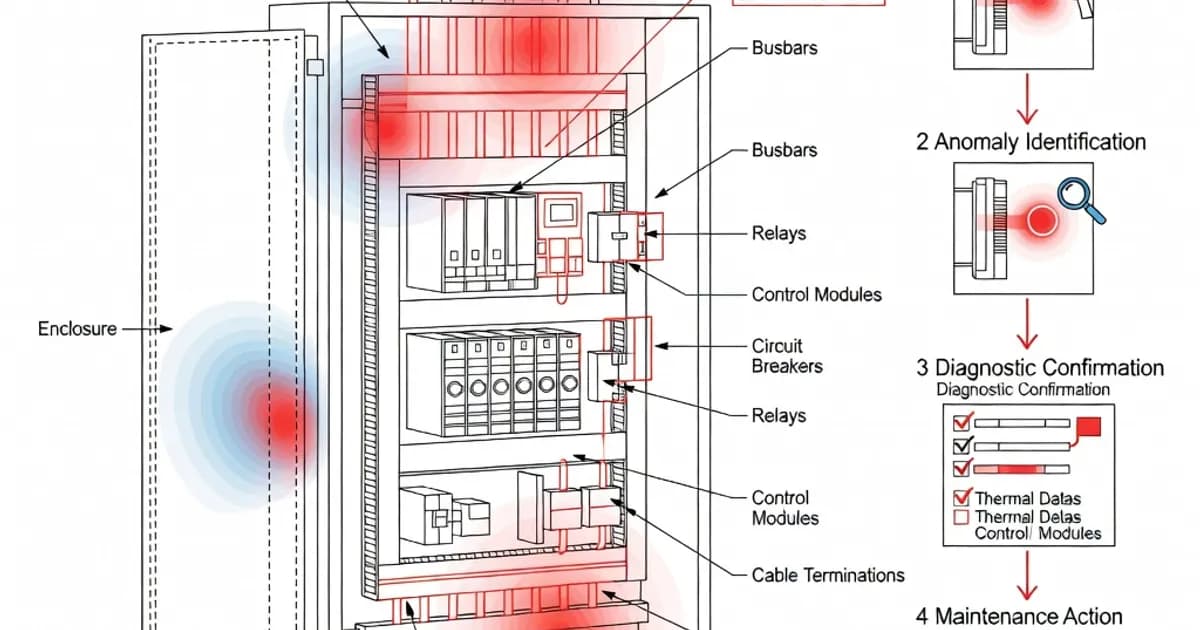
Thermal Imaging for Panel Inspection
Thermal imaging is one of the most effective non-invasive tools for inspecting low-voltage switchgear and controlgear assemblies. In IEC 61439-compliant panels, it helps identify abnormal temperature patterns before they become failures, giving maintenance teams a practical way to detect loose connections, overloads, imbalanced phases, deteriorating contacts, or ventilation problems without opening the enclosure or interrupting service.
This matters because thermal performance is not optional in a compliant assembly. Per IEC 61439-1 Clause 10.10, the manufacturer must verify that the assembly can carry its rated current without exceeding permissible temperature rise limits under specified ambient conditions, typically based on an average ambient temperature not exceeding 35°C over 24 hours. Thermal imaging does not replace that verification, but it strongly complements it in service by showing how the assembly behaves in real operating conditions.
For panelbuilders, operators, and inspectors, thermal imaging creates a bridge between design verification and operational condition monitoring. It is especially valuable in boards with high current density, dense functional units, limited ventilation, or installations in hot climates where thermal margins are reduced.
Why thermal imaging is important in IEC 61439 panel assemblies
IEC 61439 is built around the concept that an assembly must remain safe, functional, and durable at its declared ratings. Thermal verification is central to that requirement. The standard requires proof that temperature rise stays within acceptable limits at current-carrying parts such as busbars, terminals, and functional units. In practice, thermal stress is one of the most common causes of premature degradation in low-voltage assemblies because heat accelerates oxidation, insulation aging, loosening of spring pressure, and contact resistance growth.
Thermal imaging helps detect these issues while the panel remains energized. This is a major advantage over traditional inspection methods, which often require shutdown, removal of barriers, or direct physical access. When used correctly, an infrared survey can identify hotspots, record temperature differentials, and support maintenance decisions before a fault escalates into an outage, nuisance trip, or fire risk.
As noted in manufacturer guidance and IEC 61439 practice documents, a hotspot often indicates an underlying defect rather than a simple temperature rise. A localized temperature anomaly at a terminal, breaker lug, fuse holder, or busbar joint is frequently associated with loose hardware, undersized conductors, contamination, phase imbalance, or overload. Thermal imaging gives the operator a clear visual signature of that abnormality.
How thermal imaging supports IEC 61439 compliance
IEC 61439 defines several methods for verifying an assembly design, including testing of the complete assembly, comparison with a verified reference design, and calculation-based methods in defined cases. Per IEC 61439-1 and associated guidance, thermal verification under Clause 10.10 ensures that the assembly can operate at the declared rated current without excessive temperature rise. This is the core standard requirement behind thermal performance.
Thermal imaging does not itself constitute type verification, but it is highly relevant to routine verification and operational assessment. It can confirm whether a panel in service continues to behave consistently with its design assumptions. If a panel was type-tested at one set of construction parameters and later modified in the field, thermal imaging can reveal whether the modification has introduced an abnormal heat pattern that may compromise compliance or reliability.
In practical terms, thermal inspection supports the IEC 61439 lifecycle in three ways:
- Design validation support: It helps confirm that the assembly layout, ventilation, and component selection are thermally robust under load.
- Routine condition monitoring: It identifies defects that arise after commissioning, such as loose joints or overloaded circuits.
- Maintenance prioritization: It allows maintenance teams to focus corrective action on the hottest and most critical points first.
Relevant standards and verification context
Thermal imaging for panel inspection sits within a broader framework of IEC and EN standards that govern low-voltage assemblies, enclosures, and switchgear. The most important references are IEC 61439-1:2020 + A1:2023 and the part-specific product standard IEC 61439-2:2021 for power switchgear and controlgear assemblies.
| Standard | Scope | Relevance to thermal imaging |
|---|---|---|
| IEC 61439-1 | General rules for low-voltage switchgear and controlgear assemblies up to 1000 V AC / 1500 V DC | Clause 10.10 temperature rise verification; basis for thermal compliance |
| IEC 61439-2 | Power switchgear and controlgear assemblies | Defines thermal performance expectations for typical distribution and power boards |
| IEC 60947 series | Low-voltage switchgear and controlgear components | Component-level endurance and operating characteristics inside the assembly |
| IEC 60529 | Degrees of protection by enclosure (IP code) | Important when adding IR windows or inspection ports without reducing enclosure protection |
| IEC 62262 | IK impact protection | Relevant where viewing windows or access features must preserve mechanical robustness |
| IEC 60664-1 | Insulation coordination, creepage and clearance | Temperature rise testing and design must not compromise spacing or insulation performance |
| IEC TR 61641 | Guide for internal arc testing of assemblies | Useful for understanding thermal and fire risks in fault conditions |
Per IEC 61439 verification rules, the manufacturer may verify thermal performance by direct test, calculation in limited cases, or by using design rules derived from a tested reference arrangement. Public guidance notes that calculation methods are limited and are not a universal substitute for testing, especially in complex or multi-compartment arrangements. As summarized in IEC 61439 practice references, calculation-based verification is typically constrained to assemblies up to 1600 A in certain configurations, while type-tested evidence remains the most robust route for more demanding designs.
Temperature rise limits are also tied to the materials used inside the panel. Manufacturer guidance referencing IEC 61439 notes that insulating materials must withstand normal heat as well as abnormal heat without losing functional integrity. That is why thermal inspection is not just about copper temperature; it is also about the condition of terminals, supports, barriers, cable insulation, and plastic housings.
What thermal imaging can detect in a live panel
Thermal cameras are especially effective at revealing issues that are difficult to detect with the naked eye. In a live assembly operating under load, the camera can show small but meaningful temperature differences across similar components. The most common findings include:
- Loose or under-torqued connections: A higher-resistance joint heats faster than adjacent healthy joints.
- Overloaded conductors or devices: Excess current increases temperature along a feeder, breaker, or busbar section.
- Phase imbalance: One phase may run hotter than the others in three-phase systems.
- Cooling deficiencies: Blocked vents, failed fans, clogged filters, or poor enclosure layout can trap heat.
- Deteriorating components: Contact wear, oxidation, or insulation degradation often produces localized heating.
- Incorrect assembly or retrofit effects: After modifications, previously acceptable thermal behavior can change materially.
A practical rule used in the field is to compare similar terminations or poles under similar load. A noticeably hotter pole or terminal group often indicates a defect worth immediate follow-up. Many maintenance programs prioritize a temperature differential rather than an absolute temperature alone, because the surrounding ambient, load profile, and emissivity all affect the reading.
Typical inspection workflow
A good thermal inspection is structured, repeatable, and aligned with the operating profile of the installation. The best results come when the panel is energized, loaded as close as possible to normal operating conditions, and inspected with a clear baseline for comparison.
A practical workflow is as follows:
- Confirm the panel identification, operating voltage, load level, and ambient conditions.
- Inspect during a period of meaningful load, ideally when the circuit is carrying a stable and representative current.
- Scan busbar chambers, incoming and outgoing terminals, breaker bodies, fuse holders, cable lugs, contactors, and transformer connections.
- Document thermal images alongside visible-light photos so that each hotspot can be located precisely later.
- Compare each suspect point against similar phases, similar devices, or historical baseline data.
- Schedule corrective action based on severity, trend, and criticality of the circuit.
In many facilities, thermal inspections are integrated into monthly, quarterly, or annual preventive maintenance programs. High-risk installations, such as process plants, data centers, hospitals, and facilities in hot climates, often benefit from more frequent surveys. In Southeast Asia and other regions where ambient temperatures routinely approach or exceed the IEC reference value of 35°C, thermal headroom is reduced and inspection frequency becomes even more important.
Specification table: thermal imaging use in compliant panel inspections
| Inspection element | Best practice | IEC 61439 relevance |
|---|---|---|
| Load condition | Inspect under stable representative load, preferably high enough to reveal abnormal heating | Supports meaningful assessment of temperature rise behavior per Clause 10.10 |
| Ambient reference | Record ambient temperature and ventilation conditions | IEC 61439 thermal verification commonly assumes average ambient ≤35°C |
| Target locations | Busbars, terminals, breakers, contactors, fuse bases, cable lugs, neutral links | These are the most thermally stressed current-carrying points in an assembly |
| Acceptable comparison | Compare like-for-like phases and identical devices | Helps distinguish normal load-dependent warming from abnormal resistance heating |
| Follow-up | Retorque, clean, repair, or replace defective parts after de-energization | Restores conformity with safe design and routine verification expectations |
Design features that improve thermal inspection access
Modern IEC 61439-compliant assemblies increasingly include features that make infrared inspection easier without compromising protection against touch, dust, or mechanical damage. Manufacturer solutions often include IR-transparent windows, inspection ports, segmented barriers, and access arrangements that allow a camera line of sight to key joints while maintaining enclosure integrity.
As documented in manufacturer literature, thermal imaging access should be designed alongside enclosure performance rather than added as an afterthought. Any viewing port or access panel should preserve the declared IP rating per IEC 60529 and, where relevant, maintain the required mechanical impact resistance. That is especially important in industrial environments where the panel may be exposed to dust, moisture, vibration, or accidental impact.
Examples cited in manufacturer and industry materials include Siemens gas-insulated and low-voltage systems with infrared inspection capability, ABB assemblies with routine thermal check support, Schneider Electric’s integration of thermal awareness into its panel ecosystems, and Eaton and Rittal solutions that provide access or enclosure arrangements suited to condition monitoring. The common design theme is simple: if the panel is easier to inspect thermally, it is easier to maintain safely and reliably.
Interpreting thermal images correctly
Thermal imaging is powerful, but only when interpreted correctly. A camera measures infrared radiation, not electrical compliance by itself. Readings are affected by emissivity, reflected heat, distance, focus, viewing angle, and the presence of shiny metallic surfaces. Copper busbars and plated terminals can appear cooler or hotter than they really are if settings are incorrect. For that reason, inspectors should use consistent emissivity settings and, where necessary, reference known surface characteristics.
It is also important to avoid oversimplified thresholds. A terminal at 60°C may be acceptable in one context and serious in another. The decisive factors are the delta between comparable parts, the loading level, the design temperature rise limit, and the manufacturer’s verified construction data. In many maintenance programs, a temperature difference of 20°C to 30°C between comparable points is treated as a warning sign requiring investigation, particularly when the hotter point is on a critical feeder or main incomer. The exact action threshold should always follow site policy and OEM guidance.
Thermal evidence should be documented with the operating current, camera settings, ambient conditions, and load profile. This makes later trend analysis possible and allows the team to distinguish a transient load event from a persistent defect.
Comparison of verification methods and where thermal imaging fits
| Verification approach | Description | Strengths | Limitations |
|---|---|---|---|
| Testing of complete assembly | Direct thermal verification on the finished panel | Most representative; strong evidence of compliance | Time-consuming and may require specialized test setup |
| Calculation | Thermal performance assessed by approved calculation methods | Useful for some standardized designs | Limited applicability; not suitable for all multi-compartment assemblies |
| Design rules from tested references | Uses similarity to a previously verified design | Efficient for families of similar panels | Requires disciplined control of construction details and loss assumptions |
| Thermal imaging in service | Infrared inspection during operation | Non-invasive, fast, excellent for detecting emerging faults | Does not replace formal type verification |
This comparison is important because thermal imaging is often misunderstood as a compliance test. It is not. Instead, it is a diagnostic and preventive maintenance tool that complements the standard’s verification framework. In the field, it can validate that the installed condition still aligns with the assumptions used during the original verification process.
Best practices for reliable thermal inspections
To obtain useful and repeatable results, inspections should be embedded in a disciplined maintenance process. The most effective programs follow a few core principles:
- Inspect under load: The panel must be energized and carrying enough current to reveal thermal anomalies.
- Use consistent baselines: Compare current readings against previous surveys and similar components.
- Check the highest-risk joints first: Main incomers, outgoing feeders, busbar joints, and heavily loaded terminals deserve priority.
- Verify with follow-up testing: Where a hotspot is found, perform torque checks, contact resistance tests, cleaning, or component replacement during a planned outage.
- Document everything: Save images, operating current, ambient temperature, and corrective actions for traceability.
Industry experience shows that predictive thermal monitoring can reduce unplanned failures substantially when it is paired with corrective maintenance. Publicly available case discussions frequently cite major reductions in failure rates and downtime when type-tested panels are combined with structured thermal inspection and routine verification practices. In other words, the value is not simply in taking infrared pictures; it is in acting on the trend data.
For panels built to IEC 61439, this proactive approach is especially compelling. A compliant assembly should already be engineered to manage thermal stress safely. Thermal imaging gives operators an early warning system that indicates when aging, field modifications, or abnormal operating conditions are pushing the assembly away from its intended thermal envelope.
Thermal imaging, fire prevention, and fault safety
Although thermal imaging is usually discussed in the context of reliability, it also contributes to fire prevention. Overheated terminals and overloaded conductors can char insulation, weaken supports, and, in severe cases, initiate internal faults. That makes thermal monitoring relevant to broader safety objectives, including those addressed by IEC TR 61641 for internal arc considerations.
Well-managed thermal conditions reduce the likelihood that a local defect will develop into a major incident. This is especially important in densely packed switchboards, where a single overheating point can affect adjacent devices or compartments. In this sense, thermal imaging is part of a larger risk-control strategy that includes correct design, proper installation torque, routine verification, ventilation management, and periodic re-inspection after load changes or retrofits.
Conclusion
Thermal imaging for panel inspection is one of the most practical ways to support the long-term reliability of IEC 61439-compliant low-voltage assemblies. It provides a non-invasive view of electrical stress, exposes hidden defects before they become failures, and helps maintenance teams act early. Used properly, it complements the standard’s temperature rise verification requirements, supports routine verification, and improves operational safety.
The key is to treat thermal imaging as part of a broader compliance and maintenance strategy. The assembly must still be designed, verified, and installed in accordance with IEC 61439. But once in service, infrared inspection gives operators a powerful means
Frequently Asked Questions
Ready to Engineer Your Next Panel?
Our team of electrical engineers is ready to design, build, and deliver your custom panel solution — fully compliant with international standards.