Copper vs Aluminum Busbars: Selection Criteria
Technical comparison for busbar material selection.
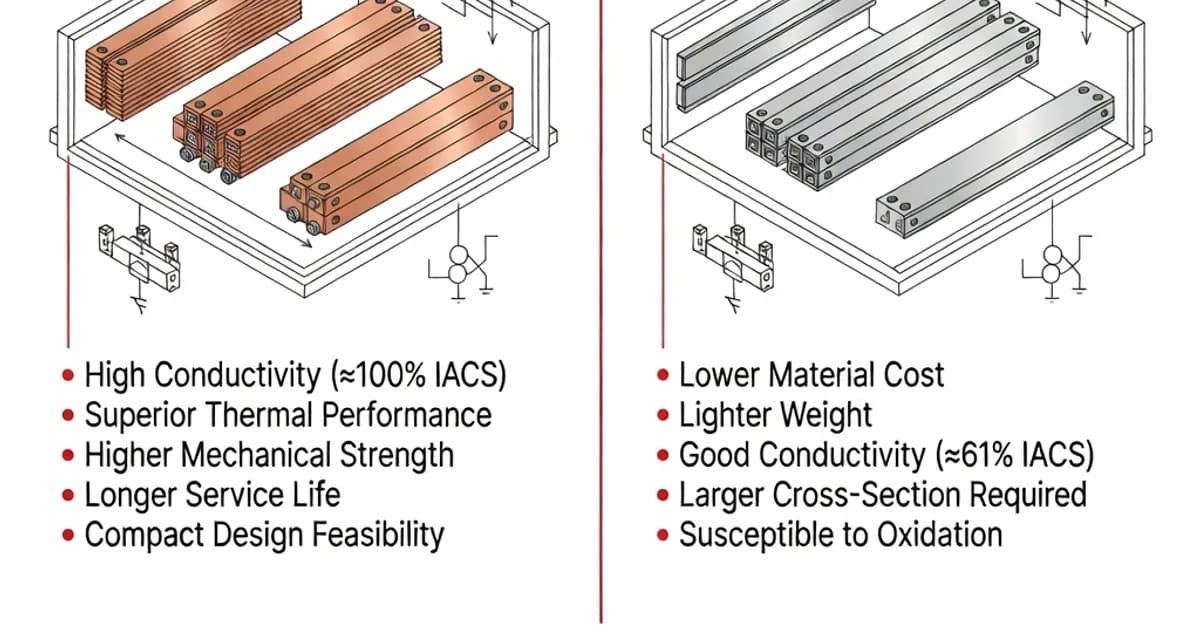
Copper vs Aluminum Busbars: Selection Criteria
Choosing between copper and aluminum busbars is not simply a matter of material preference or budget. In IEC 61439-compliant low-voltage panel assemblies, busbar selection affects current-carrying capacity, temperature rise, short-circuit withstand, mechanical stability, installation weight, and long-term maintenance. The correct decision depends on the assembly’s rated current, thermal environment, available space, mounting method, corrosion risk, and the verification evidence required by IEC 61439-1 and IEC 61439-2.
Copper remains the benchmark for compact, high-ampacity panel design because it combines very high conductivity with excellent mechanical strength. Aluminum, by contrast, is attractive where weight reduction, larger conductor profiles, and lower material cost are priorities. As documented in manufacturer guides and technical references, both materials can be used successfully in low-voltage assemblies if the design accounts for their different electrical and mechanical behaviors and if the assembly is verified in accordance with IEC 61439.
Material Properties That Drive Busbar Selection
The first design criterion is electrical conductivity. Copper has a conductivity of approximately 58 MS/m, corresponding to 100% IACS, with resistivity of about 1.68 × 10⁻⁸ Ω·m at 20°C. Aluminum is lower at approximately 37 MS/m, or about 60-62% IACS, which means it must use a larger cross-sectional area to carry the same current at similar temperature rise. In practical terms, aluminum busbars often require around 60% more cross-section than copper for equivalent ampacity, depending on enclosure conditions, spacing, ventilation, and the verification method used.
This conductivity difference is why copper is commonly selected for compact switchboards, motor control centers, and high-density distribution sections. Aluminum remains viable for trunking systems, long runs, and larger equipment spaces where physical size is less constrained. Per IEC 61439-1 Clause 10.10, the assembly must be verified for temperature rise under rated current, so the material choice must always be validated against the actual thermal performance of the complete assembly, not just the base conductivity of the conductor.
Mechanical behavior is equally important. Copper has a tensile strength typically in the range of 32,000-50,000 psi, which gives it better resistance to deformation during installation, transport, and fault conditions. Aluminum is lighter and easier to form, but its lower strength and higher thermal expansion coefficient increase the risk of loosening at bolted joints if the connection system is not properly engineered. This is especially important in panel assemblies subject to vibration, thermal cycling, or frequent load variation.
Key Copper and Aluminum Busbar Characteristics
| Property | Copper | Aluminum | Design Impact |
|---|---|---|---|
| Electrical conductivity | About 58 MS/m, 100% IACS | About 37 MS/m, 60-62% IACS | Aluminum requires a larger cross-section for the same current |
| Resistivity at 20°C | 1.68 × 10⁻⁸ Ω·m | Higher than copper | Higher resistive losses in aluminum if size is not increased |
| Typical ampacity tendency | About 1.7 A/mm² | About 1.0 A/mm² | Aluminum often needs about 60% more area |
| Density / weight | Higher, heavier | Up to 70% lighter | Aluminum reduces structural load and handling effort |
| Tensile strength | About 32,000-50,000 psi | Lower than copper | Copper is more resistant to bending and deformation |
| Thermal expansion | Lower | Higher | Aluminum joints need stronger connection control |
| Installation size | More compact | Larger for equivalent current | Copper suits space-limited assemblies |
Electrical Performance and Ampacity
For most panel designers, ampacity is the decisive factor. Copper’s superior conductivity allows higher current density in a smaller package, which makes it ideal for compact assemblies and high fault-duty applications. Aluminum can carry the same current, but only when the cross-section is increased and the connection system is designed for the material’s thermal and mechanical characteristics.
A practical rule often used in preliminary design is that aluminum busbars require around 60% larger cross-sectional area than copper to achieve similar current-carrying performance. For example, a 100 mm² copper busbar may carry approximately 170 A under a given installation condition, while an aluminum bar may need around 160 mm² to carry a similar current. These values are not universal nameplate ratings; they are indicative comparisons that must be confirmed by the assembly’s verified design data and temperature-rise test results.
IEC 61439 does not permit assumptions alone. The assembly must be verified for temperature rise, dielectric properties, short-circuit withstand, and clearances/creepage distances. In practice, busbar sizing should be based on the manufacturer’s verified tables, test evidence, or a design equivalent to a previously tested arrangement. This is especially important because enclosure ventilation, bar orientation, surface treatment, ambient temperature, and adjacent components all influence thermal performance.
Where losses matter, copper has an additional advantage: lower resistance means lower I²R heating at a given current. That can translate into lower operating temperature, reduced thermal stress on nearby insulation, and a more stable long-term connection. Aluminum can still perform well, but the design must compensate with larger conductor area and careful joint engineering.
Mechanical Strength, Thermal Expansion, and Connection Stability
Busbars are not only electrical conductors; they are also structural elements inside the assembly. During a fault event, electrodynamic forces can be substantial. Under IEC 61439-1 Clause 10.9, the assembly must be verified for short-circuit withstand strength. That means the busbar system, supports, and connection hardware must survive the fault current without unacceptable displacement, rupture, or loss of function.
Copper’s higher tensile strength gives it better resistance to flexing and permanent deformation. This is beneficial in compact busbar chambers where support spacing is tight and mechanical margins are limited. Aluminum’s lower stiffness and greater thermal expansion can create challenges at bolted joints, especially if the assembly undergoes repeated heating and cooling cycles. If contact pressure relaxes over time, the joint resistance may rise, causing localized heating and possible discoloration, oxidation, or failure.
For aluminum systems, the connection strategy matters as much as the conductor itself. Designers should use connectors rated for Cu/Al interfaces, apply the correct contact paste or surface treatment where specified by the manufacturer, and verify torque values during installation. In many cases, tin plating, silver plating, or nickel plating is used to improve corrosion resistance and contact stability. Copper busbars are also commonly plated, especially in humid, industrial, or high-reliability environments.
As noted in IEC 61439-1 Clause 10.7, mechanical strength verification is part of the overall assembly compliance process. A busbar material that looks suitable in isolation can still fail the application if the support system, fasteners, or terminal interfaces are not properly matched to its physical behavior.
Thermal Behavior and Temperature Rise Limits
Thermal design is central to busbar selection. IEC 61439-1 Clause 10.10 requires temperature-rise verification so that the assembly does not exceed permissible limits under rated operating conditions. A common design target is a maximum temperature rise of 70 K for accessible surfaces and internal parts as applicable to the relevant component ratings and construction details. The exact limits depend on the specific material, insulation system, and component standards involved.
Copper’s higher conductivity and smaller required cross-section generally help control temperature rise in compact designs. However, a smaller bar can also mean less surface area for heat dissipation, so the thermal outcome depends on the full geometry. Aluminum can be advantageous in some cases because its larger required cross-section provides more exposed surface area, which can improve heat dissipation if the enclosure allows adequate airflow and spacing. This does not eliminate the need for derating; rather, it means the thermal behavior must be evaluated case by case.
Temperature rise is influenced by ambient temperature, enclosure IP rating, internal segregation, and whether the busbars are open, enclosed, or part of a trunking system. A busbar chamber with limited ventilation may favor copper because the conductor can achieve the required current in a smaller volume. Conversely, a long busduct installation with ample spacing and a strong requirement for reduced weight may favor aluminum, provided the jointing system is designed accordingly.
Corrosion, Plating, and Interface Materials
Corrosion control is essential for both metals, but it is particularly important for aluminum. Aluminum naturally forms an oxide layer that is electrically resistive at contacts, so connection quality depends on the termination system and the integrity of the interface preparation. Copper also oxidizes, but its oxide behavior is generally less problematic in well-designed industrial busbar systems.
For both materials, tin plating is widely used to improve contact reliability and corrosion resistance. Silver plating may be chosen where low contact resistance and high performance are required, while nickel plating can be useful in specific harsh-environment applications. The correct plating selection depends on ambient conditions, duty cycle, and the manufacturer’s proven system design.
When copper and aluminum are connected together, galvanic corrosion can occur if the interface is not engineered correctly. That is why Cu/Al-rated lugs and connectors are mandatory in mixed-metal assemblies. The connector material, surface finish, torque procedure, and maintenance schedule should all come from the verified system documentation, not from generic hardware assumptions.
IEC 61439 Requirements for Both Materials
IEC 61439 is intentionally material-neutral. It does not prescribe copper or aluminum for busbars; instead, it requires the complete assembly to be verified for performance. This means the material choice is acceptable only if the verified design demonstrates compliance with the applicable clauses.
Key provisions relevant to busbars include:
- Clause 10.3: Clearances and creepage distances, which remain critical regardless of busbar material.
- Clause 10.7: Mechanical strength, including support integrity and resistance to deformation.
- Clause 10.9: Short-circuit withstand strength of the assembly and its busbar system.
- Clause 10.10: Temperature-rise verification under rated current.
- Dielectric properties: Ensuring insulation withstand and proper separation under operating voltage.
Enclosure protection is addressed separately through IEC 60529 IP ratings. A busbar system housed in an IP54 enclosure, for example, faces different thermal and contamination conditions than one in an IP31 housing. The IP rating does not change the conductor physics, but it strongly affects cooling, moisture ingress, and maintenance requirements.
For low-voltage assemblies up to 1000 V AC or 1500 V DC, IEC 61439-1 and IEC 61439-2 are the primary standards to reference. Component standards such as IEC 60947 also matter because connectors, switching devices, and terminals must be compatible with the selected busbar material and the assembly’s operational duty.
When to Choose Copper Busbars
Copper is usually the preferred choice when the design priorities are compactness, high current density, strong short-circuit performance, and low maintenance risk. It is especially suitable for premium switchboards, dense distribution panels, critical power systems, and environments where panel volume is constrained.
Copper busbars are a good fit when:
- Space inside the enclosure is limited.
- High ampacity is required in a small cross-section.
- Short-circuit duty is severe and mechanical robustness is important.
- Frequent thermal cycling or vibration could loosen less stable joints.
- The project prioritizes long-term reliability over initial material cost.
In practice, copper is commonly used in compact IEC 61439 assemblies such as premium distribution boards, high-performance MCCs, and substations where layout efficiency is critical. As noted in manufacturer literature, copper dominates many high-end panel families because it supports narrower busbar chambers and simpler connection geometry.
When to Choose Aluminum Busbars
Aluminum becomes attractive when the project prioritizes lower weight, reduced material cost, and larger conductor profiles that fit within spacious busduct or trunking systems. It is widely used in large installations, retrofit projects, and applications where shipping, lifting, and structural load are major design constraints.
Aluminum busbars are a strong option when:
- Weight reduction is a major installation benefit, sometimes up to 70% versus copper.
- The assembly is a long-run busway or trunking system.
- Budget pressure makes material cost a key factor.
- The enclosure can accommodate a larger conductor cross-section.
- The design includes verified Cu/Al connectors and support spacing.
Aluminum is particularly common in busduct and building distribution applications, where the lower weight can reduce support steel, ease handling, and simplify field installation. However, the design team must account for thermal expansion, larger physical size, and more demanding connection discipline.
Hybrid Copper-Aluminum Designs
Many modern assemblies use a hybrid approach. For example, a panel may use copper in the most space-constrained or fault-critical sections, while employing aluminum in risers, trunking runs, or less sensitive distribution segments. This approach can balance performance, weight, and cost.
Hybrid designs are especially useful when:
- The main switchboard requires copper for compactness, but outgoing feeders can use aluminum.
- Vertical risers benefit from aluminum’s lower weight.
- A project must align with both performance targets and budget constraints.
- Standardized connector systems are available for mixed-metal interfaces.
Even in hybrid systems, every material transition must be intentionally engineered. The interface between copper and aluminum is often the most critical point in the entire busbar route. The joint must be verified for temperature rise, contact resistance, mechanical durability, and corrosion resistance under the assembly’s expected service conditions.
Comparison Summary for Design Engineers
| Selection Criterion | Copper Busbars | Aluminum Busbars |
|---|---|---|
| Current density | Higher | Lower; requires larger section |
| Panel compactness | Excellent | Moderate to poor in tight spaces |
| Weight | Heavier | Much lighter, often up to 70% |
| Mechanical strength | Higher | Lower |
| Thermal expansion | Lower, more stable joints | Higher, needs careful joint design |
| Material cost | Higher | Lower |
| Ease of fabrication | Good, but harder to form than aluminum | Very good formability |
| Best applications | Compact, high-reliability IEC 61439 assemblies | Large busways, weight-sensitive systems, long runs |
Practical Selection Guidance
For IEC 61439 panel assemblies, the right choice is the one that meets the verified electrical and mechanical requirements with the most practical balance of space, cost, and reliability. Copper should be the default choice for compact, high-performance panels. Aluminum should be selected when the project benefits from lower weight or reduced material cost and when the larger conductor size can be accommodated without compromising thermal performance or maintenance access.
A disciplined selection process should consider these questions:
- What is the rated current and expected load profile?
- Does the enclosure have enough space for aluminum’s larger cross-section?
- What short-circuit level must the assembly withstand under Clause 10.9?
- Will thermal cycling or vibration affect joint stability?
- Are Cu/Al-rated connectors and plated interfaces specified?
- Has the busbar arrangement been verified by test, calculation, or design rules under IEC 61439?
These questions are not optional. They determine whether the busbar system is merely functional in theory or fully compliant in practice. Manufacturer catalogs from Siemens, ABB, Schneider Electric, Eaton, and Rittal consistently reflect the same engineering reality: copper is preferred where performance density matters, while aluminum is selected where scalability and weight reduction matter most.
References and Further Reading
Ready to Engineer Your Next Panel?
Our team of electrical engineers is ready to design, build, and deliver your custom panel solution — fully compliant with international standards.