Busbar Systems
Copper/aluminum busbars, busbar supports, tap-off units
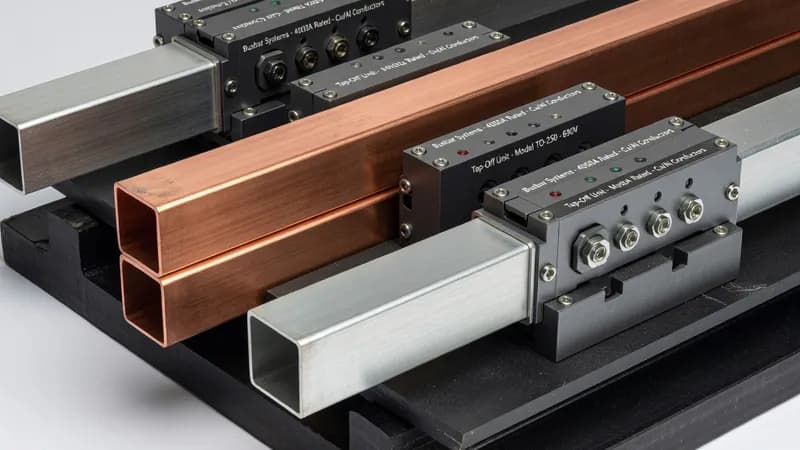
Busbar Systems are the primary current-carrying architecture in IEC 61439 low-voltage switchgear and controlgear assemblies, distributing power from incomer devices to feeder circuits with high electrical and mechanical robustness. In panel applications, they are typically fabricated from electrolytic copper or aluminum and may be supplied as flat bars, stacked bars, or prefabricated busbar trunks with insulation covers, heat-shrink sleeves, and phase separation barriers. Copper remains the preferred material for compact ACB and MCCB sections, while aluminum is often selected where weight and cost optimization are important, provided jointing and surface treatment are engineered correctly to control contact resistance and oxidation. For main distribution boards, power control centers, and motor control centers, busbar design is governed by IEC 61439-1 and IEC 61439-2, with temperature-rise performance, dielectric clearances, creepage distances, and short-circuit withstand verified by design rules or testing. Typical continuous ratings range from 400 A in compact lighting distribution boards to 6300 A or higher in large MDB and PCC assemblies, with prospective short-circuit withstand levels commonly specified at 50 kA, 65 kA, 80 kA, or 100 kA for 1 s, depending on system studies and utility fault levels. In motor control centers and soft starter panels, busbars must also coordinate with motor protection devices, contactors, overload relays, VFD input sections, and line reactors, where harmonic loading and high-frequency currents can affect thermal behavior. Busbar support systems are critical to maintaining creepage, clearance, and mechanical rigidity under fault conditions. High-strength insulating supports from product families such as Schneider PrismaSeT, ABB MNS, Siemens SIVACON, and Eaton xEnergy are commonly used, along with copper bar systems from nVent ERIFLEX, Rittal RiLine, and Legrand XL3 platforms. In busbar trunking systems and rising mains, IEC 61439-6 applies, and tap-off units are used to connect MCCBs, switch-disconnectors, fused switches, or metered outgoing ways without de-energizing the entire distribution path. This makes busbar systems ideal for data centers, commercial buildings, hospitals, utility substations, industrial plants, and multi-tenant facilities. Internal separation is a major selection criterion. Forms of separation from Form 1 to Form 4b define the degree of segregation between busbars, functional units, and terminals, affecting maintainability, safety, and service continuity. Higher forms are often specified in process industries, critical infrastructure, and high-availability PCC/MCC lineups where selective maintenance is required. Busbar chambers in capacitor bank panels must additionally tolerate capacitor inrush and harmonic currents, while DC distribution panels require attention to polarity marking, arc suppression, and suitable insulation coordination. For special environments, busbar systems may need enhanced protection under IEC 60079 for hazardous areas or verification against internal arc effects per IEC 61641 in arc-resistant assemblies. Proper busbar joint torque, silver or tin plating, thermal cycling validation, and infrared inspection access are essential in long-life installations. Patrion engineers busbar systems for custom-engineered panels, integrating ACB incomers, MCCB feeders, VFDs, soft starters, protection relays, metering devices, and energy management requirements into a compliant IEC 61439 assembly suited to the project’s fault level, load profile, and maintainability targets.
Panels Using This Component
Primary power distribution from transformer to sub-circuits. Rated up to 6300A. Houses main incoming breaker, bus-section, and outgoing feeders.
High-capacity power distribution for industrial facilities. Controls and distributes incoming power to MCC, APFC, and downstream loads.
Centralized motor control with starters, contactors, overloads, and VFDs in standardized withdrawable/fixed functional units.
Enclosed VFD assemblies with input protection, line reactors, EMC filters, output reactors, and bypass options.
Energy metering, power quality analysis, and multi-circuit monitoring with communication gateways.
Final distribution for lighting and small power. MCB/RCBO-based with DALI or KNX integration options.
Prefabricated busbar distribution per IEC 61439-6. Sandwich or air-insulated, aluminum or copper.
Bespoke panel assemblies for non-standard requirements — special ratings, unusual form factors, multi-function combinations.
Enclosed soft starter assemblies for reduced voltage motor starting with torque control, ramp-up/down profiles, and bypass contactor options.
DC power distribution for battery systems, solar installations, telecom, and UPS applications. MCCB/fuse-based DC protection.
Fixed or automatic capacitor bank assemblies for bulk reactive power compensation in industrial and utility applications.
Related Knowledge Articles
Comprehensive guide to busbar sizing, material selection, and installation.
Technical comparison for busbar material selection.
Understanding and verifying short-circuit ratings.
Complete guide to forms of separation in panel assemblies.
Frequently Asked Questions
Ready to Engineer Your Next Panel?
Our team of electrical engineers is ready to design, build, and deliver your custom panel solution — fully compliant with international standards.