Design Verification: Testing, Calculation & Design Rules
The three methods for proving IEC 61439 compliance.
Design Verification: Testing, Calculation & Design Rules
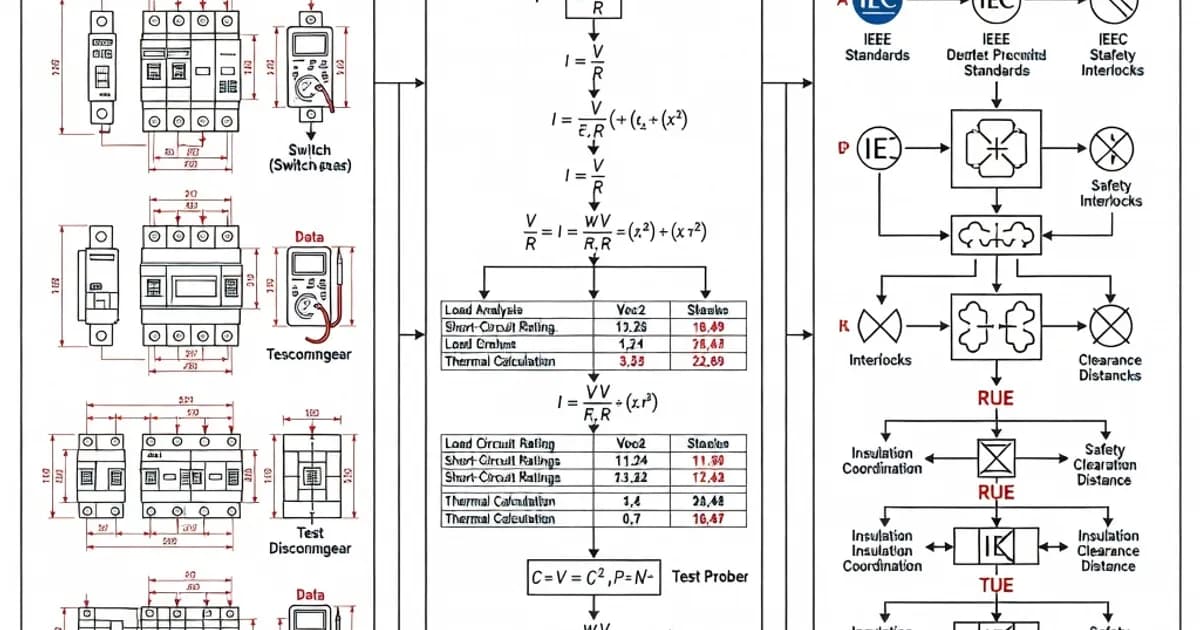
IEC 61439 changed the way low-voltage switchgear and controlgear assemblies are proven safe and fit for service. Instead of relying on the older partial type test approach used under IEC 60439, the current standard requires design verification against a defined set of characteristics for every assembly design. As described in IEC 61439-1 Clause 10 and Annex D, the original manufacturer must verify the design by one or more of three equivalent methods: testing, comparison with a verified reference design (also called derivation), or assessment using calculation and design rules.
This framework matters because a panel assembly is not a single device. It is a system of busbars, enclosures, terminals, protective bonding, switching devices, internal wiring, and ventilation arrangements. IEC 61439 requires evidence that the complete assembly can withstand thermal stress, fault currents, dielectric stress, and mechanical demands under declared operating conditions. In practice, the best verification strategy combines methods: test the most demanding representative design, derive family variants where the standard allows it, and calculate temperature rise or short-circuit performance where the standard provides accepted rules.
What design verification proves
Per IEC 61439-1, design verification confirms that the assembly design meets the declared ratings and service conditions for the intended application. The standard groups the required checks into 13 characteristics listed in Annex D Table D.1, including strength of materials, degree of protection, clearances and creepage distances, temperature rise, and short-circuit withstand strength. The manufacturer is responsible for choosing the verification method for each characteristic, but the method must be valid for the specific design and the declared performance.
That distinction is important: design verification validates the design concept, while routine verification validates each individual manufactured assembly before delivery. IEC 61439-1 Clause 11 makes routine verification mandatory for every panel and typically includes wiring checks, functional checks, and insulation/continuity checks where applicable.
Why IEC 61439 design verification replaced older practice
IEC 60439 allowed partial type testing and left more room for interpretation. IEC 61439 introduced a clearer and more rigorous verification structure. Instead of assuming that a device or enclosure is compliant because it resembles another one, the standard requires evidence for each relevant design aspect. This is especially valuable for modular, custom-built assemblies where ratings vary widely from project to project. The result is a more defensible technical file, better comparability between manufacturers, and clearer responsibilities for the original manufacturer and any subsequent panel builder.
As documented in Siemens’ design verification guidance and BEAMA’s verification guide, the standard allows compliant families of assemblies to be created efficiently, but only within the boundaries of the verified reference design and the standard’s derivation rules.
Overview of IEC 61439 Design Verification Methods
IEC 61439-1 provides three equivalent design verification methods:
- Testing – direct verification by type test or equivalent test on the assembly or a representative sample.
- Comparison with a reference design – also called derivation; a new design is shown to be equivalent to a previously verified design under defined constraints.
- Assessment – verification by calculation, measurement, or design rules accepted by the standard.
These methods are not mutually exclusive. In fact, most professional panel builders use a combined approach. For example, a base design may be tested for temperature rise and short-circuit strength, while other variants in the same product family are verified by derivation if they remain within the same thermal, mechanical, and construction envelope. BEAMA and Siemens both emphasize that this approach reduces cost and development time without lowering safety, provided that the design assumptions are preserved.
Annex D Table D.1 is central to the process. It defines the verification requirements for the key characteristics and identifies the acceptable method(s) for each characteristic. The original manufacturer must document the chosen method, the evidence, and the conclusions for the technical construction file.
The 13 characteristics to verify
| IEC 61439-1 characteristic | Clause | Typical verification method | Technical note |
|---|---|---|---|
| Strength of materials and parts | 10.2 | Test or assessment | Includes thermal stability and resistance to normal service conditions |
| Degree of protection | 10.3 | Test | IP rating tested in accordance with IEC 60529 |
| Clearances and creepage distances | 10.4 | Measurement or calculation | Must suit rated impulse voltage, pollution degree, and material group |
| Protective bonding circuit | 10.5 | Test or measurement | Verifies continuity and integrity of protective circuits |
| Incorporation of switching devices and components | 10.6 | Test or assessment | Checks mounting, thermal effects, and suitability of devices |
| Internal electrical circuits and connections | 10.7 | Test or assessment | Considers conductor sizing, routing, and connection methods |
| Terminals for external conductors | 10.8 | Test | Must withstand mechanical and thermal stresses from field wiring |
| Dielectric properties | 10.9 | Test and design rules | Impulse and power-frequency withstand where applicable |
| Temperature rise | 10.10 | Test, derivation, or calculation | Often the most design-critical check; IEC 60890 may be used for calculation |
| Short-circuit withstand strength | 10.11 | Test, comparison, or calculation | Considers electrodynamic and thermal withstand under fault conditions |
| Electromagnetic compatibility | 10.12 | Assessment | Verified against relevant EMC standards and intended environment |
| Mechanical function | 10.13 | Test | Ensures moving parts and mechanisms operate correctly |
| Mechanical strength of enclosure and components | 10.2 and related clauses | Test or assessment | Includes impact resistance and thermal effects on materials |
Although the table lists the major verification topics, the actual technical file should show how each characteristic was addressed for the specific design. For custom assemblies, a single method rarely covers everything. The strongest compliance evidence usually comes from a matrix that maps each characteristic to the supporting test report, calculation, or design-rule justification.
How the verification methods are applied in practice
Testing
Testing is the most direct verification method and is often the preferred route for the most critical characteristics. It provides high confidence because it demonstrates performance on a physical sample under controlled conditions. In IEC 61439 practice, test-based verification is especially important for degree of protection, terminal strength, mechanical function, and short-circuit withstand performance when the assembly is expected to carry high fault currents or uses a novel configuration.
Testing is typically the most expensive and time-consuming option. However, it is also the strongest foundation for a product family because a successfully tested reference design can support derivation for closely related variants. Siemens’ guidance explicitly uses the tested reference design as the basis for family expansion where geometry, thermal losses, and construction remain within the verified envelope.
Comparison with a reference design
Derivation is the process of showing that a new assembly is sufficiently similar to a verified design. IEC 61439 allows this only where the differences do not invalidate the original proof. This method is particularly valuable in modular product lines with repeated cubicles, standardized busbar arrangements, and stable device platforms.
As summarized in BEAMA’s guide and Siemens’ verification documentation, derivation is acceptable only if critical parameters remain equivalent or more favorable than the tested design. These parameters include enclosure dimensions, airflow and cooling path, breaker family, installed power loss, separation form, conductor arrangement, and the protective bonding concept. For temperature rise, the standard places clear boundaries on when derivation may be used. For example, the common industry interpretation allows certain single-compartment assemblies up to 630 A to be assessed by calculation, while multiple-compartment assemblies up to 1600 A may be derived from a tested reference if the defined criteria match.
Assessment by calculation and design rules
Assessment relies on accepted engineering rules, calculations, and measured data. This is especially common for temperature rise, where IEC 60890 provides a recognized calculation method. Manufacturers such as ABB and Eaton supply heat dissipation data for their devices so that panel builders can calculate the expected temperature profile of the assembled enclosure.
Calculation is not a shortcut. It must be based on credible device loss data, conservative assumptions, and compliant thermal design rules. The objective is to ensure that conductors, terminals, busbars, and mounted devices remain within the temperature-rise limits of IEC 61439 under declared load. For terminals, the standard commonly uses a limit of 70 K temperature rise for accessible terminals, subject to material and installation conditions. The panel builder must also account for ambient temperature, enclosure size, ventilation, internal segregation, and diversity of load.
Temperature rise: the most critical verification topic
Temperature rise verification under Clause 10.10 is often the most demanding part of IEC 61439 compliance. Excessive temperature accelerates insulation ageing, reduces component life, and can create safety hazards. Because thermal performance depends on the interaction of many variables, the standard permits testing, derivation, and calculation, but each route must be technically justified.
For lower-current assemblies, thermal calculation using IEC 60890 is widely used. For higher-current assemblies or designs with unusual thermal behavior, testing is often the most robust approach. The key input data include:
- Power dissipation of installed devices, usually from the manufacturer’s datasheet.
- Busbar and conductor cross-section.
- Enclosure dimensions and material.
- Ventilation openings and internal separation.
- Ambient temperature and installation context.
- Spare capacity and future loading assumptions.
ABB’s design workbook and Eaton’s device documentation show how manufacturers support this process by providing dissipation values and verification checklists. In practical engineering terms, temperature rise is not just a compliance check; it is a design driver. A panel that barely meets the limit at 40°C ambient may fail when installed in a hot plant room unless the builder has added sufficient margin.
Best practice for thermal verification
The most efficient approach is to test the worst-case thermal variant in a family of assemblies and then derive lower-loss variants. That strategy is widely recommended in industry guidance because one thermal type test can support many configurations. It is, however, essential that the derived variants stay within the same thermal class: same cooling principle, similar layout, comparable device losses, and no hidden hotspot changes caused by re-routing conductors or adding restrictive barriers.
When calculations are used, the technical file should record the calculation method, assumptions, source loss data, and comparison against allowable temperature-rise limits. This documentation becomes particularly important during third-party review or customer audits.
Short-circuit withstand strength and mechanical robustness
Short-circuit verification under Clause 10.11 demonstrates that the assembly can withstand the thermal and mechanical forces generated by fault currents. This is not only a question of conductor heating. High fault currents create significant electrodynamic forces that can deform busbars, loosen supports, and damage enclosures if the mechanical design is inadequate.
There are three common ways to verify short-circuit withstand:
- Testing on the assembly or a representative arrangement.
- Comparison with a verified design with equivalent fault-path geometry and support spacing.
- Calculation of forces and structural strength where the standard allows it.
For custom panels, testing remains the most persuasive evidence, especially at high prospective fault levels. Calculation can support the design, but only if the support spacing, busbar material, conductor arrangement, and enclosure stiffness are fully understood. For many panel builders, the best practice is to use tested busbar systems and tested device combinations, then preserve the verified clearances and support structures in all derived designs.
Mechanical strength also ties back to Clause 10.2, because the enclosure must retain integrity under service conditions, transport, and installation. Materials must not become brittle, warp, or lose insulating properties under thermal stress. This is one reason manufacturer-provided system hardware and enclosure ranges are often easier to verify than fully custom fabricated constructions.
Comparison of verification methods
| Method | Strengths | Limitations | Best used for |
|---|---|---|---|
| Testing | Highest confidence; direct evidence; strong for audits and certification | Costly; time-consuming; may require specialized labs | Temperature rise, IP degree, short-circuit, mechanical function |
| Comparison / derivation | Efficient for product families; leverages previous tests | Only valid within strict similarity limits; requires disciplined configuration control | Family variants, modular assemblies, standardized cubicles |
| Assessment / calculation | Fast and economical; supports early design decisions | Depends on accurate input data and conservative assumptions | Temperature rise, clearances, selected short-circuit evaluations |
In practice, no single method is universally best. The most defensible approach is to use the method that the standard supports most strongly for the characteristic in question, then supplement it with supporting evidence. That is why the verification dossier should include calculations, test reports, device datasheets, photographs, and configuration records.
Supporting standards used with IEC 61439
IEC 61439 does not exist in isolation. Several related standards support the verification process and provide the technical basis for specific checks:
- IEC 60529 for IP degree of protection.
- IEC 60890 for temperature-rise calculations in low-voltage assemblies.
- IEC 60947 for incorporated low-voltage switching and control devices.
- IEC 62271 where high-voltage concepts or references are relevant to the broader substation context.
- National adoptions such as BS EN IEC 61439-2 for country-specific harmonized use.
These standards matter because many verification failures are actually integration failures. A device may be fully compliant as a standalone product under IEC 60947, yet still be unsuitable in a specific assembly if its dissipation, terminal arrangement, or installation orientation is not compatible with the enclosure design.
Documentation and compliance strategy
A well-prepared verification package should clearly show how the assembly was validated. For each declared characteristic, the technical file should identify:
- The standard clause used.
- The verification method selected.
- The test report, calculation sheet, or reference design used.
- The exact configuration verified.
- Any constraints or limits on derivation.
- The conclusion and responsible sign-off.
Manufacturers such as Siemens, ABB, and Eaton publish design tools, loss data, and verification checklists specifically to support this documentation process. These resources are valuable because they reduce ambiguity and help the panel builder align the project file with the actual tested or calculated configuration.
For organizations building multiple variants, a controlled library of verified subassemblies is the most efficient strategy. Each library item should have a clear status: tested, derived, or calculated. When a new project is engineered, the builder can assemble a compliant panel from already verified building blocks rather than starting from scratch.
Common mistakes and how to avoid them
- Assuming similarity without proof - derivation requires strict equivalence in the factors that affect the verified characteristic.
- Using incomplete device data - thermal and short-circuit verification depend on accurate manufacturer information.
- Ignoring ambient temperature - a design verified at one ambient condition may not remain valid in a hotter installation.
- Changing cable
Related Standards
Frequently Asked Questions
Ready to Engineer Your Next Panel?
Our team of electrical engineers is ready to design, build, and deliver your custom panel solution — fully compliant with international standards.