IEC 61439-2 (PSC)
Power switchgear and controlgear assemblies — main compliance standard
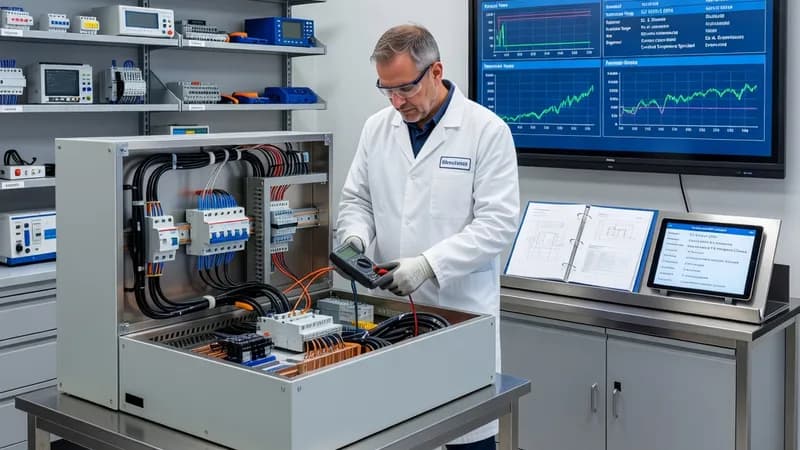
IEC 61439-2 is the core product standard for low-voltage power switchgear and controlgear assemblies (PSC) used in general industrial and commercial power distribution. It applies to assembled systems such as main distribution boards, power control centers, motor control centers, generator synchronization panels, automatic transfer switches, capacitor bank panels, harmonic filter panels, and other custom-engineered assemblies with busbar systems, feeders, and functional units. In practice, it governs how a panel builder demonstrates that an assembly can safely carry its declared rated current, withstand the specified prospective short-circuit current, and maintain thermal stability under real operating conditions. The standard works in conjunction with IEC 61439-1 (general rules) and establishes the product-specific requirements for assemblies intended for power distribution, unlike IEC 61439-3 for distribution boards intended for operation by ordinary persons. Design verification is the central compliance pathway and replaced the older IEC 60439 approach. Verification can be performed by testing, comparison with a reference design, or assessment by calculation/design rules, depending on the characteristic being verified. Key items include temperature-rise performance, dielectric withstand, short-circuit withstand, clearances and creepage distances, protective circuits, mechanical operation, and the effectiveness of enclosure protection to the declared IP degree. For real-world applications, IEC 61439-2 is critical where assemblies integrate ACBs, MCCBs, contactors, overload relays, protection relays, VFDs, soft starters, metering devices, PLC interfaces, and power-factor correction equipment. Typical rated currents range from 160 A in compact feeder sections to 6300 A or higher in large main switchboards, with short-circuit ratings commonly specified from 25 kA up to 100 kA or more depending on system study results and upstream source strength. The standard also supports form of separation requirements, such as Forms 1 through 4, helping panel designers isolate busbars, functional units, and terminals to improve maintainability, fault containment, and service continuity. Compliance is especially important for industrial manufacturing plants, data centers, hospitals, oil and gas facilities, water and wastewater plants, mining operations, marine and offshore installations, renewable-energy balance-of-plant systems, and infrastructure utilities. In these sectors, panel assemblies often include high-availability architectures, bus couplers, redundant incomers, generator control, and load shedding logic. Where hazardous areas are involved, IEC 61439-2 may be applied alongside IEC 60079 requirements for explosive atmospheres, while arc fault risk mitigation can be considered with IEC/TR 61641 guidance for internal arc testing. Electrical components inside the assembly must also meet relevant IEC 60947 product standards, such as IEC 60947-2 for circuit breakers and IEC 60947-4-1 for motor starters. For EPC contractors, consultants, and panel builders, the practical value of IEC 61439-2 is repeatable, documented compliance: a verified assembly that matches its schematic, environmental conditions, rated diversity, and installation method. At Patrion, IEC 61439-2-compliant assemblies are engineered for project-specific requirements, from power control centers and MCCs to custom panels for VFDs, soft starters, and automatic transfer schemes, with complete technical documentation and test evidence aligned to international procurement expectations.
Panels Certified to This Standard
Primary power distribution from transformer to sub-circuits. Rated up to 6300A. Houses main incoming breaker, bus-section, and outgoing feeders.
High-capacity power distribution for industrial facilities. Controls and distributes incoming power to MCC, APFC, and downstream loads.
Centralized motor control with starters, contactors, overloads, and VFDs in standardized withdrawable/fixed functional units.
Automatic capacitor switching for reactive power compensation. Thyristor or contactor-switched, detuned or standard configurations.
Automatic changeover between mains and generator/UPS. Open or closed transition, with or without bypass.
Enclosed VFD assemblies with input protection, line reactors, EMC filters, output reactors, and bypass options.
Genset start/stop sequencing, synchronization, load sharing, and paralleling controls.
Energy metering, power quality analysis, and multi-circuit monitoring with communication gateways.
Process and machine control panels housing PLCs, I/O modules, relays, HMIs, and communication infrastructure.
Bespoke panel assemblies for non-standard requirements — special ratings, unusual form factors, multi-function combinations.
Enclosed soft starter assemblies for reduced voltage motor starting with torque control, ramp-up/down profiles, and bypass contactor options.
Active or passive harmonic filtering to mitigate THD from non-linear loads. Tuned LC filters, active filters, or hybrid configurations.
DC power distribution for battery systems, solar installations, telecom, and UPS applications. MCCB/fuse-based DC protection.
Fixed or automatic capacitor bank assemblies for bulk reactive power compensation in industrial and utility applications.
Related Industries
MDB, lighting distribution, APFC, ATS, metering, BTS, capacitor bank, BMS integration
MCC, PCC, VFD panels, MDB, APFC, automation panels, soft starters, harmonic filters, capacitor banks — full range
High-reliability MDB, PCC, ATS (STS), metering, APFC, BTS, DC distribution
ATS (critical power), MDB, generator control, lighting, metering, APFC
Ex-rated panels, MCC, PCC, VFD, generator control, soft starters, ATEX/IECEx compliance
MCC, VFD panels, PLC automation, APFC, generator control, soft starters
Rugged MCC, PCC, VFD panels, generator panels, soft starters, harmonic filters
MDB, metering, APFC, ATS, PLC, DC distribution, capacitor banks
Marine-certified panels, MCC, generator sync, ATS, PLC, classification society compliance
MDB, ATS, metering, BTS, lighting distribution, DC distribution
Washdown-rated panels (IP65+), MCC, VFD, APFC, PLC, soft starters, harmonic filters
Cleanroom-compatible panels, MCC, VFD, APFC, PLC, soft starters, harmonic filters
Related Knowledge Articles
Comprehensive overview of all IEC 61439 parts, their scope, and how they apply to different panel types.
The three methods for proving IEC 61439 compliance.
Practical checklist for achieving IEC 61439 compliance.
Frequently Asked Questions
Ready to Engineer Your Next Panel?
Our team of electrical engineers is ready to design, build, and deliver your custom panel solution — fully compliant with international standards.