Hazardous Area Panel Requirements (ATEX/IECEx)
Designing panels for explosive atmosphere compliance.
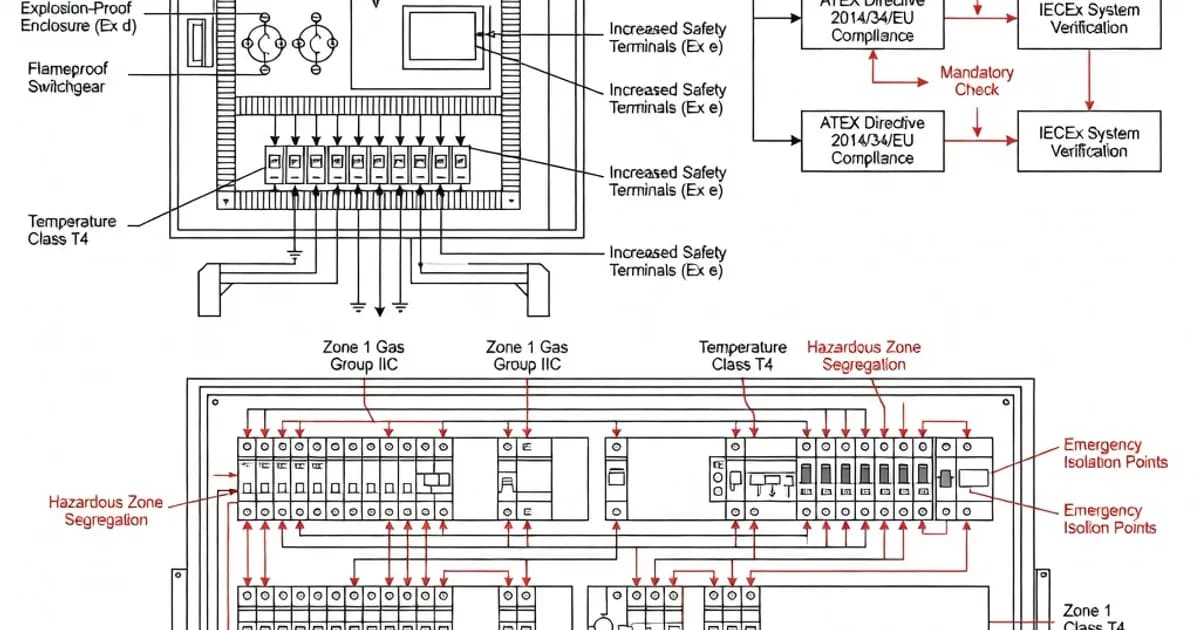
Hazardous Area Panel Requirements (ATEX/IECEx)
Hazardous area panels are low-voltage electrical assemblies installed where explosive gas or dust atmospheres may be present. Unlike standard industrial switchboards, these panels must satisfy both the construction and verification rules of IEC 61439 and the explosion-protection requirements of the IEC 60079 series. In practice, that means the panel must be designed as a compliant low-voltage assembly and also certified, marked, and installed so it cannot become an ignition source in the declared hazardous zone.
For most projects, the governing framework is twofold. In the European Union, equipment is placed on the market under ATEX Directive 2014/34/EU. Internationally, the IECEx scheme provides the certification pathway. Both systems are built on the same technical standards, especially IEC/EN 60079-0 for general requirements and IEC 60079-14 for installation, while the low-voltage assembly itself is governed by IEC 61439-1 and IEC 61439-2. As documented in the CML hazardous area guide, the practical design decision is not whether to use IEC 61439 or IEC 60079, but how to apply both correctly to the same enclosure and internal devices.[1]
Hazardous Area Classification and Equipment Protection Levels
The starting point for any hazardous area panel is the area classification. IEC 60079-10-1 classifies gas atmospheres, and IEC 60079-10-2 classifies dust atmospheres. The resulting zone determines the required Equipment Protection Level, or EPL. EPLs indicate the likelihood that equipment will become an ignition source, with Ga and Da representing the highest level of protection, Gb and Db a medium level, and Gc and Dc the basic level suitable for lower-risk zones.[1]
| Zone | Presence of Flammable Gas/Vapor | Presence of Combustible Dust | ATEX Category | IECEx EPL |
|---|---|---|---|---|
| Zone 0 / 20 | Continuous or long periods | Continuous or long periods | 1 / II 1G or 1D | Ga / Da |
| Zone 1 / 21 | Likely in normal operation | Likely in normal operation | 2 / II 2G or 2D | Gb / Db |
| Zone 2 / 22 | Unlikely and short duration | Unlikely and short duration | 3 / II 3G or 3D | Gc / Dc |
This zoning matters because panel construction choices change with the risk level. A panel intended for Zone 1 gas service must usually achieve EPL Gb, while a dust panel for Zone 21 must achieve EPL Db. If the zone is misclassified or the EPL is too low, the enclosure may be legally unsuitable even if it passes ordinary electrical tests. Process Sensing and other industry guides consistently emphasize that zone, category, and EPL must match exactly, not approximately.[2]
How ATEX and IECEx Relate to IEC 61439
IEC 61439 defines the performance and verification requirements for low-voltage switchgear and controlgear assemblies. In a hazardous area, however, IEC 61439 is only the starting point. The panel must also comply with the relevant IEC 60079 protection concept used to prevent ignition. That is why a hazardous area panel often contains IEC 60947-compliant devices inside an enclosure that is certified under a protection type such as flameproof, increased safety, dust-tight, or pressurized construction.
IEC 61439-1 requires verification of critical assembly characteristics, including temperature rise, dielectric properties, protective circuit integrity, and resistance to external influences. Clause 10.9 addresses protection against external influences and supports the use of an appropriate IP rating per IEC 60529. Clause 10.10 covers temperature-rise verification, which is especially important in hazardous areas because excessive internal temperature can create an ignition risk or exceed the permitted surface temperature class. Clause 10.11 addresses protection against electric shock and the integrity of the assembly’s protective measures. In hazardous area service, these requirements must be met without compromising the selected Ex protection concept.[3]
IECEx and ATEX use the same underlying technical basis, but they differ in certification pathway and market application. ATEX is mandatory for equipment placed on the EU market, while IECEx is an internationally recognized certification scheme frequently used for global projects, offshore installations, and multinational procurement. The technical documentation may therefore be identical or nearly identical, but the certificate, marking, and conformity assessment route differ. Hexlon and other industry sources note that IECEx is often preferred for cross-border projects because it reduces the need for separate technical requalification in multiple markets.[5]
Protection Concepts Used in Hazardous Area Panels
The most important design decision is the protection concept. For low-voltage panels, the most common approaches are flameproof, increased safety, intrinsic safety, dust protection, and pressurization. The chosen method depends on the zone, the gas or dust group, the maintenance philosophy, and the amount of access required during operation.
| Protection Type | IEC Standard | Typical Use | Suitable Zones | Key Benefit |
|---|---|---|---|---|
| db / Flameproof | IEC 60079-1 | Switching and control equipment in gas hazardous areas | Gas Zones 1 and 2 | Contains internal ignition and prevents flame transmission |
| eb / Increased Safety | IEC 60079-7 | Terminals, motors, lighting control, non-arcing components | Gas Zones 1 and 2 | Prevents arcs, sparks, and excessive temperatures under normal service |
| ia / ib / Intrinsic Safety | IEC 60079-11 | Instrumentation, signals, sensors, low-energy circuits | Gas Zones 0, 1, 2 | Limits energy to below ignition threshold |
| tb / Dust protection | IEC 60079-31 | Panels in dust atmospheres | Dust Zones 21 and 22 | Prevents dust ingress and surface ignition |
| pxb / Pressurization | IEC 60079-2 | Large control panels needing frequent access | Gas Zones 1 and 2 | Maintains protective overpressure to exclude the explosive atmosphere |
In practice, pressurization is often selected when a large control cabinet must house conventional devices that would otherwise be difficult to certify individually. Dust-tight enclosures are a common choice for Zone 21 and 22 applications because they minimize dust ingress and prevent layer formation on hot surfaces. Intrinsic safety is the preferred approach for low-power measurement and signal circuits because it allows live maintenance while sharply limiting ignition energy. As the CML guide notes, the most robust solution is not always the most complex one; rather, it is the protection concept that best fits the actual hazard and maintenance profile.[1]
Marking, Labels, and Nameplate Information
Hazardous area panels must be marked clearly and permanently according to IEC/EN 60079-0. The marking typically includes the Ex symbol, the protection concept, the EPL or category, the gas or dust group, the temperature class, and the ambient temperature range if it is restricted. The enclosure ingress protection rating is also important, especially where dust is present or washdown conditions apply.
A typical panel label may include information such as Ex eb IIC T4 Gb or Ex tb IIIC T80°C Db IP66. This tells the installer and inspector that the panel is suitable for a specific hazard group, temperature limit, and zone. For dust applications, a high ingress-protection rating is essential; IP6X is commonly expected to limit dust entry, and IP66 is often used where cleaning or outdoor exposure is part of the duty. IEC 60529 defines the IP code system, and IEC 61439-1 ties enclosure selection to environmental influences and verification requirements.[3]
Marking must be consistent with the certificate and with the actual internal configuration. If a certified enclosure is modified in a way that changes heat dissipation, clearances, component grouping, or protection concept, the marking may no longer remain valid. This is a common compliance failure in custom panel building. The safe rule is simple: the nameplate must reflect the exact certified build, not a generic family name.
Design Requirements for Ex-Compliant Low-Voltage Assemblies
When integrating switchgear and controlgear into a hazardous area panel, the designer must control several technical variables at once: heat, arcs, clearances, pollution, impact resistance, and cable entry. IEC 61439 verification does not disappear because the enclosure is Ex-rated. Instead, the assembly must satisfy both sets of requirements simultaneously.
First, internal temperature rise must be controlled. Per IEC 61439-1 Clause 10.10, the assembly must be verified so that components and conductors remain within permissible thermal limits. In hazardous areas, this becomes more restrictive because the surface temperature of the enclosure or internal parts must remain below the temperature class assigned to the atmosphere. For common gas hazards, T4 is often targeted because it limits maximum surface temperature to 135°C. Where the gas is more severe, T5 or T6 may be necessary.
Second, the enclosure must withstand external influences. IEC 61439-1 Clause 10.9 and IEC 60529 support the need for appropriate IP ratings. For dust environments, IP66 or similar is often used, but the exact rating must align with the protection concept and installation location. In harsh offshore or chemical environments, designers frequently pair Ex protection with corrosion-resistant materials, stainless hardware, and suitable gasket systems.
Third, clearances and creepage distances must be preserved. IEC 61439 verification expects the assembly to maintain electrical insulation integrity under rated conditions. Inside an Ex enclosure, poor conductor routing or compressed cable bundles can undermine both electrical performance and thermal behavior. As a result, cable management is not cosmetic; it is part of compliance.
Finally, internal devices must be selected carefully. IEC 60947 devices such as circuit-breakers, contactors, and disconnectors can be used, but only if they fit the enclosure’s thermal and protection design. For instrumentation and signals, intrinsic safety often reduces the burden on the main cabinet because associated apparatus can be located in a safe area or segregated compartment.
Cable Entry, Glands, and Installation Practices
The cable entry system is one of the most critical parts of a hazardous area panel. Even a correctly certified enclosure can fail if the gland, stopper plug, or sealing arrangement is wrong. IEC 60079-14 governs installation, and it requires that all cable entries maintain the integrity of the protection concept. That means using Ex-certified glands, barrier glands where required, and suitable thread engagement and sealing methods.
For dust service, the entry must prevent dust accumulation inside the enclosure and around hot parts. For gas service, the entry must not compromise flameproof joints or pressurized integrity. Where the panel uses pressurization, the gas supply, purge logic, alarm monitoring, and depressurization interlocks must be part of the safety strategy, not an afterthought.
Maintenance practices matter as well. IEC TR 60079-19 provides guidance for repair and overhaul of Ex equipment. This is especially relevant when a panel is modified after installation. Changing a gland, adding a terminal, replacing a heater, or upgrading a PLC can all affect temperature rise and certification status. In hazardous area work, even small changes must be reviewed as engineering changes, not routine maintenance.
Comparison of ATEX and IECEx for Panel Projects
| Topic | ATEX | IECEx |
|---|---|---|
| Legal status | Mandatory for equipment placed on the EU market | Voluntary international certification scheme |
| Technical basis | EN 60079 harmonized standards | IEC 60079 standards |
| Marking | ATEX category and Ex marking required | IECEx certificate and Ex marking required |
| Acceptance | EU/EEA regulatory framework | Widely accepted in global and offshore projects |
| Best use case | European installations and supply chains | International projects, multi-country standardization |
For panel builders, the smartest strategy is often dual-market compatibility. A panel designed and documented to IEC 60079 technical rules can usually be certified for both ATEX and IECEx, provided the conformity assessment, quality system, and marking are handled correctly. This reduces engineering duplication and makes procurement easier for multinational operators.
Manufacturer Practice and Typical Product Approaches
Major manufacturers routinely combine IEC 61439 assembly practice with Ex protection concepts. Siemens, ABB, Schneider Electric, Eaton, and Rittal all offer hazardous-area enclosure or panel solutions that align with IEC 60079 protection requirements and IEC 61439 assembly principles. Typical configurations include Ex e control panels for Zone 1, dust-protected cabinets for Zone 21/22, and pressurized assemblies for more complex control functions.
Although product families vary, the engineering pattern is consistent. The enclosure is selected first, then the protection concept, then the internal apparatus, then the cable entry system, and finally the verification and marking package. The safest way to evaluate a vendor product is to request the exact certificate, the zone and EPL scope, the ambient range, the temperature class, and the approved internal configuration. Manufacturer brochures are useful, but the certificate and instructions always govern the installed state.
BSEE guidance for offshore environments reinforces this point: hazardous-area compliance is not just a box rating. It is a combination of documentation, installation, inspection, and maintenance discipline across the entire lifecycle.[3]
Common Design Mistakes to Avoid
- Using a standard IEC 61439 panel in a hazardous area without a valid Ex protection concept.
- Matching the wrong EPL to the zone, such as using Gc equipment in Zone 1.
- Ignoring dust group classification, especially conductive dusts in IIIC applications.
- Adding unapproved devices after certification and changing heat dissipation or ignition risk.
- Using non-certified glands, plugs, or cable entry hardware.
- Assuming IP rating alone equals Ex compliance.
- Overlooking ambient temperature limits and the resulting impact on surface temperature class.
These mistakes are avoidable if the project team treats the hazardous-area panel as a certified system rather than a standard panel with extra labels. The correct sequence is hazard analysis, zone classification, protection concept selection, component validation, verification, and then installation under the approved conditions.
Practical Specification Checklist
Before releasing a hazardous area panel for manufacture or installation, verify the following minimum items:
- Declared zone classification for gas and/or dust.
- Required EPL and ATEX category.
- Applicable protection concept: db, eb, ia/ib, tb, or pressurization.
- IEC 61439 assembly verification completed, including temperature rise and dielectric performance.
- IP rating suitable for the environment, typically IP66 for dust-heavy or washdown areas.
- Temperature class selected to suit the worst-case gas group.
- Certified cable glands, sealing fittings, and stopping plugs.
- Documented maintenance and modification constraints.
Related Standards
Frequently Asked Questions
ATEX and IECEx both govern equipment used in explosive atmospheres, but they are not identical. ATEX is the mandatory European regulatory framework, based on the ATEX Directive 2014/34/EU, and applies to equipment placed on the EU market. IECEx is an international certification scheme based on IEC standards such as IEC 60079, and it is widely accepted outside the EU and often used as a basis for global approvals. For hazardous area panels, ATEX focuses on conformity assessment, technical documentation, and EU declaration requirements, while IECEx emphasizes tested design, certification, and ongoing surveillance. In practice, many manufacturers design control panels to meet IEC 60079-0, IEC 60079-1, IEC 60079-7, or IEC 60079-11, then pursue both ATEX and IECEx certification. The right route depends on the installation country, zone classification, and whether the panel is Ex d, Ex e, Ex i, or another protection concept.The main IEC standards depend on the protection concept used in the panel. IEC 60079-0 sets the general requirements for equipment in explosive atmospheres, including marking, temperature classification, and routine tests. If the enclosure is flameproof, IEC 60079-1 applies; for increased safety, IEC 60079-7 applies; for intrinsic safety, IEC 60079-11 applies; and for protection by pressurization, IEC 60079-2 applies. For dust hazards, IEC 60079-31 is critical. Installation is governed by IEC 60079-14, while inspection and maintenance are covered by IEC 60079-17. For assemblies, the control panel must also align with IEC 61439 where applicable, especially regarding internal temperatures, short-circuit withstand, and component selection. A compliant hazardous area panel is not just about certified devices; the completed assembly must be evaluated as a system, including wiring, segregation, gland selection, and environmental conditions.The protection concept depends on the zone, the gas group, the ambient conditions, and the equipment function. Ex d, or flameproof, is used when ignition sources may be enclosed and any internal explosion must be contained without propagating outside the enclosure. Ex e, or increased safety, is typically used for terminals, junctions, and non-sparking components where construction limits arcs, hot spots, and mechanical faults. Ex p, or pressurization, is often selected for larger panels, analyzers, PLC cabinets, or motor control centers where maintaining a protective purge gas pressure is more practical than making every internal component intrinsically safe or flameproof. The choice must also consider zone classification such as Zone 1, Zone 2, Zone 21, or Zone 22. In many real-world panel designs, engineers combine concepts—for example, an Ex p enclosure with Ex e terminals or Ex i barriers inside. Final selection should always be based on the hazardous area classification and certificate conditions of use.The enclosure must be selected to match the protection type, gas group, dust group, ingress protection, and ambient temperature range. For example, an Ex d enclosure must withstand internal explosion pressures and maintain flamepath integrity, while an Ex e enclosure must prevent excessive temperatures, ingress, and loose connections. IP ratings are important, but IP67 alone does not make an enclosure suitable for hazardous areas. Cable glands must also be certified for the same or compatible protection concept and installed exactly as stated in the certificate and manufacturer instructions. This includes thread type, torque values, sealing washers, entry reduction rules, and earthing of metallic glands where required. For dust applications, glands must prevent dust ingress and maintain the enclosure’s IP rating. In many audits, non-certified glands, missing stopping plugs, or incorrect blanking elements are common nonconformities. Best practice is to use certified ATEX/IECEx gland systems from manufacturers such as Hawke, CMP, or Roxtec where applicable.Temperature class is one of the most important hazardous area requirements because even a small hot spot can ignite gas, vapor, or dust. For gas atmospheres, equipment is marked with a T-class such as T1 to T6, based on maximum surface temperature limits defined in IEC 60079-0. For example, T4 means the surface temperature must not exceed 135°C under worst-case operating conditions. For dust atmospheres, the marking is normally expressed as a maximum surface temperature, often with an associated dust layer assumption. The panel designer must consider internal heat dissipation from breakers, contactors, power supplies, relays, and VFDs, then verify the enclosure temperature through calculation or type testing. Ambient temperature, solar load, ventilation, purge systems, and load diversity all affect the final result. In IEC 61439-based assemblies, temperature-rise verification is also relevant, because overloads or poor ventilation can push the enclosure beyond its certified limits.Yes, but only if the overall panel protection concept supports them and the equipment is installed within the certificate conditions. PLCs, network switches, power supplies, and I/O modules are often used inside Ex p pressurized panels, where the enclosure atmosphere is maintained with clean protective gas. In Ex e panels, only limited switching and low-energy equipment may be suitable, and heat dissipation must be tightly controlled. VFDs are more challenging because they generate heat, switching harmonics, and possible ignition risks; they are commonly installed in Ex p enclosures or in safe areas with suitably protected field devices. If intrinsic safety is used, associated apparatus such as barriers or galvanic isolators from manufacturers like Pepperl+Fuchs, MTL, or Eaton may be required. The key is that each component’s certification, power dissipation, and installation conditions must be checked individually and as part of the complete panel assembly.A compliant hazardous area panel requires more than a parts list. Typical documentation includes the hazardous area classification report, design drawings, wiring schematics, bill of materials, enclosure and component certificates, cable gland certificates, temperature-rise or thermal calculation evidence, and installation instructions. For ATEX equipment, the technical file must support conformity assessment under Directive 2014/34/EU, and the final product needs correct marking and an EU Declaration of Conformity. For IECEx, the manufacturer usually needs an IECEx certificate of conformity and supporting test reports issued by an ExCB. The file should also identify all conditions of safe use, such as torque settings, sealing requirements, permitted ambient range, and maintenance intervals. Inspection records, routine test results, and serial-number traceability are often required for quality assurance. For panel builders, keeping a complete certification pack is essential because auditors and end users frequently request evidence that every enclosure entry, device, and installation detail matches the approved design.Inspection and maintenance should follow IEC 60079-17, which sets the framework for periodic inspection of electrical installations in explosive atmospheres. The inspection level may be visual, close, or detailed depending on the risk and environment. Key checks include verifying enclosure integrity, tightness of cable glands, presence of blanking elements, condition of flamepaths, earthing continuity, surface temperature concerns, and evidence of corrosion, vibration, or overheating. Any replacement component must maintain the original protection concept and certification status. For pressurized enclosures, purge pressure, alarms, and interlocks must be tested. For Ex i circuits, barriers, segregation, and loop parameters should be confirmed. Maintenance personnel should also verify that no unauthorized modifications have been made, because even small changes can invalidate ATEX or IECEx compliance. A good maintenance program includes periodic thermal checks, torque rechecks where permitted, and documented inspection intervals aligned with site hazardous area procedures.
Ready to Engineer Your Next Panel?
Our team of electrical engineers is ready to design, build, and deliver your custom panel solution — fully compliant with international standards.