MCC Panels

ATEX / IECEx Certification

Explosive atmosphere compliance for hazardous areas
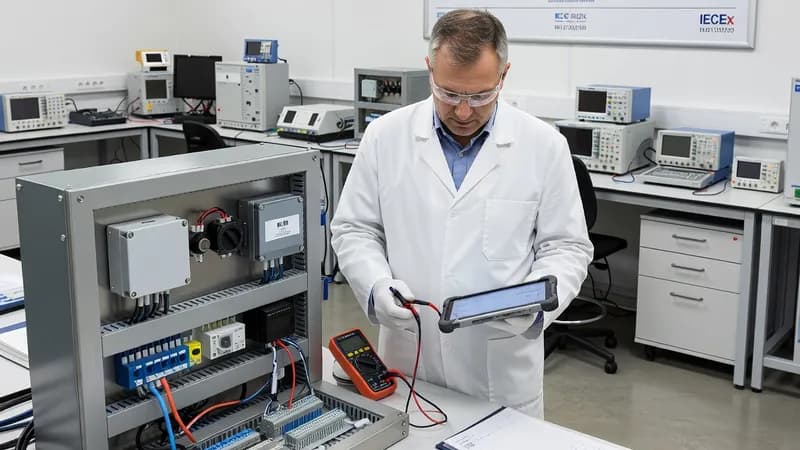
ATEX / IECEx Certification

ATEX / IECEx Certification is the compliance framework that governs electrical equipment and panel assemblies intended for explosive atmospheres where flammable gas, vapour, mist, or combustible dust may be present. For low-voltage switchboards and control panels, compliance is not limited to the certification of individual devices; the complete assembly must be engineered for the declared hazardous-area classification, temperature class, protection concept, and installation environment. ATEX applies under Directive 2014/34/EU for equipment placed on the European market, while IECEx provides a globally recognized certification scheme built on the IEC 60079 series. For EPC contractors, panel builders, and end users, the decisive factors are zone designation, gas group or dust group, maximum surface temperature, and traceable technical documentation. In practice, ATEX / IECEx panel solutions may include motor-control-center sections, VFD panels, PLC automation panels, soft starter panels, and custom-engineered control panels built around Ex p pressurization, Ex d flameproof enclosures, Ex e increased-safety terminals, Ex i intrinsically safe circuits, or hybrid arrangements. A VFD panel for a Zone 2 gas area may use a purged and pressurized enclosure with pressure monitoring, automatic shutdown logic, and pre-purge timing, while a hazardous-area MCC may incorporate Ex-certified contactors, motor protection devices, isolators, overload relays, and terminal systems arranged to preserve the selected protection method. For dust hazards in food and beverage, pharmaceuticals, mining, and bulk solids handling, ingress protection, dust-layer temperature rise, cable gland selection, and enclosure surface cleanliness become critical design parameters. Where the assembly falls within the scope of IEC 61439, the panel must still satisfy the general rules of IEC 61439-1 and the relevant product-specific part such as IEC 61439-2 for power switchgear and controlgear assemblies. Depending on application, IEC 61439-3 and IEC 61439-6 may also apply to distribution and busbar-based assemblies. Component selection typically includes ACBs, MCCBs, contactors, motor starters, protection relays, VFDs, soft starters, PLC I/O, power supplies, and monitoring devices, but only when they are suitable for the stated Ex concept and ambient conditions. Rated currents can range from compact 16 A control sections to MCC assemblies exceeding 3200 A, and short-circuit ratings must be verified by design rules or type-tested configurations, often with Icw and Ipk values defined for the whole assembly. Certification and verification normally require temperature-rise assessment, dielectric withstand, creepage and clearance review, mechanical impact resistance, enclosure ingress protection, and function tests for purge systems, interlocks, alarms, and pressure monitoring. IEC 60079-0 covers the general requirements for explosive atmospheres, while IEC 60079-1, IEC 60079-2, IEC 60079-7, IEC 60079-11, IEC 60079-14, and IEC 60079-31 apply according to the chosen protection technique and installation practice. Where internal arc risk or fault containment is part of the specification, IEC 61641 may also be relevant. In many projects, the final deliverable must include Ex marking, equipment certificates, risk assessments, wiring schedules, layout drawings, and a complete dossier for inspection by the notified body or local authority. Real-world applications include offshore oil and gas modules, compressor stations, chemical dosing skids, solvent recovery systems, grain handling plants, sugar mills, battery rooms, pharmaceutical process areas, and mining transfer stations. Patrion, based in Turkey, engineers ATEX / IECEx-compliant panel assemblies with certified hardware, detailed technical files, and project-specific construction aligned to the area classification, utility requirements, and site acceptance criteria.

Panels Certified to This Standard

Related Industries

Related Knowledge Articles

Frequently Asked Questions

ATEX is the European legal framework under Directive 2014/34/EU, while IECEx is a global certification scheme based on the IEC 60079 series. For control panels, both systems require the assembly to match the hazardous-area classification, gas or dust group, temperature class, and protection method. ATEX is mandatory for equipment placed on the EU market, whereas IECEx is often used for international projects, especially in oil and gas, mining, and chemical processing. In practice, panel builders must ensure the full assembly—not only the components—has the correct Ex concept, documentation, and marking. IEC 60079-0, IEC 60079-2, IEC 60079-7, and IEC 60079-31 are commonly referenced depending on whether the panel is pressurized, increased safety, or dust protected.
Most low-voltage assemblies can be engineered for hazardous areas if the design is compatible with the chosen protection concept. Typical examples include motor-control-center panels, VFD panels, PLC automation panels, soft starter panels, and custom-engineered distribution boards. The assembly still needs to satisfy IEC 61439-1 general rules and the appropriate part, usually IEC 61439-2 for power switchgear and controlgear assemblies. In hazardous locations, the enclosure may be Ex p pressurized, Ex d flameproof, Ex e increased safety, or use a combination of methods. Component selection must be limited to devices suitable for the Ex concept, such as certified terminal blocks, relays, barriers, or certified instrumentation interfaces. Final acceptance also depends on temperature rise, creepage and clearance, short-circuit rating, and area classification.
Yes, but the design approach depends on the zone and the selected protection method. For Zone 2, a VFD panel is commonly installed inside an Ex p pressurized enclosure with purge control, pressure monitoring, and automatic shutdown or alarm logic. In Zone 1, the requirements are stricter and the enclosure concept, equipment selection, and installation documentation must be more robust. The VFD itself may not be directly suitable for the hazardous atmosphere unless the assembly uses a certified protection arrangement. Compliance is typically checked against IEC 60079-2 for pressurization and IEC 60079-0 for general requirements, with attention to heat dissipation, surface temperature, cable glands, and internal fault behavior. The final assembly must be marked for the exact zone and temperature class.
The most common protection methods for panels are Ex p pressurization, Ex d flameproof enclosure, Ex e increased safety, and Ex i intrinsic safety for control circuits and instrumentation. In some applications, these methods are combined in the same panel. Ex p is widely used for VFDs and PLC cabinets because it allows standard industrial components to be placed in a safe internal atmosphere when purge and pressure supervision are maintained. Ex d is suitable for equipment that can contain an internal explosion without propagating it outside the enclosure. Ex e is often used for terminals, wiring compartments, and less arcing devices. Ex i is used for low-energy signals from sensors and transmitters. The selection must align with IEC 60079-0 and the relevant part for each method.
Verification usually includes temperature-rise assessment, dielectric withstand testing, creepage and clearance checks, functional testing of purge or pressure systems, wiring inspection, and ingress protection verification. Depending on the enclosure and method, impact resistance and fault containment may also be assessed. For pressurized panels, IEC 60079-2 requires checks on purge timing, pressure stability, alarms, and automatic disconnection logic. For dust applications, surface temperature and dust ingress are critical and IEC 60079-31 is often relevant. If the panel is also built as an IEC 61439 assembly, short-circuit withstand, rated current performance, and internal separation compliance must be validated. The test and documentation package should support the final Ex marking and be suitable for review by the client, notified body, or site inspector.
The most frequent users are oil and gas, mining and metals, pharmaceuticals, and food and beverage, but the requirement also appears in chemical plants, solvent processing, battery rooms, grain handling, sugar production, and wastewater facilities with biogas hazards. Oil and gas projects often need pressurized MCC and VFD panels for offshore modules, compressor stations, and skids. Mining and bulk handling require dust-rated solutions with careful attention to cable entries and surface temperatures. Pharmaceutical and food plants may need dust-tight and easy-to-clean enclosures with strict documentation. In all these sectors, the selection of ACBs, MCCBs, contactors, relays, VFDs, and soft starters must match the Ex concept and the plant’s area classification documents.
Standard MCCBs and contactors can only be used if they are installed within an Ex-approved enclosure concept that keeps the hazardous atmosphere from contacting ignition-capable parts. In many cases, this means Ex p pressurization or a suitably certified compartment arrangement. The devices themselves must also be suitable for the environmental conditions, thermal load, and short-circuit duty. For example, an MCC section may use industrial-grade MCCBs and contactors inside a pressurized cabinet, but the assembly must still satisfy IEC 60079 requirements and the applicable IEC 61439 design verification. If the equipment is directly exposed to the hazardous atmosphere, then only certified Ex-rated devices may be permitted. The final decision depends on zone, gas group, dust group, and temperature class.
A compliant package usually includes the area classification, Ex marking proposal, risk assessment, electrical schematics, enclosure and layout drawings, component certificates, purge system data if applicable, wiring schedules, and a technical file showing conformity with IEC 60079 and IEC 61439. For ATEX projects, the manufacturer must also provide evidence aligned with Directive 2014/34/EU and the applicable conformity route. The dossier should identify rated voltage, rated current, short-circuit rating, ambient limits, enclosure IP rating, temperature class, and the selected protection method. In project execution, EPC contractors often request manufacturer declarations, test records, and traceability for Ex-certified parts. Clear documentation reduces inspection delays and helps support commissioning, maintenance, and future modifications.

Ready to Engineer Your Next Panel?

Our team of electrical engineers is ready to design, build, and deliver your custom panel solution — fully compliant with international standards.