IEC 61439 Compliance Checklist for Panel Builders
Practical checklist for achieving IEC 61439 compliance.
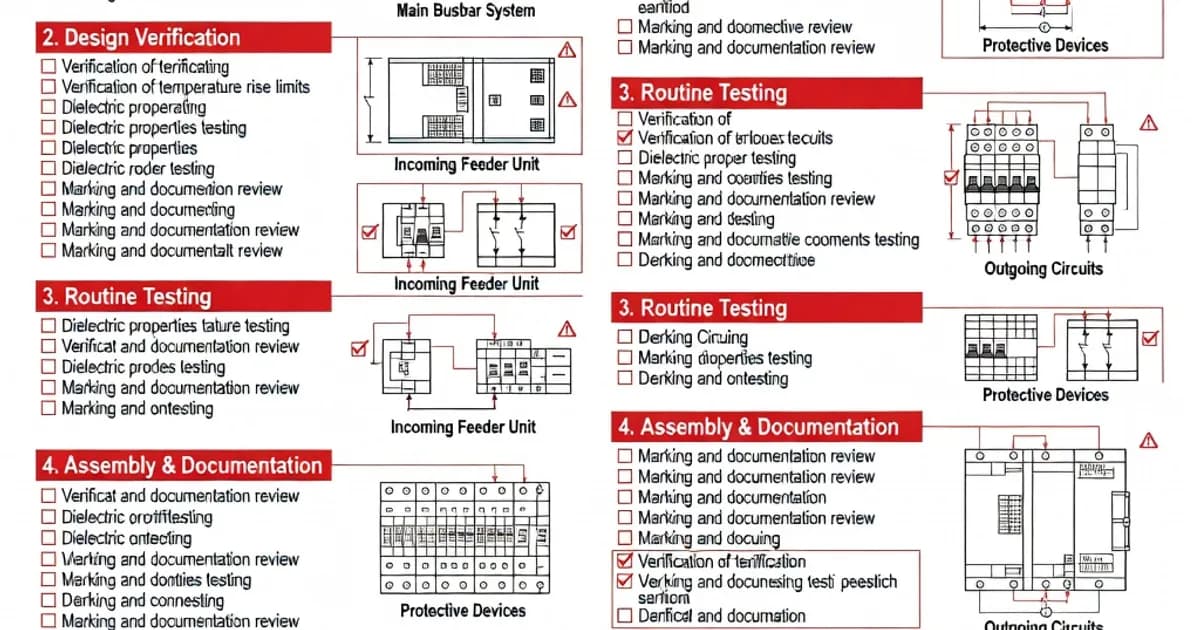
IEC 61439 Compliance Checklist for Panel Builders
IEC 61439 is the international standard series for low-voltage switchgear and controlgear assemblies, covering assemblies up to 1 kV AC and 1.5 kV DC. It replaced IEC 60439 and introduced a more rigorous, performance-based compliance model that relies on design verification and routine verification rather than assumption-based design practice. For panel builders, this means compliance is not a single test result; it is a documented process that proves the completed assembly meets the standard’s requirements for safety, performance, and durability.
In practice, IEC 61439 separates responsibilities between the original manufacturer, who defines and verifies the basic design, and the assembly manufacturer or panel builder, who completes the final assembly and performs routine verification. As explained in ABB’s practical guide and other industry references, panel builders must preserve the validity of the original design data, use compatible components, and verify the final build against the verified design configuration.
This checklist summarizes the technical requirements, the relevant verification methods, and the documentation panel builders should maintain to demonstrate compliance. It also highlights the most common failure points, because in real projects temperature rise, protection bonding, and short-circuit verification are usually the first areas where an otherwise well-built panel fails an audit or acceptance review.
1. Core IEC 61439 Compliance Requirements
Compliance with IEC 61439 depends on two layers of verification:
- Design verification, which confirms the assembly design satisfies the standard’s performance requirements.
- Routine verification, which confirms each manufactured panel matches the verified design before delivery.
Per IEC 61439-1, the design verification requirements are organized around specific characteristics such as temperature rise, short-circuit withstand, dielectric properties, and protective circuit continuity. The verification may be performed by testing, calculation, comparison with a verified reference design, or a combination of these methods. This flexibility is one of the most important differences from IEC 60439.
For panel builders, the practical implication is clear: you do not need to test every enclosure to destruction, but you do need a defensible verification trail for every applicable design characteristic.
Key verification characteristics and methods
| Verification characteristic | IEC 61439-1 clause | Typical verification method | Practical notes |
|---|---|---|---|
| Degree of protection | 8.201 | Testing to IEC 60529; inspection | Common values include IP2X for finger-safe internal barriers and IP54 for dusty or splash-prone locations. |
| Clearances and creepage distances | 8.202 | Measurement and comparison | Must suit rated impulse withstand voltage, pollution degree, and material group. |
| Protective bonding and earthing | 8.203 | Continuity measurement | Bonding paths must remain effective after final assembly, paint removal, hardware tightening, and door installation. |
| Dielectric properties | 8.204 | Power-frequency withstand test | Typically includes a routine dielectric test on the completed assembly, often at 2.5 kV AC or as specified by the design. |
| Temperature rise | 8.205 | Test, calculation, or verified comparison | One of the most common causes of non-compliance. Heat dissipation depends on enclosure size, ventilation, busbar layout, and device losses. |
| Short-circuit withstand strength | 8.206 | Testing or comparison with a verified system | Must cover rated short-time withstand current, peak withstand current, and conditional short-circuit ratings where applicable. |
| Electromagnetic compatibility | 8.207 | Comparison and application review | Usually addressed by selecting appropriate devices and layout practices in accordance with IEC 61000 series guidance. |
| Mechanical operation | 8.208 | Functional inspection and testing | Includes door operation, interlocks, withdrawable units, and moving parts. |
| Resistance to heat and fire | 8.209 | Material verification, glow-wire testing, or documented component compliance | Particularly important for polymeric enclosures, internal barriers, and cable management parts. |
As noted in the ABB workbook and supporting technical guides, panel builders should verify these characteristics in the design phase rather than trying to “inspect compliance in” at the end of the project. The standard expects the design to be proven before routine production begins.
2. Routine Verification Checklist for Every Assembly
IEC 61439-1 Clause 10 requires routine verification on every completed assembly. This is not optional. Routine verification confirms that the manufactured panel corresponds to the verified design and that workmanship has not introduced defects or performance losses.
A complete routine verification package should include the following items:
- Visual inspection of wiring, clearances, labeling, segregation, device selection, and enclosure condition.
- Protective circuit continuity check for all exposed conductive parts and bonding conductors.
- Insulation and dielectric test to confirm dielectric integrity after assembly.
- Functional test of switching devices, control circuits, interlocks, and indicators.
- Torque verification of terminals, busbar joints, and structural fasteners where specified by the manufacturer.
- Documentation review to ensure the nameplate, technical file, and declaration are complete.
Many panel builders also add thermal imaging during load testing, particularly for high-current systems and densely packed control panels. While thermal imaging is not itself the IEC routine verification requirement, it is a strong quality-control tool and can uncover loose joints, overloaded conductors, or ventilation deficiencies before shipment.
Per IEC 60364-6 and related commissioning practice, insulation resistance and earth continuity verification are also commonly performed during final acceptance, especially when the panel is part of a wider installation. These checks complement IEC 61439 routine verification and help confirm the complete installation is safe for energization.
3. Design Verification: What Panel Builders Must Prove
Design verification is the backbone of IEC 61439 compliance. The standard allows several valid methods, but the chosen method must be appropriate for the design feature being verified. In many projects, the most efficient route is comparison against a previously verified reference design provided by the original manufacturer. This is especially common when using prefabricated busbar systems, modular enclosures, and manufacturer-approved internal separation arrangements.
According to industry guidance from ABB, Unicorn Global, and CompEng, panel builders can often avoid full testing if they stay within the validated limits of the original manufacturer’s system. However, if the assembly departs from the verified configuration in a way that affects heat flow, fault withstand, protection degree, or bonding, new verification is required.
The six most critical design verification topics
- Temperature rise is usually the first major technical hurdle. Device losses, cable density, ambient temperature, and enclosure ventilation all affect compliance.
- Short-circuit withstand must match the prospective fault current at the installation point, including system earthing arrangement and protective device clearing times.
- Dielectric withstand depends on the rated insulation voltage, impulse withstand voltage, and spacing within the assembly.
- Protective circuit continuity must remain reliable across doors, gland plates, mounting plates, and removable parts.
- Degree of protection must be maintained by the final assembly, not just the enclosure shell supplied by the manufacturer.
- Mechanical strength must be sufficient to withstand handling, transport, and installed service conditions without distortion or loss of alignment.
Panel builders should treat the verified reference design as a controlled technical asset. Once a change is introduced, such as a different busbar profile, altered ventilation openings, a new device brand, or a larger conductor cross-section, the builder must reassess whether the original verification still applies.
4. Technical Limits and Practical Targets
IEC 61439 does not prescribe a single universal value for every assembly parameter. Instead, it requires the builder to prove suitability for the intended application and rating. Even so, several practical targets recur across industrial projects.
| Technical item | Typical project target | Why it matters |
|---|---|---|
| Degree of protection | IP2X to IP54 | Balances operator safety, dust ingress control, and heat dissipation. |
| Insulation / dielectric test | 2 kV to 2.5 kV AC routine test, depending on design | Confirms assembly insulation integrity after wiring and mechanical work. |
| Temperature rise | Keep terminals and accessible surfaces within permissible rises defined by the standard and device data | Prevents insulation aging, nuisance tripping, and premature component failure. |
| Short-circuit rating | Common industrial values include 25 kA, 50 kA, 65 kA, 100 kA, or higher depending on system size | Must exceed or equal the available fault level at the installation point. |
| Earthing continuity | Low-resistance bonding path verified by measurement | Ensures fault current can return safely and protective devices will operate. |
The exact acceptance values depend on the assembly type, rated current, device manufacturer documentation, and the installation environment. For example, a compact control panel in a climate-controlled room may accept a lower IP rating than a rooftop or washdown application, while a high-current motor control center requires far more careful thermal and short-circuit analysis.
5. Standards and Documents Panel Builders Should Use
IEC 61439 does not stand alone. Panel builders should work from a standards stack that includes the assembly standard, the product standards for installed devices, and the installation verification standards.
- IEC 61439-1: General rules for low-voltage switchgear and controlgear assemblies.
- IEC 61439-2: Power switchgear and controlgear assemblies.
- IEC 61439-3: Distribution boards intended to be operated by ordinary persons.
- IEC 61439-4: Assemblies for construction sites.
- IEC 61439-5: Assemblies for power distribution networks.
- IEC 61439-6: Busbar trunking systems.
- IEC 61439-7: Assemblies for specific applications such as photovoltaic installations and energy storage-related contexts, where applicable by edition and scope.
- IEC 60947 series: Low-voltage switchgear and controlgear device standards for circuit breakers, contactors, motor starters, and accessories.
- IEC 60529: IP code for enclosure protection.
- IEC 61000 series: Electromagnetic compatibility requirements.
- IEC 60364-6: Verification of electrical installations.
- IEC TR 61641: Guidance for containment of internal arc faults, where arc risk is a design concern.
Per CompEng’s summary and the educational materials linked in the Electrical Engineering Portal reference, manufacturers should also track edition changes carefully. IEC 61439-1 and -2 are now in later editions, and design documentation increasingly includes digital tools, configuration reports, and software-generated verification evidence. That evidence is acceptable only if it clearly corresponds to the actual assembly build.
6. Compliance Workflow for Panel Builders
A reliable IEC 61439 compliance process should follow a controlled workflow from quotation to handover. The strongest programs begin with design input review, then move to verification planning, production control, and final documentation.
Recommended workflow
- Define the application: rated voltage, rated current, fault level, ambient temperature, humidity, pollution degree, and IP requirement.
- Select a verified base design: enclosure, busbar system, protective devices, and internal separation scheme.
- Check design limitations: maximum current, mounting arrangement, ventilation, and permissible device combinations.
- Perform design verification: by test, calculation, or comparison with a validated reference.
- Document the build: drawings, bills of material, torque values, test forms, and declaration package.
- Carry out routine verification: every panel, every time.
- Issue the final dossier: nameplate, test report, declaration of conformity, and user instructions.
Good compliance programs also use software tools such as EPLAN, manufacturer configurators, and electrical CAD packages to reduce transcription errors and preserve traceability between the verified design and the built assembly. As documented in manufacturer support materials, configuration tools are especially useful when the assembly uses a catalogued system with predefined thermal and short-circuit data.
7. Common Mistakes That Lead to Non-Compliance
Most IEC 61439 failures come from avoidable process errors rather than exotic technical problems. The most common issues are:
- Mixing original manufacturer and panel builder responsibilities without clear documentation.
- Changing verified layouts after design approval, especially busbar geometry and ventilation.
- Ignoring temperature rise until after assembly is complete.
- Using unverified device substitutions that alter losses, dimensions, or short-circuit performance.
- Inadequate earthing and bonding due to paint, poor terminations, or missing washers.
- Failing to maintain IP protection after field wiring, door fitting, or gland plate modification.
- Incomplete documentation, especially missing routine test records and declaration data.
Industry experience consistently shows that temperature rise is the most frequent technical weak point. That is not surprising: thermal compliance is sensitive to small design changes, while routine visual inspection cannot reveal hidden overheating risk. For this reason, many builders validate thermal performance early, before finalizing the wiring layout.
8. Product Families and Manufacturer Support
Major manufacturers provide pre-verified systems, technical manuals, and configuration tools that can significantly reduce compliance effort. These systems are useful because they allow the panel builder to stay inside a known verification envelope rather than designing from first principles.
Examples cited in the research include Siemens, ABB, Schneider Electric, Eaton, and Rittal systems. Each of these vendors provides documentation that supports design verification through published performance data, application limits, and construction guidance. ABB’s workbook is particularly valuable because it includes checklists, practical examples of temperature rise verification, and guidance on conformity declarations. Siemens and other major suppliers similarly provide design manuals and configurators that help preserve compliance when assemblies are built from standardized sub-systems.
The key point is not the brand itself, but the quality of the verification evidence. A compliant assembly can use any suitable manufacturer’s components, provided the full assembly remains within the verified design assumptions and routine verification is completed correctly.
9. Compliance Checklist Summary
Use the following checklist before releasing any panel for shipment:
- Confirm the assembly falls within the scope of the correct IEC 61439 part.
- Verify rated voltage, rated current, rated short-circuit withstand, and IP requirement.
- Document the original manufacturer’s verified design data.
- Check that all component substitutions remain within allowed limits.
- Verify clearances, creepage distances, and dielectric integrity.
- Confirm protective bonding across all metal parts, doors, plates, and removable sections.
- Validate temperature rise by test, calculation, or comparison.
- Confirm short-circuit withstand rating matches the installation fault level.
- Perform all routine verification tests on the completed assembly.
Related Standards
Frequently Asked Questions
Ready to Engineer Your Next Panel?
Our team of electrical engineers is ready to design, build, and deliver your custom panel solution — fully compliant with international standards.