IP Protection Ratings for Panel Enclosures
Selecting the right IP rating for your panel installation environment.
IP Protection Ratings for Panel Enclosures
IP protection ratings are one of the most important enclosure characteristics for low-voltage switchgear and controlgear assemblies covered by IEC 61439. In simple terms, the IP code tells you how well a panel enclosure resists access by solid objects, dust, and water, and how that protection is verified under standardized test conditions. The system used is defined by IEC 60529, which IEC 61439 references for enclosure protection requirements and verification of protective measures. As documented in the ABB workbook on IEC 61439 and in the IEC 60529 framework, the rating is only valid when the enclosure is tested in its intended configuration, with covers, doors, and other protective elements in place and closed. A panel cannot be assumed to have the stated IP rating if a door is open or if accessories create unverified openings. [1][3][4]
For assemblies, the IP declaration is not just a marketing label. It is part of the design specification that must match the installation environment, including indoor or outdoor use, presence of dust or water spray, and whether the assembly is stationary or movable. IEC 61439-2 clause 3.5 links these environmental conditions to the assembly design, while IEC 61439-1 clause 10 requires verification of the declared protection level. In practice, this means the panel builder must select the enclosure, seals, gaskets, cable entry system, and ventilation strategy so the stated IP rating remains valid throughout normal service. [2][3][4]
What the IP Code Means
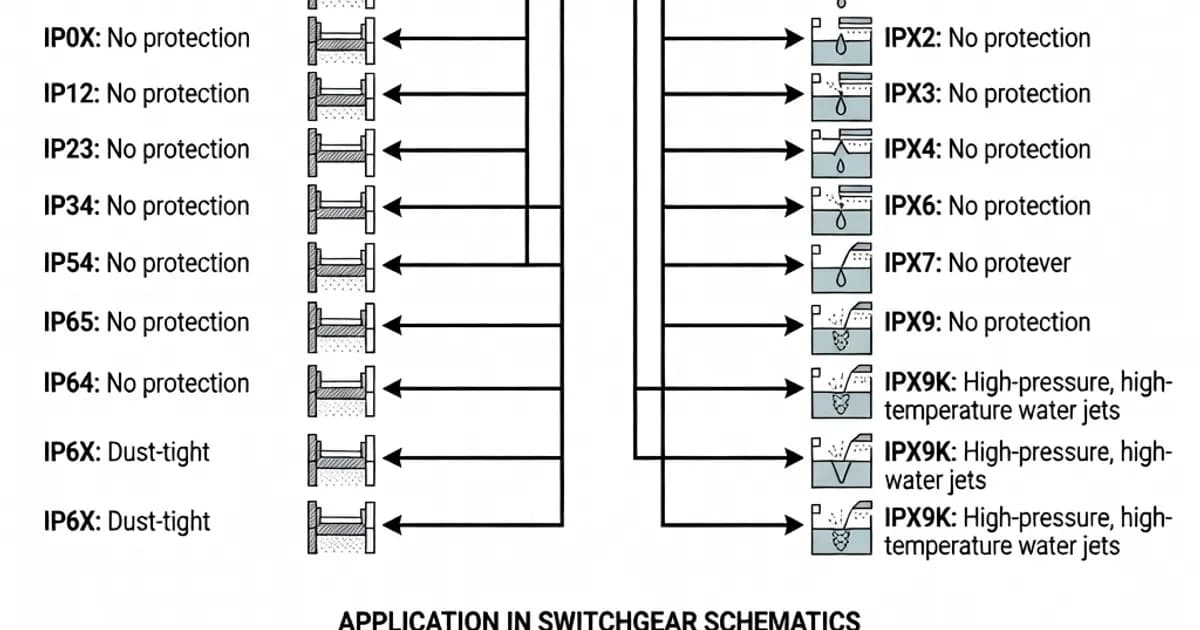
The IP code begins with the letters “IP” followed by two digits. The first digit indicates protection against ingress of solid foreign objects and access to hazardous parts, while the second digit indicates protection against harmful water ingress. IEC 60529 defines the code structure and test methods. A first digit of 4, for example, means protection against objects larger than 1 mm, while a second digit of 4 means protection against splashing water from any direction. The highest commonly used solid protection level for standard industrial enclosures is IP6X, which means dust-tight. [1][3][5]
| IP Digit | Protection Level | Practical Meaning |
|---|---|---|
| IP2X | Protection against fingers and objects larger than 12.5 mm | Basic protection for internal compartments in many indoor assemblies |
| IP4X | Protection against objects larger than 1 mm | Common for dust-limited industrial enclosures |
| IP5X | Dust-protected | Dust ingress is limited and must not impair operation |
| IP6X | Dust-tight | No ingress of dust; preferred for harsh outdoor or heavily contaminated sites |
| IPX4 | Protection against splashing water | Suitable for wet rooms and light outdoor exposure |
| IPX5 | Protection against water jets | Used where washdown or wind-driven rain may occur |
| IPX6 | Protection against powerful water jets | Appropriate for harsher outdoor and industrial environments |
| IPX7 / IPX8 | Protection against temporary or continuous immersion | Specialized applications only, not typical for standard switchboards |
IEC 61439 verification focuses on the declared condition of use, not just the enclosure shell alone. For example, a panel may be rated IP54 with the main doors closed, but only IP3X or IPXXB may apply when a door is open for maintenance, depending on the design and access barriers. This distinction is important because the standard requires verification of protection against contact with hazardous live parts, which is related to but not identical to environmental IP protection. [3][4]
IP Ratings in IEC 61439 Assemblies
IEC 61439-1 sets the general rules for low-voltage switchgear and controlgear assemblies, and IEC 61439-2 applies to power switchgear and controlgear assemblies. Together, these standards require the manufacturer of the original assembly to declare the relevant characteristics of the enclosure and to verify them through design verification. IP protection is one of the key properties that must be specified, because it directly affects safety, reliability, and thermal behavior. [1][2][4][5]
The standard does not force one universal IP level. Instead, it requires the builder to define the rating according to the installation conditions. For an indoor electrical room with controlled access and low contamination, IP20 or IP30 may be adequate. For a dusty production hall, IP54 or IP55 is often preferred. For outdoor substations, roadside kiosks, or exposed installations, IP65 or IP66 may be more appropriate. As shown in manufacturer documentation from Hager and Van Pee, the correct choice depends on both the environment and the assembly’s cooling concept. [3][6]
Another important aspect is that the IP claim must be verified for the complete assembly, not merely the empty cabinet. Busbars, wiring ducts, internal partitions, terminal covers, cable glands, ventilation elements, and door hardware can all affect ingress protection. IEC 61439 verification therefore considers the assembly as delivered, including all intended accessories and fitted components. The ABB and Modutec references both emphasize that testing and verification must reflect the actual design, because a compliant enclosure frame alone does not guarantee a compliant assembly. [1][8]
Verification, Test Conditions, and Failure Criteria
IEC 60529 defines the test methods for solids and water ingress protection. For IP tests, the assembly is assessed under controlled conditions and in the closed state unless the declared protection specifically addresses an open-door configuration. The decisive failure criteria include penetration of solid foreign bodies into protected zones and, for water tests, any water reaching live electrical equipment or otherwise impairing safe operation. IEC-based guidance notes that protection against contact with hazardous live parts and ingress of water are both critical, especially where assemblies serve in industrial or outdoor environments. [3][4][5]
In practical terms, a panel builder must ensure that seals compress properly, door latching is uniform, viewing windows are compatible with the enclosure rating, and cable entry systems preserve the same rating as the enclosure body. A strong enclosure shell with poor cable gland selection will not achieve the intended IP level. This is why complete-system verification is essential. As highlighted in the Siemens and Schneider material, higher declared IP ratings can also reduce natural ventilation, so enclosure thermal design must be validated alongside ingress protection. [2][7]
It is also important to distinguish between open-door and closed-door performance. Some manufacturers publish an “open-door” internal protection value such as IP3X or IPXXB to describe what remains protected during maintenance. This is useful for service accessibility, but it is not interchangeable with the closed-door external IP rating. In technical documentation from Hager, the closed enclosure may be rated IP44 while the accessible internal surfaces with the door open are described separately. [3]
IP, IK, and Electric Shock Protection
IP protection addresses ingress and access by foreign objects, but it does not describe resistance to mechanical impact. For that, IEC 62262 defines the IK code. The IK rating expresses the enclosure’s ability to withstand external mechanical impact energy. For example, IK10 corresponds to 20 J impact resistance, which is commonly specified for vandal-prone or exposed public installations. In many real projects, a panel needs both a suitable IP rating and a strong IK rating. [1][3][8]
Electric shock protection is related as well. In addition to the environmental IP rating, IEC 61439 uses access tests such as IPXXB to verify protection against finger access to hazardous parts. This is especially relevant for internal partitions, terminal compartments, and maintenance interfaces. A well-designed assembly therefore combines:
- an external IP rating for dust and water ingress,
- an internal accessibility rating such as IPXXB or IP2X for shock protection, and
- an IK rating for mechanical robustness where impact risk exists.
This layered approach is common in professional panel design because a safe enclosure is not defined by one characteristic alone. It must control environmental ingress, prevent dangerous access, and remain mechanically durable in the actual installation environment. [1][3][4][8]
Choosing the Right IP Rating for the Application
The correct IP level depends on the environment and operating requirements. Indoor switchboards in clean electrical rooms usually do not require the same sealing level as outdoor feeder panels or process area enclosures. The common industry practice, reflected in manufacturer guidance, is to select the rating according to contamination, washdown exposure, rainfall, condensation, and maintenance expectations. [1][3][6][7]
| Application Environment | Typical IP Rating | Design Considerations |
|---|---|---|
| Clean indoor electrical room | IP20 to IP30 | Basic protection against accidental contact; emphasis on ventilation |
| Industrial indoor area with dust | IP54 to IP55 | Sealing against dust accumulation and water spray |
| Outdoor wall-mounted panel | IP44 to IP65 | Rain, splash, and wind-driven water exposure; UV and corrosion resistance matter |
| Harsh outdoor or washdown area | IP65 to IP66 | Dust-tight construction and strong sealing of doors and cable entries |
| Public or vandal-prone location | IP54 to IP65 with IK10 | Ingress protection plus mechanical impact resistance |
Van Pee’s IEC 61439-compliant Mi distribution boards, for example, are documented with IP65 for outdoor and harsh environments, illustrating how higher sealing levels are used where dust and jetting water are expected. Schneider Electric’s outdoor enclosure documentation similarly shows that IP44 or IP4X/IPX4 may be suitable for defined outdoor conditions when the enclosure design, material, and installation method are matched to the site. [3][6]
How IP Ratings Affect Thermal Design
One of the most overlooked design issues is the connection between IP sealing and temperature rise. IEC 61439-1 clause 10.10 requires verification of temperature rise performance, and enclosure sealing directly influences heat dissipation. A higher IP rating generally reduces natural airflow, which can force a lower admissible current or require larger enclosure volume, better internal layout, or forced ventilation with filtered or compensated air exchange. [2][7]
Siemens and other manufacturers note that enclosure selection must consider the rated current, diversity factor, and ambient temperature together with the declared IP level. In a tightly sealed IP65 enclosure, the thermal margin can be significantly lower than in an IP31 or IP44 cabinet of the same size. That means an enclosure cannot be specified on IP alone; it must be balanced against the assembly’s current rating, internal losses, and operating duty cycle. [2][7]
This is especially important for assemblies with compact busbar systems, variable speed drives, or high-load distribution sections. If the design uses a high IP enclosure to protect against dust or water, the builder may need to increase cabinet size, split load centers, use heat exchangers, or reduce allowable InA to remain compliant with the temperature-rise verification. In other words, better sealing is not automatically better overall. It must be engineered into the whole assembly. [2][7][8]
Materials and Construction for Higher IP Performance
Enclosure material strongly influences both environmental protection and mechanical durability. Steel enclosures are common for indoor switchboards, while outdoor and corrosive environments often use polyester, polycarbonate, or GRP constructions. As documented in manufacturer literature, non-metallic enclosures can offer excellent corrosion resistance and easier achievement of high IP levels, provided the material meets the relevant flammability and mechanical requirements. [3][5][6]
Key construction features that support a reliable IP rating include:
- continuous perimeter gasketing on doors and covers,
- properly latched and evenly compressed closure points,
- sealed cable glands or entry plates matched to the same rating,
- protected ventilation paths, if any, and
- compatible windows, pushbuttons, and operator interfaces.
For outdoor use, UV resistance, water drainage, condensation control, and corrosion protection are just as important as the IP code itself. IEC 61439 requires the enclosure to suit the declared environmental conditions, so a technically correct IP rating still needs to be supported by the correct material choice and installation practice. [3][6][7]
Common Design and Selection Mistakes
Panels frequently fail to achieve their intended protection level because of small but critical design errors. The most common mistakes include using untested cable glands, omitting blanking plugs, overloading door-mounted accessories, compromising gasket compression, or assuming that an enclosure rating automatically transfers to the full assembly. Another common error is selecting a very high IP rating without considering cooling. This can lead to overheating and a loss of compliance under IEC 61439 temperature-rise verification. [2][4][8]
To avoid these issues, panel designers should verify the complete assembly configuration, including all openings and accessories, and document the declared IP level as part of the technical file. The builder should also confirm whether the rating applies to the entire assembly or only to a part of it, because open-door maintenance conditions may have a different protection classification than normal operation. [1][3][4]
Practical Specification Guidance
For IEC 61439 projects, the best practice is to specify IP protection as a functional requirement rather than a generic target. A good specification identifies the installation environment, exposure type, desired closed-door rating, any open-door access condition, and related IK requirement. It should also state whether the assembly is indoor or outdoor, stationary or movable, and whether special constraints such as washdown, UV exposure, or vandal resistance apply. [3][4][6][8]
A robust specification might read as follows: “The assembly shall comply with IEC 61439-1 and IEC 61439-2, with a minimum declared enclosure protection of IP54 closed door, IPXXB against hazardous live parts where applicable, and IK10 impact resistance. The enclosure shall be verified using the complete assembled configuration, including doors, covers, seals, cable entries, and internal partitions.” This type of statement aligns the design intent with the verification obligations set by the standards. [1][3][4][8]
In summary, IP ratings are not isolated enclosure labels. They are part of a broader IEC 61439 compliance strategy that includes environmental suitability, electrical safety, thermal performance, and mechanical durability. When properly selected and verified, the IP code helps ensure that the assembly can operate reliably in its intended location while maintaining protection for both equipment and personnel. [1][2][3][4][5][6][7][8]
References and Further Reading
ABB: Work book “The standard IEC 61439 in practice”
Schneider Electric: IEC 61439 rated current and enclosure protection guidance
Hager: Technical documentation for outdoor enclosures under IEC 61439
Electrical Engineering Portal: Introduction to IEC 61439
Legrand: Whitepaper on construction and certification of assemblies
Van Pee: IEC 61439 standard-conforming rating for Mi distribution boards
Elsta: Expert know-how on IEC 61439 and enclosure performance
Related Standards
Frequently Asked Questions
Ready to Engineer Your Next Panel?
Our team of electrical engineers is ready to design, build, and deliver your custom panel solution — fully compliant with international standards.