IP Protection Ratings
Ingress protection classification (IP30–IP65+)
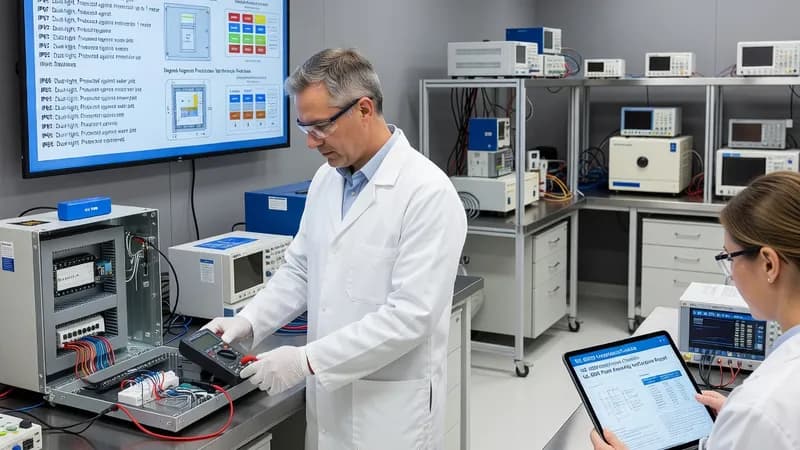
IP Protection Ratings define the enclosure sealing performance of low-voltage switchgear and controlgear assemblies under IEC 60529 and are a critical design parameter for IEC 61439-1/2/3/6 panelboards, MCCs, distribution boards, and automation panels. For panel builders and EPC contractors, the selected IP code must be coordinated with the internal architecture of the assembly, the installed components, and the site environment. A main distribution board with ACB incomers, MCCB feeders, and energy meters may be acceptable at IP31 in a clean electrical room, while a variable-frequency-drive panel, soft starter panel, or harmonic filter panel often requires IP54 or IP55 where dust, humidity, or washdown conditions are present. In marine-offshore, water-wastewater, mining-metals, and food-and-beverage applications, IP65 or higher may be necessary when the enclosure is exposed to jets, condensation, salt mist, or cleaning chemicals. IEC 60529 defines protection against solid objects and water using a two-digit code. The first digit ranges from 0 to 6 and the second from 0 to 9; for example, IP54 indicates limited dust ingress protection and splash-water resistance, while IP66 indicates complete dust-tightness and protection against powerful water jets. For outdoor or severe service installations, the enclosure design must also consider gasket compression, door overlap geometry, stainless-steel or powder-coated sheet steel construction, cable gland plates, ventilation strategy, and condensation control. In many cases, achieving a higher IP rating requires sealed ventilation packages, filtered fans, anti-condensation heaters, or thermal management using air conditioners or heat exchangers, especially in VFD and PFC panels with significant internal losses. Under IEC 61439, the declared IP degree must be verified as part of the design of the assembly, together with temperature rise, dielectric properties, creepage distances, and short-circuit withstand capability. The enclosure rating is only valid when the panel is installed as tested, with doors closed, unused openings blanked, and cable entries fitted with certified glands or sealing systems. Where busbar trunking systems interface with distribution panels, IP coordination between the trunking, tap-off units, and wall-mounted enclosures is essential. For hazardous locations, the IP rating is not a substitute for explosion protection; IEC 60079 requirements still apply for Ex-rated installations. In environments with arc-flash exposure concerns, IEC 61641 internal arc containment may be required in addition to the specified IP class. Real-world applications vary widely: IP30 is typical for clean indoor metering panels or PLC automation panels in controlled utility rooms; IP42 to IP44 suits lighting distribution boards and tenant panels in commercial buildings; IP54/IP55 is common for industrial manufacturing, water treatment, and capacitor bank panels; and IP65/IP66 is preferred for outdoor infrastructure, marine decks, renewable-energy sites, and hygienic washdown zones. Patrion’s engineering approach aligns the enclosure IP rating with the full IEC 61439 compliance package, using ACBs, MCCBs, protection relays, VFDs, soft starters, and metering devices in assemblies that are designed, tested, and documented for the intended duty cycle and environmental exposure.
Panels Certified to This Standard
Primary power distribution from transformer to sub-circuits. Rated up to 6300A. Houses main incoming breaker, bus-section, and outgoing feeders.
Automatic capacitor switching for reactive power compensation. Thyristor or contactor-switched, detuned or standard configurations.
Enclosed VFD assemblies with input protection, line reactors, EMC filters, output reactors, and bypass options.
Energy metering, power quality analysis, and multi-circuit monitoring with communication gateways.
Final distribution for lighting and small power. MCB/RCBO-based with DALI or KNX integration options.
Prefabricated busbar distribution per IEC 61439-6. Sandwich or air-insulated, aluminum or copper.
Process and machine control panels housing PLCs, I/O modules, relays, HMIs, and communication infrastructure.
Bespoke panel assemblies for non-standard requirements — special ratings, unusual form factors, multi-function combinations.
Enclosed soft starter assemblies for reduced voltage motor starting with torque control, ramp-up/down profiles, and bypass contactor options.
Active or passive harmonic filtering to mitigate THD from non-linear loads. Tuned LC filters, active filters, or hybrid configurations.
DC power distribution for battery systems, solar installations, telecom, and UPS applications. MCCB/fuse-based DC protection.
Fixed or automatic capacitor bank assemblies for bulk reactive power compensation in industrial and utility applications.
Related Industries
MDB, lighting distribution, APFC, ATS, metering, BTS, capacitor bank, BMS integration
MCC, PCC, VFD panels, MDB, APFC, automation panels, soft starters, harmonic filters, capacitor banks — full range
High-reliability MDB, PCC, ATS (STS), metering, APFC, BTS, DC distribution
ATS (critical power), MDB, generator control, lighting, metering, APFC
Ex-rated panels, MCC, PCC, VFD, generator control, soft starters, ATEX/IECEx compliance
MCC, VFD panels, PLC automation, APFC, generator control, soft starters
Rugged MCC, PCC, VFD panels, generator panels, soft starters, harmonic filters
MDB, metering, APFC, ATS, PLC, DC distribution, capacitor banks
Marine-certified panels, MCC, generator sync, ATS, PLC, classification society compliance
MDB, ATS, metering, BTS, lighting distribution, DC distribution
Washdown-rated panels (IP65+), MCC, VFD, APFC, PLC, soft starters, harmonic filters
Cleanroom-compatible panels, MCC, VFD, APFC, PLC, soft starters, harmonic filters
Related Knowledge Articles
Frequently Asked Questions
Ready to Engineer Your Next Panel?
Our team of electrical engineers is ready to design, build, and deliver your custom panel solution — fully compliant with international standards.