Marine Panel Standards and Classification Requirements
Meeting classification society requirements for marine panels.
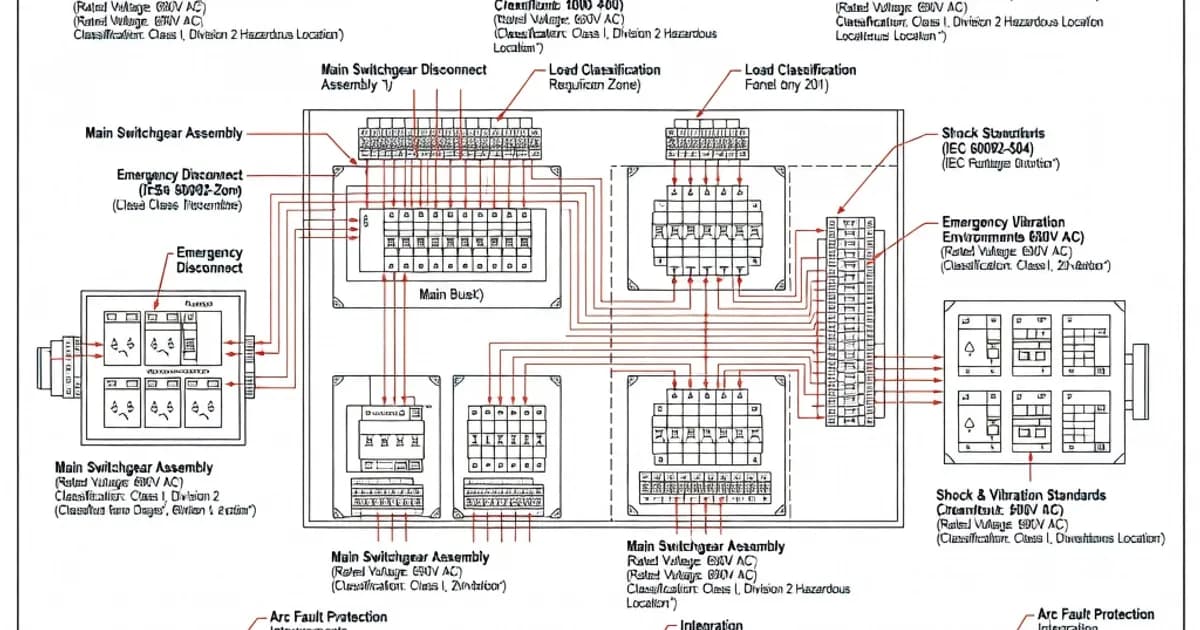
Marine Panel Standards and Classification Requirements
Marine low-voltage panels sit at the intersection of electrical safety, environmental robustness, and class approval. Unlike standard indoor switchboards, shipboard and offshore assemblies must continue to perform under vibration, shock, humidity, salt contamination, and wide temperature swings. For that reason, modern marine panels are normally designed and verified against the IEC 61439 series, then assessed against classification society requirements from bodies such as DNV, ABS, Lloyd’s Register, and Bureau Veritas.
IEC 61439 defines the rules for low-voltage switchgear and controlgear assemblies up to 1,000 V AC or 1,500 V DC. In practice, the marine panel builder must prove that the assembly can withstand temperature rise, short-circuit stress, dielectric stress, ingress of water and solids, and the mechanical effects of a ship environment. As documented in the ABB workbook on IEC 61439 and reinforced in industry guidance from Siemens and Hager, compliance is no longer based on the old IEC 60439 type-test concept; instead, it relies on design verification plus routine verification of the final assembly.
Why marine panels require a higher design margin
Marine electrical systems operate in conditions that accelerate failure mechanisms. Salt-laden air attacks enclosure finishes and busbar connections. Continuous vibration can loosen terminations. Condensation can reduce insulation resistance. Impact and shock can misalign internal barriers or damage devices. For this reason, class-approved marine assemblies often use stainless steel or marine-grade coated steel, segregated compartments, anti-vibration hardware, and higher ingress protection than a comparable land-based panel.
IEC 61439 provides the core electrical framework, while classification society rules add environmental and operational expectations. As noted in Siemens’ technical guidance, marine assemblies are typically verified using IEC 61439 together with marine-specific approval requirements, and environmental testing often references IEC 60068 methods for vibration and shock. In other words, IEC 61439 establishes the electrical performance envelope, and class rules confirm that the assembly will survive the vessel environment.
Standards that govern marine low-voltage panels
The most important standards are summarized below. The exact combination depends on whether the installation is on a ship, offshore unit, or marina-based installation.
| Standard | Primary scope | Marine relevance |
|---|---|---|
| IEC 61439-1:2020 | General rules for low-voltage assemblies | Defines design and routine verification, including temperature rise, dielectric properties, and protection against electric shock and ingress |
| IEC 61439-2:2020 | Power switchgear and controlgear assemblies | Typical basis for marine main switchboards, MCCs, and PCCs |
| IEC 61439-7:2023 | Assemblies for marinas, camping sites, and electric vehicle charging stations | Applies to shore-side installations, not shipboard or houseboat systems; relevant for marina power pedestals |
| IEC 60529 | IP degree of protection | Used by IEC 61439-1 Clause 10.11 to verify enclosure protection against dust and water |
| IEC 62208 | Empty enclosures for low-voltage assemblies | Important when evaluating enclosure form, strength, and protection before assembly integration |
| IEC 60947 series | Switching and control devices | Used for breakers, contactors, isolators, and auxiliaries installed inside the panel |
| IEC 60068-2 | Environmental testing | Supports shock, vibration, and climatic endurance testing often required by class societies |
IEC 61439-1 also introduced the modern concept of design verification through test, calculation, or design rules. As explained by Hager and PIMA, the assembly manufacturer must prove compliance for each relevant characteristic, rather than relying on a generic type test from a similar product family.
Core IEC 61439 verification requirements for marine assemblies
Marine panels are not certified by a single label or test. They must satisfy several technical verifications under IEC 61439-1, with the most critical being temperature rise, short-circuit withstand, dielectric performance, protection degree, and mechanical strength. These requirements are especially important in marine service because environmental stress compounds thermal and electrical stress.
Temperature rise verification is one of the most common failure points. Per IEC 61439-1:2020 Clause 10, the assembly must remain within permissible temperature limits under rated load. For terminals, the average temperature rise limit is typically 70 K above ambient, and the standard permits calculation methods for certain assemblies, including multi-compartment arrangements up to 1,600 A rated current. Standard verification ambient conditions are generally based on a 35°C test environment. In marine applications, this matters because reduced ventilation, solar gain, and clustered compartments can push internal hot spots beyond safe limits.
Short-circuit withstand is covered in IEC 61439-1:2020 Clause 10.9. The assembly must demonstrate its ability to withstand both Icw (short-time withstand current) and Ipk (peak withstand current). This replaces older reliance on legacy breaking capacity notions such as Icn for assembly-level assessment. Verification may be achieved by testing, calculation, or comparison with a design rule based on a reference arrangement. For marine panels, this is critical because fault energy in a compact shipboard distribution system can be severe and must be contained without busbar deformation, device rupture, or loss of segregation.
Dielectric properties are verified under IEC 61439-1 Clause 10.7. Clearances and creepage distances must conform to the applicable tables, and the assembly must pass power-frequency withstand voltage tests. Marine humidity and conductive salt deposits reduce effective insulation margins, so designers generally avoid minimum-spacing configurations unless they are fully supported by the standard and the component data.
Degree of protection is covered in IEC 61439-1 Clause 10.11 using the IP code methodology of IEC 60529. A water-jet or splash test is not merely about keeping the enclosure dry; the decisive criterion is that water must not contact live parts in a way that compromises safety. Marine panels frequently specify IP54 or higher, and many installations seek IP55 or IP66 where washdown, spray, or exposed deck mounting is expected.
Mechanical strength and vibration resistance are addressed in IEC 61439-1 Clause 10.12, but marine qualification typically extends beyond the standard. Classification societies often require evidence of vibration and shock performance using IEC 60068-2 test methods or equivalent documented procedures. This is especially important for busbar supports, device fixings, cable terminations, and hinged doors, which are all vulnerable to loosening under continuous engine-room or hull vibration.
Marine design parameters that affect approval
Although IEC 61439 is not a “marine-only” standard, several practical design parameters determine whether the assembly will survive class inspection and service. Panel builders should treat these as integral to the verification plan, not as optional extras.
- Corrosion resistance: Use stainless steel, marine-grade aluminum, or coated steel systems suitable for C5M or equivalent severe-corrosion environments per ISO 12944 practice.
- Ingress protection: Specify at least IP54 for splash-prone spaces, with higher ratings where hose-down or exposed location conditions apply.
- Impact resistance: Consider IK-rated enclosure systems and internal bracing to protect against mechanical shock.
- Segregation: Use Form 3 or Form 4 separation where operational continuity and fault containment are required; many marine designs favor compartmentalization for maintainability and safety.
- Thermal derating: Account for confined spaces, reduced airflow, and elevated ambient temperatures near machinery spaces.
- Vibration-proof assembly: Locking devices, captive fasteners, and properly torqued terminals should be standard practice.
In practice, marine panel manufacturers often oversize busbars by 20 to 30 percent for thermal margin, especially where load profiles are highly dynamic. They also use realistic Rated Diversity Factor calculations to avoid overestimating simultaneous load on feeders and outgoing circuits. This improves temperature-rise compliance and may reduce unnecessary conductor oversizing.
Specification comparison: typical marine panel expectations
| Characteristic | Typical IEC 61439 basis | Marine-oriented expectation |
|---|---|---|
| Voltage rating | Up to 1,000 V AC / 1,500 V DC | Same electrical limits; verify system earthing and insulation coordination carefully |
| Temperature rise | Clause 10; terminal rise commonly limited to 70 K | Use conservative loading and ventilation assumptions; verify at 35°C ambient where applicable |
| Short-circuit rating | Clause 10.9; Icw and Ipk | Coordinate with generator, transformer, and breaker fault levels; confirm containment under ship fault duty |
| Ingress protection | Clause 10.11 / IEC 60529 | Commonly IP54 to IP66 depending on exposure |
| Mechanical robustness | Clause 10.12 | Supplement with IEC 60068 vibration and shock testing, especially for class approval |
| Corrosion protection | Not fully defined by IEC 61439 | Specify marine-grade materials and coating systems verified for salt atmospheres |
Classification society requirements beyond IEC 61439
IEC 61439 establishes the electrical design baseline, but classification societies impose additional conditions for shipboard use. DNV, ABS, Lloyd’s Register, and Bureau Veritas typically require evidence of environmental suitability, documentation control, and product traceability. In many cases, this includes salt spray testing such as IEC 60068-2-11, vibration and shock qualification, and confirmation that the enclosure, devices, and busbar system remain safe after exposure.
These requirements are not merely administrative. A marine panel can be electrically correct under IEC 61439 and still fail class acceptance if cable glands are inappropriate, the finish cannot survive corrosion, or the assembly does not demonstrate adequate resistance to vibration-induced loosening. Siemens’ marine technical guide illustrates this point by linking IEC 61439 compliance with marine rule compliance and type approval expectations.
Classification approval generally focuses on:
- Construction quality: materials, thickness, welds, coatings, and fasteners
- Environmental endurance: salt mist, humidity, vibration, shock, and temperature cycling
- Electrical safety: insulation, earthing, segregation, and protective device coordination
- Documentation: drawings, bills of material, test reports, and conformity declarations
- Traceability: identification of components, ratings, and approved variants
How IEC 61439 responsibilities are shared
One of the most important changes introduced by IEC 61439 is the split of responsibility between the original manufacturer and the assembly manufacturer. The original manufacturer defines the design platform, component compatibility, and verified arrangements. The assembly manufacturer builds the actual panel, ensures that the selected components are used within the verified limits, and completes final routine verification.
This division is especially important for marine projects because class approval is often lost when builders substitute unverified breakers, modify busbar geometry, or reduce enclosure ventilation without recalculating thermal performance. As summarized in the ABB and Hager guidance, the assembly manufacturer must verify every relevant design characteristic for the final configuration, even if the base system was already validated in another context.
In practical terms, marine panel builders should keep a robust verification dossier containing:
- rated current, voltage, frequency, and fault level data
- temperature-rise evidence or calculation reports
- short-circuit withstand documentation
- clearance and creepage assessments
- IP test evidence
- mechanical and corrosion test records where required by class
- routine test records for the completed assembly
Routine verification and factory testing
Before shipment, each panel should undergo routine verification under IEC 61439-1 Clause 11. This includes visual inspection, wiring checks, dielectric tests where applicable, protective circuit continuity checks, and functional checks of devices and interlocks. Marine projects often add torque verification for all terminations because vibration can amplify any assembly weakness left in the factory.
Routine verification is not a substitute for design verification. It confirms that the delivered assembly matches the approved design and that the builder has not introduced errors during manufacture. For class-approved marine systems, this final check is often the difference between a smooth acceptance process and a costly rework cycle at the shipyard.
Examples from major manufacturers
Leading panel manufacturers have developed marine-focused systems that align IEC 61439 compliance with class approval pathways. Siemens’ SIVACON marine switchgear, for example, is documented as IEC 61439-1 and -2 compliant and offered with marine-oriented environmental qualification, including high IP ratings and vibration testing. ABB’s marine-capable UniGear and Emax-based assemblies emphasize conductor sizing, verified arrangements, and remote monitoring integration. Schneider Electric, Eaton, and Rittal similarly offer configurations designed for offshore, naval, or marine distribution applications, often with corrosion-resistant enclosures and class-recognized construction practices.
These products illustrate a key principle: compliance is not just about selecting certified devices. The complete assembly, including enclosure, busbars, internal separation, wiring, cooling strategy, and documentation, must be verified as a system. A panel built from excellent components can still fail if the assembled system has excessive heat rise, inadequate IP sealing, or unverified short-circuit strength.
Best-practice checklist for marine panel builders
For projects that require both IEC 61439 compliance and classification approval, the following practices improve first-pass success:
- Start with the ambient envelope: define expected temperature, humidity, vibration, and corrosion class before selecting the enclosure.
- Use verified component combinations: keep breaker, busbar, and enclosure arrangements within the original manufacturer’s documented limits.
- Prioritize thermal verification: temperature rise is often the first point of nonconformity in dense marine panels.
- Specify a realistic IP rating: do not over-specify to the point that thermal performance becomes unacceptable.
- Include marine-grade hardware: stainless fasteners, locking devices, and corrosion-resistant terminals reduce field failures.
- Document everything: maintain a conformity file with calculations, drawings, component declarations, and routine tests.
- Plan for class inspection early: involve the classification society or approved surveyor before final build if the project is mission-critical.
When these practices are followed, the result is a panel that is not only compliant on paper but also durable in service. Industry experience consistently shows that most marine panel failures arise from predictable causes: excessive temperature rise, moisture ingress, corrosion at terminations, or mechanical loosening under vibration. Good design eliminates those risks before the enclosure ever reaches the vessel.
Conclusion
Marine panel standards are best understood as a layered compliance model. IEC 61439 sets the technical requirements for safe low-voltage assemblies, while classification society rules extend those requirements into real shipboard service conditions. A successful marine panel must therefore be electrically sound, mechanically robust, corrosion-resistant, and fully documented. Builders who treat temperature rise, short-circuit withstand, IP protection, and vibration resistance as integrated design inputs will achieve better class acceptance and lower lifecycle risk.
For shipowners, shipyards, and panel builders, the message is straightforward: select verified components, build within proven design limits, and verify the completed assembly with the same discipline used for any critical marine system. That is the most reliable path to IEC 61439 compliance and class-ready marine performance.
References and Further Reading
ABB: The standard IEC 61439 in practice (workbook)
Ready to Engineer Your Next Panel?
Our team of electrical engineers is ready to design, build, and deliver your custom panel solution — fully compliant with international standards.