Marine Classification (DNV/Lloyd's/BV)
Type approval for marine and offshore installations
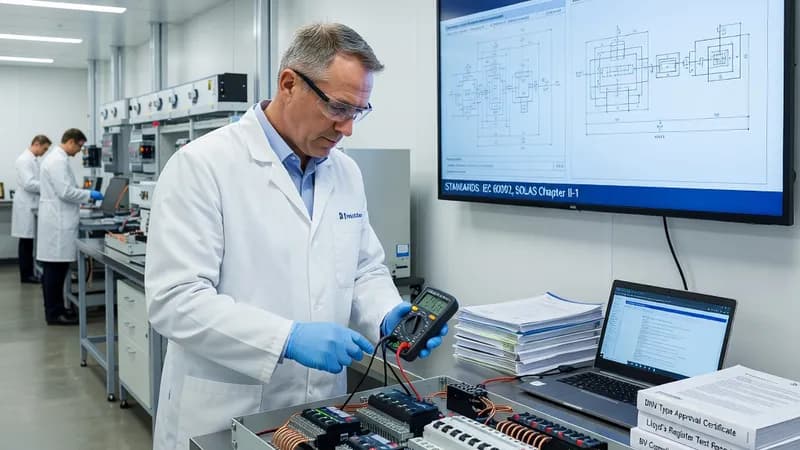
Marine Classification approval for DNV, Lloyd’s Register, Bureau Veritas, and similar societies is a critical compliance layer for IEC 61439 low-voltage switchgear and controlgear assemblies used on ships, offshore units, FPSOs, drillships, naval auxiliaries, and port infrastructure. Unlike a standard indoor industrial panel, a marine-certified assembly must demonstrate suitability for continuous vibration, shock, humidity, salt-laden atmosphere, inclination, electromagnetic interference, and fire risk conditions that occur at sea. In practice, this means the enclosure, busbar system, wiring, devices, terminations, and accessories must be engineered and documented for class acceptance, often alongside IEC 61439-1/2 verification and additional society-specific type approval requirements. Typical marine assemblies include main switchboards, emergency switchboards, generator control panels, propulsion MCCs, pump and ballast control panels, shore connection boards, and auxiliary distribution panels. These often incorporate ACBs and MCCBs for incomer and feeder protection, motor starters, contactors, overload relays, VFDs for pumps and thrusters, soft starters for large motors, protection relays for generators and synchronizing functions, metering, and PLC-based automation. Depending on the vessel application, the system may also require segregation by functional unit, bus couplers, dual-bus arrangements, or redundant power paths to preserve availability during faults or maintenance. Compliance is typically demonstrated through a combination of design review, component certification, and test evidence. IEC 61439-1 and IEC 61439-2 govern assembly design verification, temperature-rise limits, dielectric strength, short-circuit withstand, clearances and creepage distances, and protection against electric shock. For marine service, test and environmental considerations frequently extend to IEC 60068-2-6 for vibration, IEC 60068-2-27 for shock, IEC 60068-2-52 for salt mist, and inclination tests reflecting shipboard mounting conditions. Depending on the location and installed equipment, IEC 60079 may be relevant for hazardous-area interfaces, while IEC 61641 can be applied where internal arcing performance is requested for enhanced personnel protection. Enclosures are commonly specified in stainless steel or marine-grade painted steel with IP and corrosion performance aligned to the duty, and internal materials are selected for flame retardancy and low smoke behavior consistent with IEC 60092 shipboard electrical practices. A marine type-approval pathway usually begins with submission of single-line diagrams, GA drawings, BOM, thermal calculations, short-circuit studies, and device certificates. Classification surveyors may then witness routine tests and FAT, including functional checks, insulation resistance, dielectric withstand, phase sequence, interlocks, protection relay settings, and alarm simulations. Short-circuit ratings are particularly important: assemblies may need verified withstand levels such as 50 kA, 65 kA, or higher depending on generator fault level and downstream selectivity. For generator control panels, synchronization, load sharing, reverse power, under/over-voltage, and under/over-frequency functions are commonly scrutinized. For MCCs, starting duty, thermal performance, and compartment separation are key concerns. Forms of separation under IEC 61439 are often specified at marine level to improve maintainability and safety, especially in mission-critical systems. Form 2, 3, or 4 configurations may be required depending on segregation between busbars, functional units, and terminals. The final approved design gives EPC contractors, shipyards, and operators a traceable compliance route for installation on vessels and offshore assets where reliability, maintainability, and class acceptance are non-negotiable.
Panels Certified to This Standard
Centralized motor control with starters, contactors, overloads, and VFDs in standardized withdrawable/fixed functional units.
Genset start/stop sequencing, synchronization, load sharing, and paralleling controls.
Bespoke panel assemblies for non-standard requirements — special ratings, unusual form factors, multi-function combinations.
Related Industries
Related Knowledge Articles
Frequently Asked Questions
Ready to Engineer Your Next Panel?
Our team of electrical engineers is ready to design, build, and deliver your custom panel solution — fully compliant with international standards.