Modular vs Custom Panel Assembly: How to Choose
Comparing modular type-tested systems with custom-built panels.
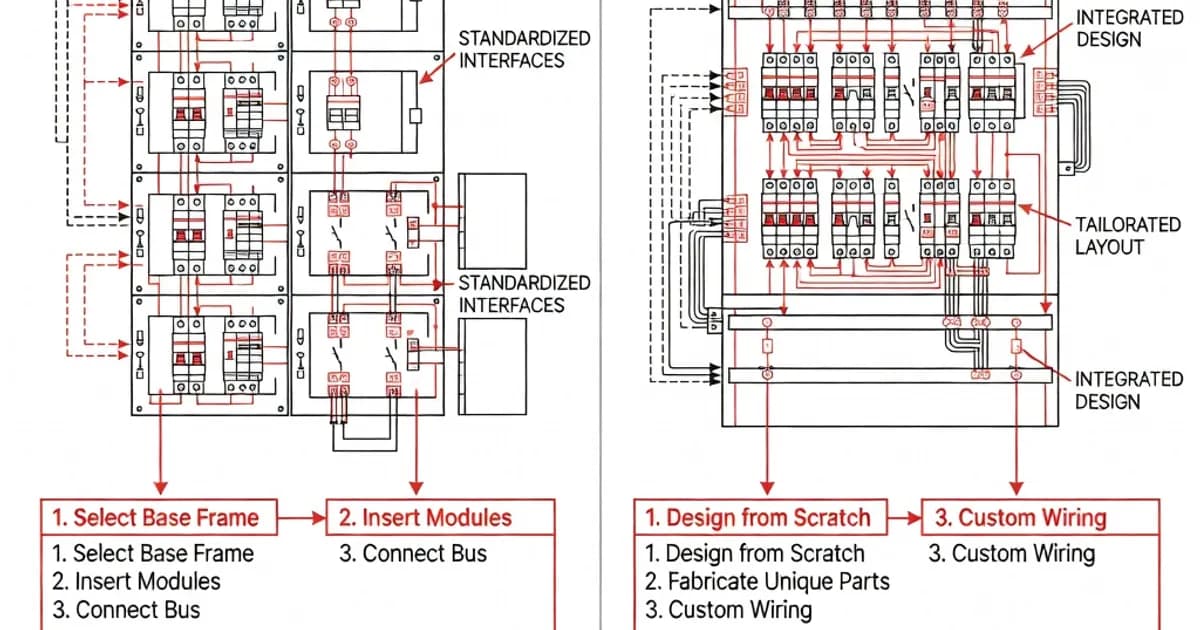
Modular vs Custom Panel Assembly: How to Choose
Choosing between a modular panel assembly and a custom-built panel is not simply a matter of preference. It affects compliance, engineering effort, delivery time, lifecycle flexibility, and the amount of verification required to demonstrate safety. Under the IEC 61439 series, the decisive issue is not whether a panel is “standard” or “special,” but whether the assembly has been properly design verified and routine verified for the intended application. Per IEC 61439-1, the manufacturer must confirm performance against 12 design verification characteristics using testing, calculation, or comparison with a verified reference design.
In practice, modular type-tested systems are best when you need speed, repeatability, and scalable expansion. Custom-built panels are appropriate when the project has unusual dimensions, non-standard device combinations, or severe space constraints that cannot be resolved with a standard platform. The key is to match the assembly strategy to the project risk profile, electrical duty, and long-term operating needs.
What Modular and Custom Panel Assemblies Mean in Practice
Modular panel assembly
A modular panel assembly is built from standardized, pre-engineered sections, enclosures, busbar systems, mounting plates, and device compartments. These systems are often marketed as type-tested or design-verified platforms because the manufacturer has already validated the critical thermal, dielectric, and short-circuit performance of the platform. This approach reduces engineering uncertainty and shortens commissioning time. As documented in Siemens SIVACON technical materials and similar manufacturer guides, modular systems are designed for repeatability, with pre-verified mechanical interfaces and standardized compartment arrangements.
Modular assemblies are especially valuable in industrial facilities, data centers, utilities, renewable energy plants, and production lines that may expand in phases. They allow sections to be added or reconfigured while keeping the underlying platform consistent. In many platforms, plug-in or withdrawable device arrangements also simplify maintenance and reduce outage duration.
Custom-built panel assembly
A custom-built panel is engineered around a specific set of project constraints rather than a standardized platform. That might include an irregular room layout, special clearances, unusual cable entry points, mixed-voltage integration, or a requirement to fit maximum functionality into a very limited footprint. Custom construction can solve problems that modular products cannot, but it places a heavier burden on engineering and verification.
Under IEC 61439-1, a custom assembly still must satisfy all relevant design verification criteria. The difference is that the manufacturer cannot rely on a previously verified platform to the same extent. The assembly manufacturer may need to perform more calculations, more test evidence review, or more comparison against a verified design to prove compliance.
Key Technical Differences Between Modular and Custom Assemblies
The table below summarizes the practical differences that matter most in selection and specification. It also highlights the IEC clauses that govern each topic.
| Aspect | Modular Type-Tested System | Custom-Built Panel | Relevant IEC References |
|---|---|---|---|
| Verification method | Uses pre-verified modular units and a proven platform; routine verification is performed on the assembled panel. | Requires full design verification for the specific build, often with greater engineering effort. | IEC 61439-1 Clause 10; routine verification requirements in the same series. |
| Short-circuit withstand | Often validated on the platform up to high fault levels, with defined device combinations. | Must be demonstrated for the specific configuration by calculation, comparison, or test evidence. | IEC 61439-1 Clause 10.10 and Clause 13. |
| Temperature rise | Standard thermal data and tested layouts simplify compliance. | Thermal performance must be assessed for the exact arrangement. | IEC 61439-1 Clause 10.9 and Clause 11.1; temperature-rise limits commonly referenced at 70 K average and 105 K for critical accessible surfaces, depending on material and location. |
| Ingress protection | Standard enclosure ratings and finger-safe bus arrangements are commonly available. | Protection level varies and must be verified for the specific enclosure and penetration details. | IEC 60529 for IP codes; IEC 61439-1 Clause 10.2 and related enclosure verification. |
| Segregation / forms | Standardized forms of internal separation are available across the platform. | Can be tailored, but the design must still be proven. | IEC 61439-2 and platform design rules; internal separation guidance aligned with Clause 8 and design verification criteria. |
| Engineering effort | Lower; configuration replaces much of the bespoke design work. | Higher; each arrangement may require detailed engineering review. | IEC 61439-1 design verification framework. |
| Scalability | Excellent for phased expansion and standardized plant growth. | Possible, but future expansion must be designed in from the start. | Project-specific; not a clause issue but a practical design outcome. |
IEC 61439: The Standards Framework That Drives the Decision
The move from IEC 60439 to IEC 61439 changed the way low-voltage assemblies are evaluated. Instead of depending on rigid “type-test” labels alone, IEC 61439 establishes a modern design verification approach. This framework applies to the complete assembly and requires evidence for a defined set of performance characteristics. As summarized in Schneider Electric’s white paper on IEC 61439, this is not just an incremental update; it is a fundamentally different compliance model.
IEC 61439-1 contains the general rules and definitions, while IEC 61439-2 covers power switchgear and controlgear assemblies. The standard places responsibility on two key roles:
- Original manufacturer — the organization that establishes the verified design platform and provides the design rules and evidence.
- Assembly manufacturer — the organization that builds the actual assembly and performs routine verification on the finished product.
That distinction is important. In a modular system, the original manufacturer has already done most of the heavy lifting. In a custom build, the assembly manufacturer often carries a much larger share of the verification burden.
The 12 design verification characteristics
IEC 61439-1 requires verification of multiple assembly characteristics, typically covering:
- strength of materials and parts
- degree of protection of enclosures
- clearances and creepage distances
- protection against electric shock and integrity of protective circuits
- incorporation of switching devices and components
- internal electrical circuits and connections
- terminal properties for external conductors
- dielectric properties
- temperature-rise limits
- short-circuit withstand strength
- electromagnetic compatibility, where applicable
- mechanical operation
For modular assemblies, much of this evidence is inherited from the platform. For custom assemblies, the verification evidence must be assembled carefully from tests, calculations, or comparison with verified reference designs. Per IEC 61439-1 Clause 10, the manufacturer must prove compliance, not assume it.
When Modular Assembly Is the Better Choice
Modular assembly is usually the right answer when the project values speed, consistency, and lower technical risk. It is particularly strong in the following situations:
- Industrial expansions where future load growth is likely
- Multi-site standardization where identical panels are replicated across facilities
- Data centers and critical infrastructure where downtime must be minimized
- Renewable energy systems with evolving feeder requirements and auxiliary distribution changes
- Projects with international compliance needs where a proven IEC platform reduces local interpretation risk
Modular systems also tend to improve project execution. Standardized lineups reduce drafting effort, limit part variation, and simplify procurement. Assemblies built on a proven platform often reach routine verification faster because the installer is not inventing a new mechanical and electrical architecture for each project. This is why modular platforms are often preferred for repeated plant layouts and time-sensitive delivery schedules.
From a maintenance perspective, modular systems can also support better uptime. Standard device compartments, plug-in protection devices, and predictable spare-part structures make troubleshooting faster and reduce the chance of installation errors. Many modern platforms also support tool-less or reduced-tool access methods that simplify service work while maintaining safe isolation practices.
When Custom Assembly Is the Better Choice
Custom panel assembly is justified when the project cannot be served safely or efficiently by a standard platform. Typical reasons include:
- Space limitations that require non-standard cabinet geometry
- Special segregation or separation needs tied to process risk or maintainability
- Unusual incoming or outgoing arrangements that do not fit modular busbar rules
- Integration with legacy equipment that has fixed physical interfaces
- Multi-voltage or hybrid control architectures requiring tailored compartment design
Custom design can deliver superior fit and function, but only if the engineering team controls the compliance process rigorously. That means defining the electrical data first, then confirming the enclosure, busbar, device, and thermal performance before fabrication begins. If a custom assembly is rushed without full design verification, the risk of non-compliance rises sharply.
This is where the cost equation often changes. A custom panel may appear cheaper at the procurement stage, but the added engineering hours, verification effort, and potential redesigns can make it more expensive over the full lifecycle. In contrast, a modular system may have a higher upfront product cost but a lower overall project risk and shorter delivery timeline.
Comparison of Performance and Compliance Factors
Beyond cost and lead time, engineers should compare the following factors before choosing an assembly approach:
- Short-circuit withstand rating: The assembly must tolerate prospective fault currents without unacceptable damage. Under IEC 61439-1 Clause 10.10 and Clause 13, this may be established by test, calculation, or comparison with a reference design.
- Temperature rise: Excess heat shortens component life and can invalidate a design. Proper thermal verification is essential, especially when the enclosure is densely populated or installed in a warm environment.
- Ingress protection: IP ratings matter when dust, moisture, or touch protection are concerns. IEC 60529 defines the degree of protection against access and environmental intrusion.
- Internal separation: Forms of separation affect safety, maintenance continuity, and fault containment. Modular systems usually offer predefined forms, while custom designs must prove the intended segregation.
- Arc-flash performance: Where arc containment is required, additional testing or evidence under IEC/TR 61641 may be needed, especially for high-energy industrial installations.
IEC 61439 does not eliminate engineering judgment. It structures it. The manufacturer still has to determine whether the assembly will perform safely under expected electrical and environmental stress. That is why design verification should begin early, ideally at the concept stage, not after fabrication has started.
How Major Manufacturers Approach Modular Platforms
Large manufacturers have invested heavily in modular low-voltage platforms because they reduce technical variability and support compliance across multiple markets. Siemens SIVACON systems are a well-known example of a modular, verified platform for power distribution and control. Rittal cabinet systems similarly emphasize standardized enclosure architecture, tool-assisted or tool-less assembly features, and strong cable-management integration. Schneider Electric, ABB, and Eaton all offer modular or hybrid product families designed around IEC 61439 principles.
These platforms are typically built around a common architecture: standardized busbar supports, repeatable feeder sections, validated compartment layouts, and known device families such as MCCBs, ACBs, contactors, and motor starters. When a manufacturer publishes verified current ratings, thermal limits, and short-circuit data for the platform, the assembler gains a strong compliance advantage.
That said, modular does not mean “one-size-fits-all.” A good modular platform still allows project-specific configuration. It simply constrains the design inside a verified framework. That is often exactly what engineering teams want: enough flexibility to meet the project requirement, but not so much freedom that compliance becomes uncertain.
How to Decide: A Practical Selection Method
The simplest way to choose between modular and custom assembly is to evaluate five questions in order:
- Is the electrical load profile stable and repeatable?
- Will the installation likely expand in phases?
- Do the space and cable-entry constraints fit standard platform dimensions?
- Is rapid compliance evidence important for the schedule?
- Does the project demand special mechanical or segregation features?
If the first four answers are mostly yes, modular assembly is usually the safer and faster route. If the last question is yes, or if the project geometry is unusual, custom assembly may be justified. In many real projects, the best answer is a hybrid: use a modular backbone for the main distribution sections, then apply custom interfaces only where necessary.
A sound workflow is:
- Define load, fault level, and environmental conditions
- Select the assembly philosophy early
- Confirm the incoming and outgoing device strategy
- Verify thermal and short-circuit performance against IEC 61439
- Specify enclosure rating, segregation form, and access needs
- Complete routine verification and commissioning checks before energization
Best Practices for Engineers and Specifiers
Whether you choose modular or custom, a disciplined specification process reduces risk. The best projects start with the electrical single-line diagram, transformer data, prospective fault current, ambient temperature, ventilation assumptions, and maintenance strategy. From there, the panel architecture should be chosen to support compliance, not force it after the fact.
For modular systems, ask for the manufacturer’s IEC 61439 verification evidence, including thermal limits, short-circuit data, IP rating, and assembly instructions. Confirm the permitted combinations of functional units, busbar ratings, and compartment options. For custom systems, require the design verification package and ensure it covers every relevant clause, especially temperature rise, dielectric strength, protection against electric shock, and short-circuit withstand.
As noted in several industry guides, including IEC 61439 design summaries and manufacturer technical references, the safest approach is to treat verification as a design input, not a final inspection step. That mindset is what distinguishes a compliant assembly from one that merely looks complete.
Conclusion
Modular and custom panel assemblies both have a valid place in low-voltage power distribution. Modular platforms offer standardized engineering, faster delivery, easier scalability, and lower compliance risk because much of the design has already been verified under IEC 61439. Custom panels remain essential when the application demands a unique footprint, special integration, or non-standard functional arrangement.
The right decision depends on the project’s electrical duty, physical constraints, compliance requirements, and future expansion strategy. If the application is repeatable and time-sensitive, choose modular. If the application is unusual and cannot be safely served by a standard platform, choose custom — but insist on full IEC 61439 design verification. In either case, the goal is the same: a safe, maintainable, and demonstrably compliant low-voltage assembly.
References and Further Reading
Related Panel Types
Frequently Asked Questions
Ready to Engineer Your Next Panel?
Our team of electrical engineers is ready to design, build, and deliver your custom panel solution — fully compliant with international standards.