Custom Engineered Panel
Bespoke panel assemblies for non-standard requirements — special ratings, unusual form factors, multi-function combinations.
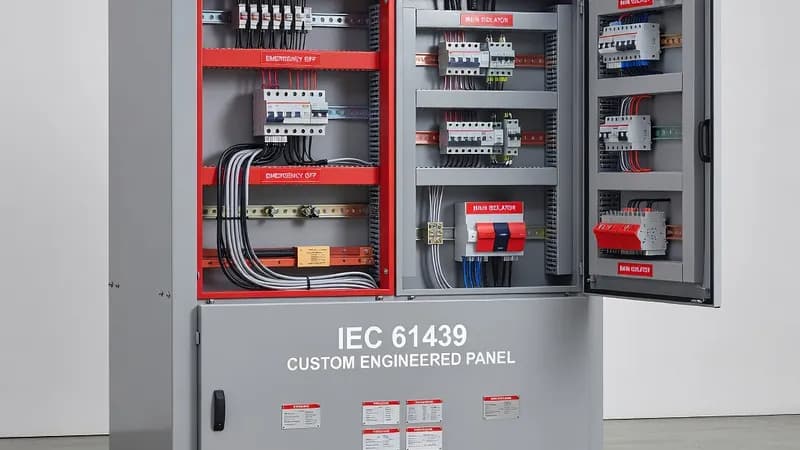
Custom Engineered Panel assemblies are bespoke low-voltage switchgear and controlgear solutions designed for projects where off-the-shelf distribution boards, MCCs, or control panels cannot satisfy the electrical, mechanical, environmental, or functional specification. They are typically engineered as IEC 61439-2 assemblies for power switchgear and controlgear, with design verification completed in accordance with IEC 61439-1. Depending on the scope, the assembly may also incorporate elements governed by IEC 60947 for ACBs, MCCBs, contactors, motor starters, VFDs, soft starters, and protection relays, ensuring the complete system is coordinated from the incomer through to the final load. In practical applications, rated operational voltages are commonly 400/415 V AC, 480 V AC, or up to 690 V AC, with busbar ratings ranging from 400 A to 6300 A and short-circuit withstand values typically from 25 kA to 100 kA for 1 s, subject to the available fault level and protective device coordination. The primary value of a custom engineered panel is integration. A single assembly can combine an incoming air circuit breaker, multiple outgoing MCCB feeders, variable-frequency drives for pumping, HVAC, conveyors, and process equipment, soft starters for high-inertia motors, capacitor banks for power factor correction, power meters and analyzers, PLC I/O modules, HMI/SCADA interfaces, surge protection devices, and protection relays for feeder, motor, transformer, or generator duty. This makes the panel suitable for multi-function installations where power distribution, motor control, monitoring, and automation must coexist in one coordinated enclosure. For engineering teams, this often means careful attention to heat dissipation, cable segregation, harmonics from VFDs, neutral loading, and reserve space for future expansion. Form of internal separation is a key design decision. Depending on maintainability and fault containment requirements, custom engineered panels may be built to Form 2, Form 3, or Form 4 arrangements, with Form 4b frequently selected for better segregation between functional units and busbars. In critical sites, this helps reduce downtime and improves service safety by allowing work on one feeder section without exposing adjacent circuits. Design verification must address temperature rise, dielectric properties, short-circuit withstand, clearances and creepage distances, mechanical strength, and protective circuit continuity as required by IEC 61439-1/2. Environmental and project-specific constraints often drive the enclosure design. Panels can be supplied in IP31 to IP66 ratings, with powder-coated mild steel, stainless steel, or galvanized steel enclosures, anti-condensation heaters, filtered ventilation, forced cooling, or heat exchangers. For harsh industrial and marine environments, corrosion resistance, vibration performance, and EMC behavior per IEC 61000 become essential. Where hazardous locations or adjacent equipment interfaces are involved, ATEX and IECEx considerations may influence the panel architecture, while marine classification approvals, seismic qualification, and internal arc assessment under IEC 61641 may be required for offshore, utility, transport, or emergency power applications. Custom Engineered Panels are widely used in data centers, healthcare, oil and gas, mining, water and wastewater, infrastructure utilities, commercial towers, food and beverage plants, pharmaceuticals, renewable energy plants, and marine offshore assets. They are also often specified for export projects requiring UL 891 or CSA alignment. The engineering objective is consistent across all sectors: deliver a verified IEC 61439 assembly with the right ratings, segregation, protection philosophy, and lifecycle maintainability. For EPC contractors, panel builders, and facility managers, a custom engineered panel provides a reliable way to integrate OEM and third-party equipment into a single compliant solution tailored to the site and the process.
Components for This Panel
Air Circuit Breakers (ACB) selection, integration, and best practices for Custom Engineered Panel assemblies compliant with IEC 61439.
Moulded Case Circuit Breakers (MCCB) selection, integration, and best practices for Custom Engineered Panel assemblies compliant with IEC 61439.
Variable Frequency Drives (VFD) selection, integration, and best practices for Custom Engineered Panel assemblies compliant with IEC 61439.
Soft Starters selection, integration, and best practices for Custom Engineered Panel assemblies compliant with IEC 61439.
PLCs & I/O Modules selection, integration, and best practices for Custom Engineered Panel assemblies compliant with IEC 61439.
Contactors & Motor Starters selection, integration, and best practices for Custom Engineered Panel assemblies compliant with IEC 61439.
Capacitor Banks & Reactors selection, integration, and best practices for Custom Engineered Panel assemblies compliant with IEC 61439.
Metering & Power Analyzers selection, integration, and best practices for Custom Engineered Panel assemblies compliant with IEC 61439.
Surge Protection Devices (SPD) selection, integration, and best practices for Custom Engineered Panel assemblies compliant with IEC 61439.
Busbar Systems selection, integration, and best practices for Custom Engineered Panel assemblies compliant with IEC 61439.
HMI & SCADA Systems selection, integration, and best practices for Custom Engineered Panel assemblies compliant with IEC 61439.
Protection Relays selection, integration, and best practices for Custom Engineered Panel assemblies compliant with IEC 61439.
Applicable Standards
IEC 61439-2 (PSC) compliance requirements, testing procedures, and design considerations for Custom Engineered Panel assemblies.
ATEX / IECEx Certification compliance requirements, testing procedures, and design considerations for Custom Engineered Panel assemblies.
Marine Classification (DNV/Lloyd's/BV) compliance requirements, testing procedures, and design considerations for Custom Engineered Panel assemblies.
Seismic Qualification (IEEE 693/IBC) compliance requirements, testing procedures, and design considerations for Custom Engineered Panel assemblies.
UL 891 / CSA C22.2 compliance requirements, testing procedures, and design considerations for Custom Engineered Panel assemblies.
IP Protection Ratings compliance requirements, testing procedures, and design considerations for Custom Engineered Panel assemblies.
Arc Flash Protection (IEC 61641) compliance requirements, testing procedures, and design considerations for Custom Engineered Panel assemblies.
EMC Compliance (IEC 61000) compliance requirements, testing procedures, and design considerations for Custom Engineered Panel assemblies.
Industries Using This Panel
Custom Engineered Panel assemblies engineered for Commercial Buildings applications, addressing industry-specific requirements and compliance standards.
Custom Engineered Panel assemblies engineered for Industrial Manufacturing applications, addressing industry-specific requirements and compliance standards.
Custom Engineered Panel assemblies engineered for Data Centers applications, addressing industry-specific requirements and compliance standards.
Custom Engineered Panel assemblies engineered for Healthcare & Hospitals applications, addressing industry-specific requirements and compliance standards.
Custom Engineered Panel assemblies engineered for Oil & Gas applications, addressing industry-specific requirements and compliance standards.
MCC, VFD panels, PLC automation, APFC, generator control, soft starters
Custom Engineered Panel assemblies engineered for Mining & Metals applications, addressing industry-specific requirements and compliance standards.
Custom Engineered Panel assemblies engineered for Renewable Energy applications, addressing industry-specific requirements and compliance standards.
Custom Engineered Panel assemblies engineered for Marine & Offshore applications, addressing industry-specific requirements and compliance standards.
Custom Engineered Panel assemblies engineered for Infrastructure & Utilities applications, addressing industry-specific requirements and compliance standards.
Custom Engineered Panel assemblies engineered for Food & Beverage applications, addressing industry-specific requirements and compliance standards.
Custom Engineered Panel assemblies engineered for Pharmaceuticals applications, addressing industry-specific requirements and compliance standards.
Related Knowledge Articles
Comparing modular type-tested systems with custom-built panels.
Comprehensive overview of all IEC 61439 parts, their scope, and how they apply to different panel types.
Practical checklist for achieving IEC 61439 compliance.
What must appear on the panel nameplate and in documentation.
Frequently Asked Questions
Ready to Engineer Your Next Panel?
Our team of electrical engineers is ready to design, build, and deliver your custom panel solution — fully compliant with international standards.