Testing and Commissioning of Panel Assemblies
Complete guide to panel testing and commissioning procedures.
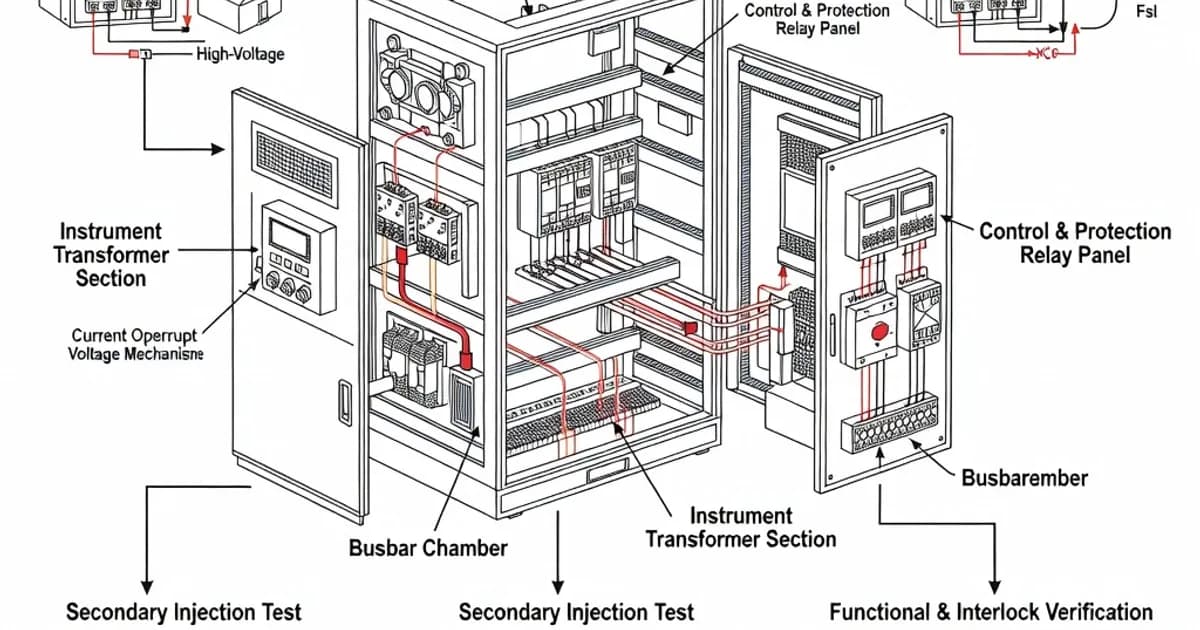
Testing and Commissioning of Panel Assemblies
Testing and commissioning are the final technical gates before a low-voltage panel assembly is handed over for service. For IEC 61439-compliant assemblies, this work is not optional documentation activity; it is part of the verification chain that demonstrates the assembly remains safe, functional, and consistent with its verified design. IEC 61439-1 distinguishes between design verification under Clause 10 and routine verification under Clause 11. Design verification confirms that the design concept can meet the required performance. Routine verification confirms that the specific assembled panel has been built correctly and operates as intended.
In practical terms, testing and commissioning cover everything from tightening terminations and checking protective bonding to performing insulation resistance tests, functional tests, and phase rotation checks. Site commissioning then extends those checks into the installed environment, where cable routing, earthing, upstream protection settings, and source conditions must also be confirmed. As documented in the ABB workbook on IEC 61439 practice and the Siemens and Schneider commissioning procedures, this sequence is essential to prevent avoidable faults during energization and to preserve the integrity of the assembly at handover.
Why testing matters in IEC 61439 assemblies
IEC 61439 panels are safety-related assemblies, not just enclosures filled with devices. A unit may contain circuit-breakers, busbars, control wiring, metering, PLC interfaces, and interlocking functions, and every one of these elements can affect compliance. A panel that has passed design verification can still fail in service if a conductor is left loose, a protective earth path is incomplete, an IP gasket is damaged, or device settings do not match the intended coordination study. For that reason, routine tests and commissioning checks are the final opportunity to verify workmanship and site-specific correctness before energization.
Per IEC 61439-1 Clause 11, routine verification is performed on each completed assembly or on each assembly section as applicable. The intent is to confirm that the manufactured panel corresponds to the verified design and that no assembly defects compromise performance. In addition, the site commissioning process validates the installation context: supply characteristics, cable termination quality, protective device settings, and the sequence of energization.
IEC 61439 Testing Framework
The IEC 61439 series uses a structured verification model. Clause 10 covers design verification, which may be established by testing, calculation, comparison with a verified reference design, or a combination of these methods. Clause 11 covers routine verification, which must be applied to the manufactured assembly. This distinction is important: temperature rise, short-circuit withstand, and dielectric capability are design verification topics, while the builder still needs to confirm workmanship and assembly integrity on the actual unit.
IEC 61439-2 applies specifically to power switchgear and controlgear assemblies, including assemblies rated up to 6300 A. In practice, this means most distribution boards, MCCs, and power panels fall within the scope of the 61439-2 product standard. Individual devices fitted inside the assembly are additionally governed by IEC 60947 series requirements, particularly for circuit-breakers, contactors, disconnectors, and motor starters. In Europe and the UK, the harmonized EN/BS EN versions are used for conformity with applicable regulatory requirements, including the Low Voltage Directive and EMC obligations where relevant.
Design verification versus routine verification
| Verification type | Scope | Typical evidence | Applies to |
|---|---|---|---|
| Design verification | Confirms the design concept meets IEC 61439 requirements | Type tests, calculations, comparison with a reference design, documented ratings | Representative design or configuration |
| Routine verification | Confirms the actual assembled unit is built correctly | Visual inspection, functional tests, continuity, dielectric checks, assembly records | Each production assembly |
| Site commissioning | Confirms the installed panel operates correctly in the field | Point-to-point checks, phase rotation, energization sequence, settings confirmation | Installed equipment at site |
Routine Tests Required for Low-Voltage Panel Assemblies
IEC 61439-1 Clause 11 identifies the routine verifications that must be performed on the completed assembly. The exact execution may vary by product type and manufacturer, but the core intent is consistent: verify functionality, insulation, protective bonding, and constructional integrity. Industry guidance from ABB, Schneider Electric, and technical practice notes from engineering portals broadly align on the same sequence.
1. Functional checks
Functional checks verify the electrical and mechanical operation of all installed devices. This includes opening and closing of switches and circuit-breakers, mechanical interlocking, door interlocks, selector switch positions, indication lamps, meters, and auxiliary contacts. Devices must operate in accordance with the drawings and settings schedule. A breaker that trips correctly but has an incorrect shunt-trip wiring connection or an inverted auxiliary contact arrangement fails the intent of routine verification.
These checks should include verification of all accessible control functions, emergency stop circuits where fitted, and any electrically operated mechanisms. Where withdrawable units are used, racking functions, position indication, and mechanical interlocks should be checked through their full operating range. Siemens and ABB commissioning documents emphasize that the mechanical sequence matters as much as the electrical result because a control circuit may appear functional while a mismatch in interlocking leaves the assembly unsafe.
2. Dielectric properties and insulation testing
Dielectric verification confirms that live parts are adequately insulated from each other and from exposed conductive parts. For routine testing, the assembly is tested de-energized with no loads connected. Short-circuit-sensitive devices should be protected or disconnected as required by the manufacturer’s instructions. Practically, panel builders commonly apply insulation resistance measurements with a suitable megohmmeter and then perform a dielectric withstand test where specified by the test procedure.
Research sources note a practical insulation resistance target of at least 0.5 MΩ for typical 230/400 V assemblies, while the minimum insulation resistance criterion is often expressed as 1000 Ω/V relative to nominal voltage. For example, a 400 V assembly would require a minimum of 0.4 MΩ by that rule, although many organizations adopt a higher internal acceptance threshold for greater reliability margin. The exact test voltage and duration should follow the applicable IEC 61439 part and the manufacturer’s procedure; UL’s guidance on IEC 61439 testing also notes the use of a 1-minute dielectric withstand procedure where specified.
Good practice is to verify insulation after the assembly has been fully dressed, cleaned, and dried, but before final energization. Accumulated dust, trapped wiring scraps, moisture, or incorrect gland termination can produce misleading or failing results. If the test fails, the source of leakage should be located by sectional isolation rather than simply repeating the test.
3. Protective circuit continuity
Protective earthing and bonding are fundamental to assembly safety. IEC 61439 requires continuity of the protective circuit so that all exposed conductive parts are effectively connected to the main earth terminal or earth bar. Industry guidance commonly applies a low-resistance ohmmeter and looks for a resistance of less than 0.1 Ω between exposed metal parts and the main ground bus, subject to test lead compensation and the practical length of the circuit under test.
This check must include doors, gland plates, cable support plates, withdrawable carriers where applicable, sub-assemblies, and any removable conductive section that could become dangerous if disconnected. Earthing faults are often caused not by an obvious open circuit but by poor mechanical contact, paint under lugs, missing serrated washers, loose bonding straps, or unbonded accessories. ABB’s IEC 61439 guidance places strong emphasis on the continuity of the protective circuit because this is one of the most important routine verifications for safe operation.
4. Degree of protection and enclosure integrity
The enclosure’s degree of protection, expressed as an IP code under IEC 60529, should be visually checked during routine verification and again during commissioning after cable entry and accessory installation. In many cases, the IP performance of the empty enclosure or factory-assembled section is established by design verification, but site work can compromise that protection. Missing blanks, poorly fitted gland plates, damaged seals, or incorrectly torqued cover fasteners can reduce the actual protection level significantly.
For assemblies installed in harsh environments, such as utility substations, process plants, or outdoor service areas, this check becomes especially important. A panel may remain electrically correct while failing to resist ingress of dust, moisture, or conductive contamination. Control-panels.org and manufacturer manuals consistently treat enclosure integrity as a commissioning-critical item, not merely a cosmetic one.
5. Clearances, creepage distances, and mounting arrangement
IEC 61439-1 Clause 10 establishes the design requirements for clearances and creepage distances, and routine verification should confirm that the as-built arrangement still conforms to the verified design. This includes checking that busbars, terminals, cable lugs, and auxiliary wiring remain properly separated, that insulating barriers are present where required, and that no field modification has compromised spacing.
Mounting integrity also matters. Devices must be fastened securely, busbar supports must be correctly installed, and terminals must be tightened to the manufacturer’s specified torque. A panel can pass functional testing and still fail operationally if a busbar support is omitted or a partially tightened conductor heats under load. Schneider Electric’s LV commissioning guidance and ABB’s practice notes both stress torque verification as a recurring source of defect prevention.
Site Commissioning Procedure
Commissioning is broader than routine testing. It is the controlled transition from a verified assembly to an energized operational system. The process typically begins with a formal pre-commissioning inspection and ends only after the panel has been progressively energized, load-tested where appropriate, and its settings validated against the design documentation.
Pre-commissioning inspection
Before any electrical test, the assembly should be inspected mechanically and visually. This inspection typically covers identification labels, circuit references, wire markers, torque witness marks, cleanliness, terminal condition, shipping restraints, correct installation of removable parts, and conformity to the latest as-built drawings. Any temporary transit supports or packing materials must be removed. If the panel has been transported in sections, all interconnection hardware should be verified against the assembly schedule.
At this stage, it is also prudent to verify that all protection settings, control relays, and metering multipliers are consistent with the approved documentation. Commissioning errors often occur because the installed settings do not match the latest coordination study or because a device was factory-set for a different operating profile.
Point-to-point wiring verification
Point-to-point checks confirm that each terminal connection corresponds to the wiring diagram. This is especially important for control circuits, interlocks, CT/VT secondary circuits, emergency stop chains, and communication wiring. A single transposed conductor can prevent correct device operation or create false indications at the HMI or SCADA level.
For panels with extensive field wiring, a structured continuity check from source to destination is essential. Many commissioning procedures include sign-off sheets for each circuit group so that missing terminations, mixed conductors, and unintentional bridges are captured before energization. The procedure is straightforward but highly effective, and it is a common feature of professional method statements used by major LV equipment manufacturers.
Phase rotation and supply verification
Before closing onto the incoming supply, the phase sequence should be verified as L1-L2-L3 or the site-defined equivalent. Incorrect phase rotation can damage rotating machinery, reverse motors, and cause control logic to behave unpredictably. Voltage magnitude should also be checked at the incomer and at key downstream points, with the typical aim of confirming supply within about ±10% of nominal unless the project specification states otherwise.
For multi-source or generator-backed systems, commissioning should also confirm synchronization logic, transfer interlocking, and source prioritization. Progressive energization should proceed from the incomer through selected outgoing feeders, not by applying full load immediately. This staged approach allows abnormal heating, nuisance tripping, incorrect phasing, or hidden wiring errors to be detected safely.
Setting adjustment and final functional demonstration
After the panel is energized, final settings can be confirmed and adjusted in line with the approved coordination study. This may include overload relays, protective trip units, time delays, undervoltage releases, metering scaling, and PLC logic. The assembly should then be demonstrated through a controlled operating sequence that proves the system responds correctly to normal and abnormal commands.
Final commissioning should include a record of which circuits were energized, which tests were performed, what measured values were obtained, and which settings were applied. This record becomes the baseline for maintenance, troubleshooting, and future modifications.
Specification and Acceptance Checklist
The following table summarizes typical acceptance points used during routine testing and commissioning of IEC 61439 assemblies. The exact limits should always be checked against the approved design documentation, manufacturer instructions, and the project specification.
| Test item | Typical acceptance criterion | Reference basis |
|---|---|---|
| Functional operation | All devices operate according to drawings and sequences | IEC 61439-1 Clause 11; IEC 60947 device instructions |
| Insulation resistance | Common practice target ≥ 0.5 MΩ; minimum often 1000 Ω/V relative to nominal voltage | IEC 61439 routine verification practice |
| Protective circuit continuity | Typically < 0.1 Ω between exposed metal parts and main earth bus | IEC 61439 protective bonding verification |
| Clearance and creepage | Matches verified design and rated insulation level | IEC 61439-1 Clause 10 |
| IP integrity | Seals, gland plates, blanks, and covers correctly installed | IEC 60529; site inspection |
| Phase rotation | Correct phase sequence at incomer and outgoing circuits | Commissioning best practice |
| Voltage at energization | Within project tolerance, commonly ±10% of nominal | Project specification and commissioning procedure |
Common Manufacturer Practices and Product Examples
Major panel and switchgear manufacturers provide assembly-specific commissioning guidance because IEC 61439 compliance is not achieved by a generic test sheet alone. ABB, Siemens, Schneider Electric, Eaton, and Rittal each publish product or application documentation that details torque checks, continuity verification, and routine functional testing for their systems. These documents are valuable because they translate the standard into practical site actions.
For example, ABB’s IEC 61439 workbook highlights routine verification and earthing continuity as core requirements. Siemens commissioning material for systems such as NXPLUS C emphasizes dielectric withstand, continuity checks, and progressive energization. Schneider Electric’s LV commissioning method statements typically include torque table use, dielectric testing, and trip/close functional verification. In each case, the manufacturer’s own instructions should be treated as the controlling implementation detail, especially where the assembly includes proprietary interlocks, withdrawable mechanisms, or special busbar arrangements.
Common Errors and How to Avoid Them
Many commissioning failures are simple workmanship or documentation errors rather than fundamental design defects. The most common issues include loose terminals, missing bonding straps, incorrect breaker settings, incomplete point-to-point checks, damaged seals, and unverified phase rotation. Another frequent problem is assuming that a factory-assembled line-up needs no site verification. Transport, installation, and field wiring can all alter the condition of the equipment.
To reduce risk, commissioning teams should use a controlled checklist, calibrated test instruments, and signed test sheets. Torque tools should be calibrated and traceable. Protective devices should be checked against the current single-line diagram and settings schedule. If the assembly contains sections or forms that were modified after factory testing, the modified areas should be re-verified before energization.
One practical rule is to progress from least intrusive to most intrusive verification: visual inspection, mechanical checks, continuity testing, insulation testing, low-power energization, then full functional demonstration. This reduces the likelihood of energizing a system with a hidden defect and makes fault isolation simpler if a problem is found.
Documentation and Handover
Commissioning is incomplete without documentation. The handover pack should include the as-built drawings, test reports, torque records, settings schedules, serial numbers of installed devices, calibration details for test equipment, and any nonconformance reports or corrective actions. For safety-critical installations, retaining this evidence is essential because it shows that the panel was not only built to an accepted design, but also checked and energized under controlled conditions.
Where third-party certification or client witnessing is required, the formal record should show who performed each test, when it was performed, and what the outcome was. This is particularly important for global supply chains and multi-site projects, where the same panel design may be replicated across several installations but commissioned under different site conditions.
Best-Practice Commissioning Sequence
A disciplined sequence improves both safety and efficiency. A typical workflow is: confirm documentation, inspect the enclosure and wiring, verify tightening and bonding, perform continuity tests, carry out insulation checks, confirm phase rotation and supply quality, energize the incomer, test control and indication circuits, check protective settings, and then progressively load the outgoing feeders. This sequence is consistent with industry guidance and reflects the logic used in manufacturer method statements and technical practice
Related Standards
Frequently Asked Questions
Ready to Engineer Your Next Panel?
Our team of electrical engineers is ready to design, build, and deliver your custom panel solution — fully compliant with international standards.