Temperature Rise Verification per IEC 61439
Methods for verifying panel temperature limits.
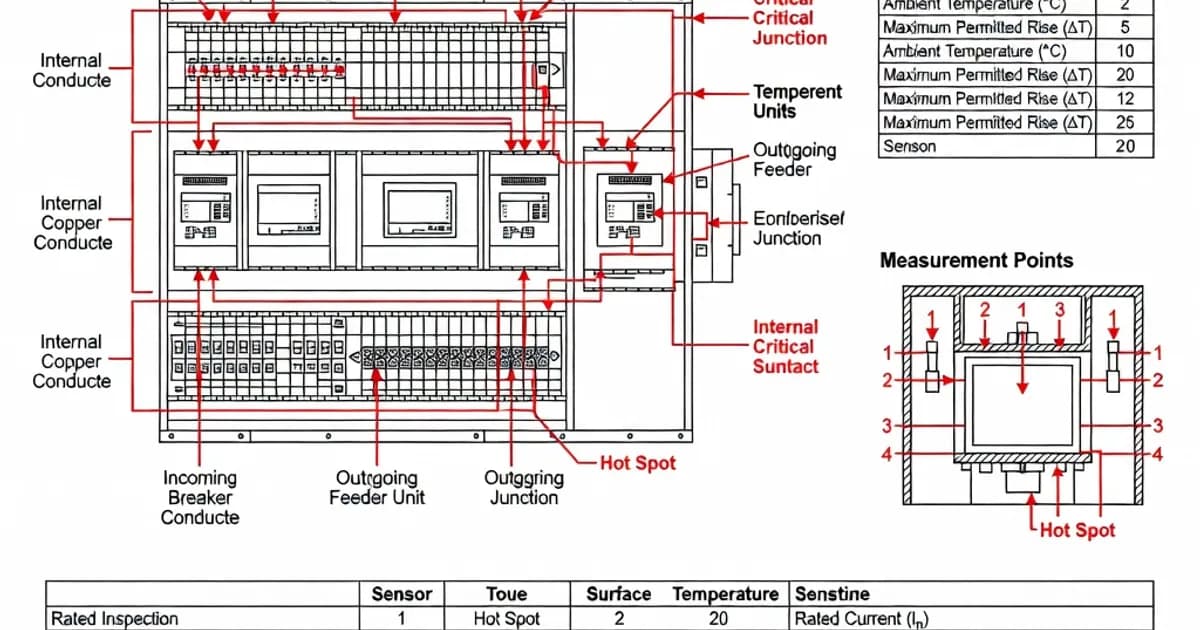
Temperature Rise Verification per IEC 61439
Temperature rise verification is one of the most important design verification requirements in IEC 61439 for low-voltage switchgear and controlgear assemblies. Its purpose is straightforward: prove that the assembly can carry its rated current without any part reaching a temperature that would damage insulation, reduce service life, create unsafe touch conditions, or accelerate the deterioration of busbars, terminals, protective devices, and wiring. Per IEC 61439-1:2020 Clause 10.10, the verification must demonstrate thermal stability under defined ambient conditions and rated load, either by test, by comparison with a verified reference design, or by calculation/assessment where permitted.
In practical terms, temperature rise verification answers a critical engineering question: if the panel is installed and operated as intended, will it remain thermally safe at full load? For Patrion-style IEC 61439 assemblies, this is not a paperwork exercise. It is a core part of ensuring compliance, long-term reliability, and predictable performance in service.
Why temperature rise matters in low-voltage assemblies
Electrical losses in busbars, terminals, contactors, circuit breakers, and conductors are converted into heat. If that heat is not dissipated effectively, the enclosure temperature rises. Excessive heat can soften insulation, loosen terminations, increase contact resistance, and trigger nuisance tripping or premature failure. This risk grows with higher current, compact layouts, higher ambient temperature, restricted ventilation, and higher internal power loss density.
IEC 61439 therefore sets clear temperature-rise limits for different materials and components and requires verification at the assembly level, not just at individual component level. The standard recognizes that a device that is acceptable by itself may still overheat when installed in a dense enclosure with other heat sources.
How IEC 61439 Defines the Thermal Environment
IEC 61439-1 Clause 6.1 establishes the reference ambient conditions for temperature rise verification. The standard assumes a maximum ambient air temperature of 40°C, with a daily average not exceeding 35°C. Verification is typically based on operation in this reference environment unless a special environment is declared and agreed. The practical implication is that temperature rise limits are measured above a 35°C reference ambient, not in absolute temperature alone.
This matters because a panel that is acceptable at a 35°C ambient may be overloaded thermally in a hotter installation, such as a plant room, rooftop enclosure, or poorly ventilated utility space. Where the ambient is above the standard reference conditions, the manufacturer must consider derating, improved ventilation, or a different design.
Typical temperature-rise limits used in verification
IEC 61439 and related design guidance distinguish between exposed conductive parts, insulated conductors, and individual components. The commonly applied limits are summarized below, noting that exact values depend on the specific part, material, and standard clause applied.
| Item | Common Limit | Notes |
|---|---|---|
| Bare copper busbars | 140°C | Typical limit cited in verification guidance for uninsulated copper current-carrying parts. |
| Bare aluminum busbars | 80°C | Lower limit reflects aluminum’s material characteristics and connection behavior. |
| Individual components | 125°C | Applied to many electrical components subject to the relevant product standard and assembly conditions. |
| External insulated conductors | 105°C | Used to protect insulation performance and connected accessories. |
These values are widely referenced in IEC 61439 design guidance and manufacturer documentation, including ABB, Schneider Electric, and BEAMA materials that explain how the standard is applied in practice. As documented in ABB’s “The standard IEC 61439 in practice,” verification must ensure that all relevant parts remain within their permitted thermal limits at rated current and rated ambient conditions.[1] Schneider Electric likewise emphasizes the 105/125/140°C framework as the basis for thermal stability in low-voltage assemblies.[6]
IEC 61439 Temperature Rise Verification Methods
Per IEC 61439-1 Clause 10.10, there are multiple acceptable methods for temperature rise verification. The method selected depends on the design, the current rating, the configuration complexity, and whether a tested reference design exists.
1. Verification by test of the complete assembly
The most direct method is to test the complete assembly under representative load. This proves the actual thermal behavior of the panel as built, including the interactions between busbars, devices, wiring, internal barriers, and enclosure ventilation. It is the most robust method when the design is novel, highly compact, or likely to experience localized hot spots.
This approach is especially valuable for assemblies with unusual geometry, high power density, or special cooling arrangements. It provides the clearest evidence that the final product meets the standard in the installed configuration.
2. Verification by separate assessment of parts or functional units
IEC 61439 also permits verification of the main busbar system, distribution busbars, and functional units separately, provided the results are valid for the intended assembly configuration. This modular approach is widely used by manufacturers because it reduces the need to test every possible combination as a complete assembly.
As described in the BEAMA guide to verification, design verification can be built from a combination of tested subassemblies and validated thermal data, as long as the final configuration remains within the bounds of what was verified.[5] This approach is common in modular systems from manufacturers such as Rittal, Schneider Electric, Siemens, ABB, and Legrand.
3. Verification by calculation or assessment
Clause 10.10.4 permits temperature-rise verification by calculation or assessment in certain cases. This is especially relevant for naturally ventilated assemblies and for designs where a tested reference is available. For assemblies up to 630 A, IEC/TR 60890 is commonly used as the simplified calculation method. It assumes that heat losses scale in a predictable manner and provides a practical route to verification without full thermal testing.[1]
For higher current assemblies, the 2020 edition of IEC 61439 broadens the practical scope of calculation-based approaches, including application to naturally ventilated assemblies above 1600 A in suitable cases, as noted in manufacturer and industry guidance.[2][4] However, this does not remove the need for engineering judgment. The designer must still account for air paths, enclosure type, power density, and the distribution of losses inside the assembly.
4. Power-loss method for assemblies up to 630 A
For assemblies rated up to 630 A, Clause 10.10.4.2.1 allows a power-loss method using the total dissipated heat of the installed devices and conductors. This method is widely used because it is efficient and conservative when applied correctly. The designer compares the expected heat losses against the thermal capability of a verified enclosure and ventilation arrangement, often with support from IEC/TR 60890 tables and manufacturer software.[1][5]
In practice, this is one of the most useful methods for standard distribution boards, feeder pillars, and smaller switchboards where the internal layout follows a repeatable pattern. ABB’s workbook on IEC 61439 shows how the method can be applied to practical enclosure and busbar configurations, particularly where the assembly remains within the verified current and enclosure envelope.[1]
Relevant Standards and Supporting Documents
Temperature rise verification does not rely on IEC 61439 alone. Several related standards support the design and assessment process.
- IEC 61439-1:2020 — General rules for low-voltage switchgear and controlgear assemblies, including Clause 10.10 on temperature rise verification and Clause 6.1 on ambient conditions.[2][5]
- IEC 61439-2:2020 — Specific requirements for power switchgear and controlgear assemblies, with detailed application of thermal verification for main and distribution busbars and functional units.[4][5]
- IEC/TR 60890:2016 — Method for calculating temperature rise in naturally ventilated enclosures, especially applicable to assemblies up to 630 A.[1]
- IEC 60947 series — Product standards for low-voltage switchgear and controlgear devices, which define component ratings and thermal behavior within assemblies.[1]
- IEC 60529 — IP degree of protection, relevant because enclosure sealing and ventilation influence heat dissipation.[1]
- IEC 62271 series — High-voltage switchgear standards; generally secondary for LV panels but occasionally referenced in hybrid installation contexts.[1]
BEAMA’s verification guide is particularly useful because it translates the standard into a practical engineering workflow and clarifies how multiple verification methods can be combined in one design dossier.[5] Legrand’s white paper also highlights the broader application of calculation methods in modern assemblies, especially where modular design and higher currents require flexible but defensible verification strategies.[4]
Design Implications for Busbars, Functional Units, and Terminals
Temperature rise verification is not just about the enclosure. It is about every current-carrying path in the assembly. Busbars carry the bulk of the current and therefore generate the greatest concentrated losses. Functional units such as molded-case circuit breakers, switch-disconnectors, contactors, and motor starters contribute their own losses, often as localized heat sources. Terminals and conductor connections are especially important because contact resistance can rise sharply if torque, material compatibility, or conductor preparation are poor.
For this reason, design verification must address:
- main busbar temperature rise,
- distribution busbar temperature rise,
- functional unit thermal performance,
- terminal heating,
- interconnection conductor heating, and
- internal air circulation and heat rejection through the enclosure.
In modular systems, the thermal behavior of the busbar system is often verified separately from the device compartments. Rittal’s documentation on thermal verification, for example, describes how individual enclosure sections and modular components can be assessed so that the final assembly remains compliant when configured from proven building blocks.[3]
Manufacturer Practice and Typical Verification Strategies
Major manufacturers apply IEC 61439 using a mix of test evidence, simulation, and reference design logic. The goal is to establish a repeatable thermal design method that supports product families rather than one-off panels.
| Manufacturer | Example Product/System | Typical Temperature-Rise Strategy |
|---|---|---|
| ABB | STRIEBEL & JOHN distribution boards | Uses IEC/TR 60890 calculations and verified configurations up to 630 A; software tools support thermal design and configuration checks.[1] |
| Rittal | Modular enclosure systems | Verifies individual compartments and enclosure variants using modular thermal data and documented enclosure behavior.[3] |
| Schneider Electric | Prisma low-voltage switchboards | Applies IEC 61439-1 Clause 10.10 by testing the complete assembly or validating busbars and functional units separately.[6] |
| Legrand | Power switchgear assemblies | Uses calculation methods for naturally ventilated assemblies, including higher-current designs where supported by the standard.[4] |
| Siemens / Eaton | Modular LV systems | Often relies on power-loss summation up to 630 A and routine verification of the final build against the verified design family.[5] |
These approaches reflect a consistent principle in IEC 61439: the original manufacturer is responsible for design verification, while the assembly manufacturer must ensure the final build matches the verified design and perform routine checks on workmanship, clearances, and documentation.[2][5] This separation of responsibility is essential in multi-variant product families and project-built switchboards.
Best Practices for Reliable Thermal Design
Good temperature-rise performance starts at the concept stage. Once a panel is already crowded with devices, cable bends, and cable ducts, fixing thermal problems becomes expensive and difficult. The most reliable assemblies are designed with heat flow in mind from the beginning.
Use realistic power-loss data
Always use manufacturer power-loss figures for installed devices and busbar systems rather than nominal current alone. The total thermal load is the sum of real losses, not just the rated amperage. This is particularly important for heavily loaded feeders, harmonically stressed systems, and panels with many switching devices.
Preserve natural air paths
Natural ventilation is only effective when internal air can move. Blocking the lower and upper convection paths with dense wiring, cable ducts, or oversized components reduces cooling effectiveness. In naturally ventilated enclosures, the internal arrangement must support upward convection and heat rejection through the enclosure surfaces.
Control ambient assumptions
IEC 61439 assumes 35°C daily average and 40°C peak ambient conditions. If the actual environment is hotter, the design must be adjusted. Likewise, altitude, direct sunlight, humidity, condensation, and poor surrounding airflow can all reduce the margin to thermal limits.[1]
Check the whole current path
A compliant busbar system can still fail if a terminal, plug-in connector, or cable lug is poorly selected or improperly tightened. Thermally sound design depends on correct torque, compatible materials, clean contact surfaces, and proper conductor sizing.
Use combined verification methods intelligently
Many manufacturers combine calculation, reference comparison, and test evidence within one design verification package. This is efficient and fully aligned with the standard when the scope of each method is respected. For example, a busbar system may be tested, while the enclosure’s thermal performance is confirmed through calculation and the device compartments are validated using a previously verified layout.[5][6]
Common Compliance Pitfalls
Even experienced designers can make mistakes in temperature rise verification. The most common issues include:
- assuming component ratings automatically guarantee assembly compliance,
- ignoring extra losses from device grouping and dense wiring,
- reusing a verified layout but changing ventilation openings or enclosure depth,
- overlooking the impact of IP degree of protection on heat dissipation,
- failing to account for higher ambient temperatures at the installation site, and
- treating a calculation as valid when the actual assembly departs materially from the verified reference design.
These errors matter because thermal compliance is highly sensitive to details. A small reduction in airflow or a modest increase in internal loss can shift a panel from safe operation to marginal performance. That is why IEC 61439 places the verification burden on the design and on the actual assembly configuration, not only on catalog component ratings.
What the 2020 Edition Changed
Edition 3 of IEC 61439, published in 2020, strengthened and clarified the verification framework. Industry guidance notes that the newer edition expands the practical use of calculation methods, particularly for naturally ventilated assemblies above 1600 A where appropriate engineering evidence is available.[2][4] The updated structure also aligns better with modular product families and the way modern assemblies are actually engineered and validated.
In practical terms, this helps manufacturers with broad product ranges by making it easier to build a compliance dossier from tested building blocks, validated thermal data, and controlled configuration rules. It does not relax the thermal requirement; rather, it gives manufacturers more precise tools to prove compliance efficiently.
How Patrion-Style IEC 61439 Assemblies Should Approach Verification
For IEC 61439-compliant low-voltage panel assemblies, the correct approach is to treat temperature rise verification as a design discipline. The engineer should define the current path, calculate or measure the thermal load, verify the busbar and enclosure behavior, and ensure that the final build matches the verified configuration. Where a family of assemblies is offered, the verification method should be repeatable and documented so that every variant stays inside its allowed thermal envelope.
That approach supports both compliance and maintainability. It also reduces risk at commissioning and throughout the service life of the panel. When properly executed, temperature rise verification helps ensure the assembly can operate at rated current without overheating, nuisance failures, or premature aging.
References and Further Reading
[1] ABB: The standard IEC 61439 in practice
[2] IEC 61439 verification methods overview
[3] Rittal thermal verification document
[4] Legrand white paper: Construction and certification of assemblies
Ready to Engineer Your Next Panel?
Our team of electrical engineers is ready to design, build, and deliver your custom panel solution — fully compliant with international standards.