Busbar Systems Design Guide for Industrial Panels
Comprehensive guide to busbar sizing, material selection, and installation.
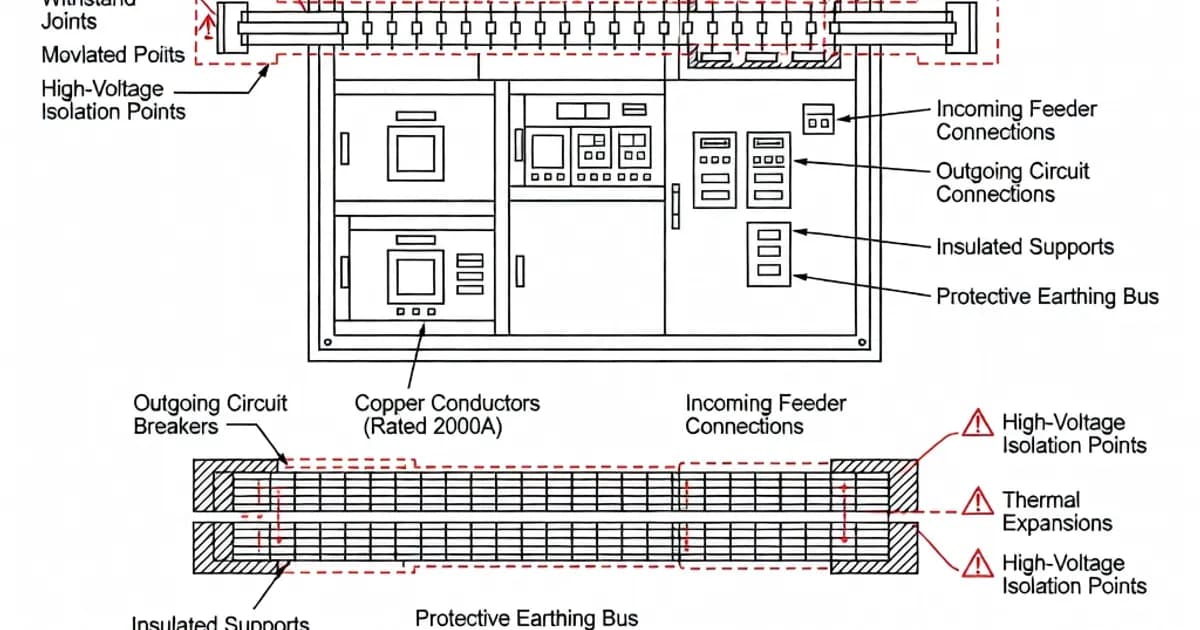
Busbar Systems Design Guide for Industrial Panels
Busbar systems are the backbone of industrial low-voltage panels, switchboards, and distribution assemblies. A correctly designed busbar arrangement delivers high current density, compact installation, predictable fault performance, and maintainable power distribution. An incorrectly designed system, by contrast, can overheat, deform under fault stress, or fail to coordinate with protective devices. That is why modern industrial panel design must be approached through IEC 61439 compliance, not by informal sizing alone.
IEC 61439 is the governing family of standards for low-voltage switchgear and controlgear assemblies with rated voltages up to 1000 V AC and 1500 V DC, as noted in IEC 61439-1 and summarized in multiple industry guides. The standard replaced IEC 60439 and shifted the focus from component-level assumptions to verified assembly performance, including temperature rise, dielectric strength, clearances, creepage, and short-circuit withstand capability. Per IEC 61439-1, the manufacturer of the assembly must verify the design before it is placed on the market or put into service.
Why busbar design matters in industrial panels
Busbars distribute power from the incoming source to feeders, motor starters, drives, control circuits, and downstream distribution loads. Because they typically carry the full assembly current, busbars must be sized for continuous current, transient overloads, and prospective short-circuit current. As documented in the ABB workbook on IEC 61439 practice, the busbar arrangement inside the enclosure must be validated as part of the complete assembly, not as a standalone conductor in free air. That distinction is important because enclosure geometry, ventilation, support spacing, insulation, and adjacent functional units all influence thermal and mechanical behavior.
For industrial panels, busbar systems also improve build consistency. Compared with point-to-point cabling, a structured busbar architecture reduces wiring density, simplifies expansions, and improves repeatability across production batches. Modern systems often eliminate drilling of live conductors by using purpose-built adapters, standoffs, and feeder blocks, which reduces installation error and supports safer maintenance. As noted in manufacturer guidance from Messung and Hensel, the design goal is not only to carry current, but to do so with controlled temperatures, predictable fault performance, and practical service access.
IEC 61439 scope and structure
The IEC 61439 family is organized by assembly type. IEC 61439-1 covers general rules for low-voltage switchgear and controlgear assemblies, while IEC 61439-6 addresses busbar trunking systems and busbar trunking units. UL’s overview of these parts confirms that IEC 61439-6 focuses specifically on busbar trunking as a product category, including configurations with tap-off facilities and modular connection arrangements. This distinction matters because trunking systems and assembled switchboards face different mechanical and thermal constraints.
IEC 61439 also replaced the older IEC 60439 framework. The newer standard introduced a more rigorous verification philosophy, especially for thermal rise and short-circuit behavior. In practical terms, this means panel builders can no longer rely solely on generic tables or historical precedent; they must verify the exact assembly design, including busbar layout, conductor selection, supports, and enclosure conditions.
Voltage, current, and system boundary conditions
Busbar design begins with the system’s electrical limits. IEC 61439 applies to assemblies rated up to 1000 V AC and 1500 V DC, which covers the vast majority of industrial low-voltage distribution applications. Within that envelope, the designer must determine the rated operational current, prospective short-circuit current, frequency, ambient temperature, altitude, pollution conditions, and enclosure IP rating. These factors influence conductor sizing and verification margins.
In practice, a busbar that performs well at 40°C ambient in a ventilated room may require derating in a sealed enclosure, a rooftop installation, or a location with high internal heat from drives and transformers. IEC 61439 requires the assembly manufacturer to declare the rated current under defined conditions and to verify that temperature rise limits are respected. Schneider Electric’s IEC 61439 guidance highlights that rated current is not a fixed property of the busbar alone; it is a property of the complete panel system under the declared installation conditions.
Short-circuit withstand capability
Short-circuit withstand is one of the most critical busbar design requirements. When a fault occurs, the busbar must remain mechanically intact and electrically secure until the associated short-circuit protective device disconnects the fault. Per IEC 61439-1 clause 8.6.1 and the verification requirements in clause 9.3, conductors must be dimensioned to withstand the fault current expected at the supply side of the assembly.
The standard places explicit constraints on the arrangement of non-protected live conductors. According to the ABB guidance and IEC 61439-related design notes, the total length of non-protected live conductors between the main busbar and the associated short-circuit protective device should not exceed 3 m. This requirement reduces the risk that an upstream fault will propagate into an unprotected conductor section before the protective device clears the fault.
Designers must also ensure that busbars and their supports can resist electrodynamic forces. Under high fault current, parallel conductors repel or attract each other violently, and insufficient support spacing can cause deformation, insulation damage, or phase-to-phase contact. That is why short-circuit verification is both electrical and mechanical. It is not enough to know the thermal Icw value; the assembly must also survive the peak current and associated forces without displacement or rupture.
Busbar arrangement, insulation, and spacing
IEC 61439-1 clause 8.6.1 requires busbars, whether bare or insulated, to be arranged so that internal short circuits are prevented. The conductors must be selected and installed so that a short circuit between phases or between phase and earth is not expected in normal service, with specific arrangements addressed in the standard’s tables and verification methods. This means the physical layout is part of compliance.
Good busbar design uses controlled centerline spacing, consistent support points, and insulation systems appropriate to the operating voltage and contamination level. Many industrial panels use copper busbars with insulating barriers or heat-shrink sleeves to improve creepage and clearance performance. Where bare busbars are used, the enclosure must provide adequate separation and barrier protection. In all cases, the busbar system must be coordinated with the enclosure and internal partitioning so that access to one functional unit does not expose adjacent live parts unnecessarily.
As shown in Hensel’s IEC 61439 guide, practical design also considers connection method, tightening torque, and the use of standardized mounting adapters. A well-structured busbar system avoids ad hoc drilling or field modification of live conductors, which would undermine verified performance and increase the chance of assembly errors.
Busbar material and typical physical parameters
Copper remains the dominant material for industrial busbars because of its high conductivity, good thermal performance, and favorable mechanical strength. In some applications aluminum is used to reduce weight or cost, but copper is generally preferred where compactness, higher fault strength, and robust terminations are required. The selected cross-section must support both continuous current and short-circuit duties, while also fitting within the thermal limits of the enclosure.
The table below summarizes common design parameters seen in industrial panel busbar practice. Actual values must always be verified against the specific system design and the manufacturer’s IEC 61439 verification data.
| Design Parameter | Typical Value | Design Significance |
|---|---|---|
| Standard voltage range | Up to 1000 V AC / 1500 V DC | Defines IEC 61439 applicability |
| Non-protected conductor length | Maximum 3 m | Limits fault exposure before protective device clearing |
| Busbar material | Copper, commonly | High conductivity and fault withstand capability |
| Typical centerline spacing | 60 mm | Common industrial layout for phase separation |
| Typical thickness | 10 mm for phases, 5 mm for PE in some systems | Illustrative dimensioning reference, not universal |
| Terminal tightening torque | 6.0 Nm in some systems | Ensures stable contact resistance and avoids overheating |
These values, referenced in manufacturer and design guide literature, are useful starting points only. The final busbar dimensions depend on current rating, ambient temperature, ventilation, enclosure type, and short-circuit duty. Overly conservative spacing can waste enclosure volume, while insufficient spacing risks dielectric failure and overheating.
Current-carrying capacity and thermal verification
IEC 61439 requires verification of temperature rise limits for busbars, connections, and functional units. Thermal behavior is central because contact resistance increases with temperature, and increased temperature can accelerate insulation aging and reduce reliability. Verification can be performed by test, comparison with a tested reference design, or assessment using documented design rules and calculation methods.
Design tools from busbar manufacturers commonly calculate current-carrying capacity using busbar cross-section, support spacing, orientation, and enclosure data. For example, one published design reference indicates that a 20 mm × 10 mm busbar with two supports spaced 300 mm apart can achieve approximately 53 kA short-circuit strength. Such values illustrate how support geometry affects mechanical resilience, not just ampacity. A busbar with the correct cross-section but poor support spacing may still fail under fault stress.
Thermal verification also covers connection points. Busbar joints, tap-offs, and feeder terminals often run hotter than the straight busbar sections because of localized resistance and reduced surface area for heat dissipation. For that reason, torque control, contact surface preparation, and approved connector hardware are essential parts of the verified design. As emphasized in IEC 61439 practice guides, every bolted connection should be assembled to the manufacturer’s specified torque and checked during commissioning.
Busbar trunking systems under IEC 61439-6
Busbar trunking systems deserve special attention because they are prefabricated distribution systems intended to route power over distance while maintaining compact form and safe tap-off capability. IEC 61439-6 defines busbar trunking units as assemblies that include busbars, supports, insulation, an outer enclosure, and connecting means, with or without tap-off facilities. The standard also recognizes modular geometries such as straight sections, elbows, tees, and crosses.
One practical advantage of trunking is flexibility. Instead of pulling large parallel cables through congested routes, designers can install a trunking backbone and add tap-off units as loads evolve. This is especially valuable in factories, data halls, warehouses, and production lines where distribution points may change over time. IEC 61439-6 also covers trolley-type tap-off facilities, allowing roller- or brush-type interfaces for moving loads or specialized equipment.
However, trunking systems must still meet the same core obligations: verified temperature rise, short-circuit withstand, proper enclosure integrity, and reliable connection methods. The modular nature of busbar trunking does not reduce compliance obligations; it simply changes how the distribution system is packaged and installed.
Verification methods and compliance workflow
IEC 61439 recognizes three verification methods: verification by test, verification by comparison, and verification by assessment. In a modern industrial panel workflow, the designer should treat these as complementary tools within a controlled compliance process.
Verification by test is the most direct method and is commonly used for reference assemblies, new busbar systems, or arrangements with unusual thermal or mechanical loading. Verification by comparison allows a designer to rely on a proven design if the new arrangement stays within the tested envelope. Verification by assessment uses engineering judgment and documented calculation rules when the underlying assumptions are well established.
The critical change introduced by IEC 61439 is that busbar systems must be evaluated in the enclosure and configuration in which they are actually used. This is a major improvement over earlier approaches that relied too heavily on isolated conductor tests. As noted in industry commentary, in-situ testing provides more realistic data because the busbar, mounting hardware, enclosure, and airflow all interact in service.
Design best practices for industrial panel builders
Successful busbar design starts before fabrication. The panel engineer should define the electrical and mechanical requirements at the design stage, including normal current, prospective fault current, mounting constraints, upgrade path, and environmental conditions. This is where component selection matters most. The busbar product, protective devices, enclosure, terminal system, and accessories must be chosen as a coordinated set, not as independent parts.
Key best practices include:
- Specify the rated current and prospective short-circuit current early in the project.
- Verify thermal performance for the exact enclosure and ventilation conditions.
- Maintain approved support spacing and avoid unverified field modifications.
- Use manufacturer-approved connectors, adapters, and tap-off devices.
- Apply specified tightening torque to all busbar joints and terminal connections.
- Confirm that non-protected live conductor runs stay within the 3 m limit.
- Document the verification method used for each design requirement.
Modern busbar systems also support faster maintenance. Instead of re-terminating multiple cables, technicians can isolate a feeder and replace a tap-off module or functional unit. This reduces downtime and improves service consistency, provided the system is designed with safe access and clear isolation points.
How to select a busbar system for a new panel
When specifying a busbar system for an industrial panel, the designer should compare several technical attributes: continuous current rating, short-circuit withstand level, centerline spacing, degree of internal separation, tapping flexibility, enclosure compatibility, and available verification data. For larger assemblies, it is also important to consider whether the system is optimized for horizontal distribution, vertical risers, or modular trunking between cells.
Manufacturer tools from suppliers such as Wöhner, and technical documentation from ABB, Hensel, and others, can be used to estimate current capacity and short-circuit performance based on geometry and support arrangement. These tools are valuable, but they do not replace the need for full assembly verification. They should be used to support the design process, not as a substitute for compliance evidence.
In practice, a well-chosen busbar system should offer enough electrical headroom for future load growth, while remaining compact enough to preserve workable cable routing and heat management inside the enclosure. Over-specifying the busbar can inflate cost and size; under-specifying it can create reliability and compliance problems. The best design is the one that is verified, documented, and appropriate to the application.
Comparison of busbar system considerations
| Aspect | Busbar System | Conventional Cable Distribution |
|---|---|---|
| Space efficiency | High; compact power backbone | Lower; cable bundles occupy more volume |
| Expansion | Tap-off units simplify additions | New cable runs and re-termination often required |
| Verification focus | Thermal rise, mechanical support, fault withstand in enclosure | Cable ampacity, routing, and termination quality |
| Maintenance | Modular and accessible when properly designed | More labor-intensive for large feeder groups |
| Fault performance | Highly dependent on support spacing and enclosure verification | Dependent on conductor size and protective coordination |
Documentation, testing, and commissioning
IEC 61439 compliance is not complete until the assembly is documented and the required verifications are traceable. The panel manufacturer should maintain evidence for rated current, short-circuit withstand, dielectric performance, temperature rise, and constructional details. Commissioning should include inspection of busbar supports, joint tightening, barrier placement, and the physical integrity of insulation components.
Commissioning checks are especially important for busbar systems because many failures originate from loose connections, incorrect torque, missed insulating parts, or unauthorized site modifications. A visually correct installation is not enough; the installer must confirm that the assembly matches the verified design. Where the busbar system is part of a larger plant distribution network, coordination with upstream and downstream protective devices should also be checked to ensure the intended fault-clearing sequence.
Summary
Busbar design for industrial panels is a standards-driven engineering task. IEC 61439 requires verified performance up to 1000 V AC and 1500 V DC, with explicit attention to temperature rise, short-circuit withstand, conductor arrangement, and assembly construction. The most important design principles are simple but non-negotiable: choose the correct material and cross-section, maintain approved support spacing, keep non-protected live conductor runs within the allowed limit, and verify the complete assembly in its real enclosure.
When designed and verified correctly, a busbar system offers compactness, scalability, and dependable power distribution. When designed casually, it creates thermal and fault risks that no amount of field workmanship can fully correct. For industrial panels, IEC 61439 compliance is therefore not an administrative checkbox; it is the foundation of safe and reliable busbar engineering.
References and Further Reading
- IEC 61439 Busbar Standard overview
Related Panel Types
Main Distribution Board (MDB)Primary power distribution from transformer to sub-circuits. Rated up to 6300A. Houses main incoming breaker, bus-section, and outgoing feeders.
Power Control Center (PCC)High-capacity power distribution for industrial facilities. Controls and distributes incoming power to MCC, APFC, and downstream loads.
Related Components
Related Standards
Frequently Asked Questions
Busbar sizing in an IEC 61439 assembly is not based on a single table alone; it must be verified for temperature rise, short-circuit withstand, and spacing within the specific enclosure. Start with the rated operational current (Ie), ambient temperature, and enclosure ventilation, then use manufacturer data for the exact bar profile and support system. IEC 61439-1 requires the assembly designer to confirm that temperature limits are not exceeded under reference conditions, while short-circuit performance must align with the conditional short-circuit current rating (Icc) or verified withstand data. In practice, copper bars are often selected using current density guidance, but final sizing should be validated against the panel builder’s tested configuration. For industrial panels, busbar cross-section, phase arrangement, and support spacing all affect heat dissipation and fault performance. Always check the bar arrangement against the assembly verification report, not just a generic ampacity chart.Copper is usually preferred in industrial switchboards because it offers higher conductivity, better compactness, and more reliable terminations in IEC 61439 assemblies. It allows smaller cross-sections for the same current, which helps in dense panels, MCCs, and PCCs. Aluminum can be a valid choice where weight and cost reduction are priorities, but it requires careful surface preparation, correct lugs, anti-oxidation measures, and compatible hardware to control joint resistance. IEC 61439 does not mandate one material over the other; it requires the assembly to meet thermal, mechanical, and short-circuit verification requirements. For high-duty applications such as 630 A to 4000 A systems, copper busbars are often easier to engineer and verify. Where aluminum is used, panel builders typically specify tinned or anodized interfaces and torque-controlled connections to reduce oxidation-related heating. The best choice depends on current rating, enclosure size, environment, and maintenance philosophy.Busbar spacing must be determined by the assembly’s rated insulation voltage, pollution degree, altitude, and the insulation system used. IEC 61439 requires sufficient clearances and creepage distances to avoid flashover and tracking under normal service conditions, but the exact distances depend on the application and the insulation material group. In industrial panels, bare copper bars usually rely on air clearances plus barriers, shrouds, or heat-shrink insulation to maintain safety margins. For metal-enclosed assemblies, spacing also affects short-circuit force withstand and ease of maintenance. As a practical matter, panel builders often use phase barriers, finger-safe covers, and insulated support systems from manufacturers such as Schneider Electric, ABB, Siemens, or Rittal to achieve consistent separation. Any reduction in spacing must be backed by verified design data. If the panel operates in humid, dusty, or corrosive environments, larger creepage distances and better shielding are strongly recommended.Reliable busbar joints depend on clean contact surfaces, correct overlap area, controlled torque, and suitable hardware. In IEC 61439 assemblies, joint quality is critical because poor connections create local heating, voltage drop, and reduced short-circuit robustness. Busbar interfaces should be prepared by removing oxide, using matched plating where applicable, and tightening with calibrated torque tools to the values specified by the busbar system manufacturer. Spring washers or Belleville washers may be used where the system design calls for maintaining contact pressure under thermal cycling. For copper systems, tin-plated bars and compatible copper lugs are common; for aluminum, contact compound and immediate assembly after surface preparation are often required. Joints should be mechanically supported so that fault forces do not transfer directly to the connection bolts. After installation, thermal imaging during commissioning is a good practice to detect abnormal resistance before the panel is placed into service.Yes. IEC 61439 requires the assembly designer to verify that the busbar system can withstand the expected short-circuit stresses without dangerous deformation, disconnection, or insulation failure. This is not optional for industrial panels because fault currents can produce extreme electrodynamic forces and rapid thermal rise. Verification can be achieved by testing, comparison with a tested reference design, calculation, or design rules where applicable. The relevant values include prospective short-circuit current, peak withstand current, and short-time withstand current (Icw). A busbar system that is adequate for normal load current may still fail during a fault if the supports are too far apart, the bar thickness is insufficient, or the connection hardware is underrated. Manufacturers such as Schneider Canalis, Siemens Sivacon, ABB, and Rittal provide verified busbar systems with published short-circuit ratings. Always align the busbar arrangement, support spacing, and enclosure layout with the verified data for the exact product family used.The best finish depends on the environment, current level, and maintenance strategy. Bare copper is common inside controlled industrial enclosures, but tinned copper is often preferred because it resists oxidation and improves long-term contact stability at bolted joints. Silver plating offers excellent conductivity and low contact resistance, but it is usually reserved for high-performance applications, very high currents, or critical connection interfaces because it is more costly and can tarnish in certain environments. IEC 61439 focuses on the assembly’s performance rather than prescribing a finish, so the decision is typically made by the panel designer based on thermal and corrosion requirements. In humid, polluted, or coastal locations, tinned or insulated busbars are generally safer choices. For aluminum busbars, surface treatment is even more important because oxide formation can increase joint resistance. Whatever finish is selected, it must be compatible with the connector, torque specification, and protective coating system used in the panel.Busbar support insulators do more than hold the bars in place; they determine spacing, vibration resistance, and short-circuit mechanical strength. In IEC 61439 assemblies, the busbar support system must be verified for the electrodynamic forces generated during faults, which can be very high even for short durations. If supports are too far apart or made from a low-strength material, the bars can deflect, clash, or loosen at joints. Support insulators also influence heat dissipation, since they may partially block airflow around the conductors. Common industrial solutions include polyester, glass-reinforced polyester, or epoxy-based supports from OEM busbar system suppliers. The right support spacing depends on the bar size, fault level, and orientation. Vertical and horizontal mounting can have different mechanical behavior. For high-current panels, engineers often use tested support kits from systems like ABB Zubba, Siemens busbar assemblies, or Schneider busbar trunking components to ensure documented performance under load and fault conditions.Any modification to an IEC 61439 panel that affects current path, spacing, supports, terminations, or enclosure ventilation should trigger a revalidation review. Even seemingly small changes, such as adding a tap-off, replacing a busbar support, changing bar thickness, or moving a cable entry, can alter temperature rise and short-circuit performance. IEC 61439 places responsibility on the assembly designer or modifier to ensure the updated design remains compliant. If the change is outside the original verified configuration, you may need recalculation, comparative assessment, or testing depending on the extent of the modification. For example, substituting a non-original busbar support or drilling extra holes in a bar can reduce mechanical strength and invalidate the fault rating. In industrial practice, OEM systems from manufacturers like Siemens, ABB, Schneider Electric, or Rittal should be modified only within their documented accessory ranges. If the alteration is significant, treat the panel as a new assembly and verify it accordingly before energizing.
Ready to Engineer Your Next Panel?
Our team of electrical engineers is ready to design, build, and deliver your custom panel solution — fully compliant with international standards.