Circuit Breaker Testing and Maintenance
Testing and maintaining ACBs and MCCBs in panel assemblies.
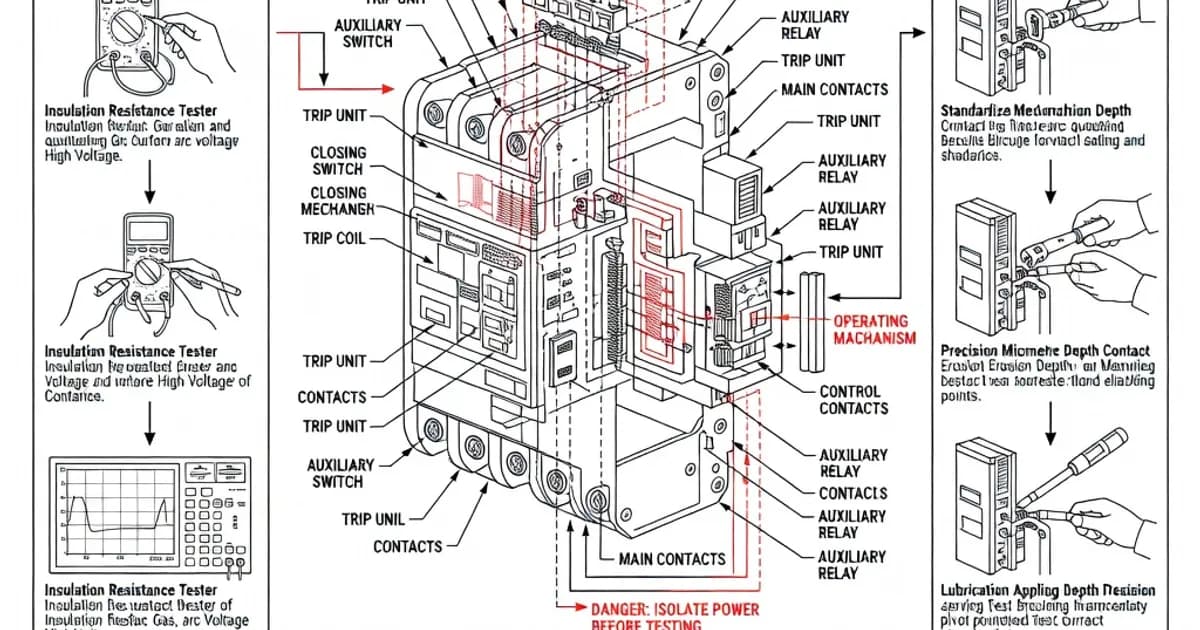
Circuit Breaker Testing and Maintenance
Circuit breaker testing and maintenance in IEC 61439 low-voltage panel assemblies is not a generic “check and clean” activity. It is a structured verification process that confirms the assembly still meets its declared performance for dielectric strength, temperature rise, short-circuit withstand, protective circuit continuity, mechanical operation, and degree of protection. In assemblies built around ACBs and MCCBs, these checks protect both the breaker and the panel as a complete system. Per IEC 61439-1, the assembly must be verified by design verification and routine verification, and maintenance should preserve the conditions on which that verification was based.
In practice, this means maintenance teams must understand not only the breaker manufacturer’s instructions, but also the assembly-level requirements in IEC 61439-1 and IEC 61439-2. For example, a breaker may be rated for high interrupting capacity, but the panel still needs verified clearances, creepage distances, busbar spacing, protective conductor continuity, and thermal margins. As documented in the ABB “Standard IEC 61439 in Practice” workbook and related guidance, the assembly is only as strong as the weakest verified interface between components, conductors, enclosure, and installation method.
Why testing matters in IEC 61439 assemblies
Testing and maintenance serve two different purposes. Design verification confirms that a type of assembly can withstand electrical and thermal stresses when built according to the declared design. Routine verification confirms that the specific panel delivered to site was assembled correctly and remains safe in service. IEC 61439-1 Clause 11 requires routine verification of critical items before energization, including wiring continuity, insulation resistance, and functional operation. In service, periodic maintenance is used to detect deterioration caused by heat, vibration, pollution, condensation, loose terminations, mechanical wear, or fault stress.
This distinction is important for both ACBs and MCCBs. An air circuit breaker in a main incomer may be subjected to high short-time current duties, while an MCCB in a feeder compartment may see frequent switching and thermal cycling. Both devices depend on the panel’s ability to support their declared Ui, Ue, and Uimp values and to prevent unsafe temperature rise under load.
Applicable standards and verification framework
The core references for low-voltage assembly testing are IEC 61439-1:2020 and IEC 61439-2:2020. IEC 61439-1 provides the general rules, including design verification in Clause 10 and routine verification in Clause 11. IEC 61439-2 applies to power switchgear and controlgear assemblies, including many breaker-based switchboards above 630 A. IEC 60947-2 governs the circuit breakers themselves, while IEC 60529 defines enclosure degrees of protection. Where thermal verification is based on calculation rather than physical testing, IEC 60890 is commonly used for assemblies up to 630 A, subject to the manufacturer’s documented design assumptions.
In technical documentation from ABB, Hager, Schneider Electric, and other manufacturers, the practical message is consistent: breaker maintenance cannot be separated from assembly compliance. A properly maintained panel preserves the verified design; a neglected panel can invalidate the assumptions behind the IEC 61439 verification package.
What must be tested in circuit breaker assemblies?
For assemblies containing ACBs and MCCBs, the main testing categories are dielectric verification, temperature rise verification, short-circuit withstand verification, and routine operational checks. These are not optional extras. They address the primary failure modes of low-voltage switchboards: insulation breakdown, overheating, mechanical malfunction, and fault-related destruction.
| Verification item | IEC reference | Purpose | Typical evidence |
|---|---|---|---|
| Dielectric properties | IEC 61439-1 Clause 10.9 | Confirms insulation withstands overvoltage and test stress | Power-frequency withstand test, insulation resistance reading |
| Temperature rise | IEC 61439-1 Clause 10.10 | Ensures components remain within safe operating temperatures | Test report, calculation, or reference design comparison |
| Short-circuit withstand strength | IEC 61439-1 Clause 10.11 | Proves the assembly can survive specified fault current | Test record or verified reference design |
| Routine verification | IEC 61439-1 Clause 11 | Confirms correct assembly and safe operation before energization | Continuity, insulation, function, inspection checklist |
Dielectric properties verification
Per IEC 61439-1 Clause 10.9, dielectric verification checks the insulation system of the main circuit and associated auxiliary and control circuits connected to it. The standard allows verification by power-frequency withstand voltage test, and the test values are derived from the rated insulation voltage Ui. For assemblies in the common range of 300 V < Ui ≤ 690 V, the test level in Table 8 is typically 1890 V AC for 1 second, applied under the prescribed conditions.
Insulation resistance is another key metric. Practical maintenance guidance and IEC-based summaries commonly apply a minimum of 1000 Ω/V relative to nominal voltage. In a 230/400 V system, this yields a target of at least 0.5 MΩ, with higher values preferred in clean, dry assemblies. In service, many maintainers aim for values above 1 MΩ as a pragmatic benchmark, especially after cleaning and drying. A low reading may indicate moisture ingress, dust contamination, carbon tracking, damaged wiring, or a deteriorated breaker accessory circuit.
Because dielectric failure can be sudden and catastrophic, maintenance should include visual inspection for discoloration, cracking, soot, loose terminations, and evidence of corona or tracking around terminals, shrouds, and busbar supports. Schneider Electric’s short-circuit withstand guidance and ABB’s IEC 61439 materials both emphasize that layout, spacing, and accessory installation strongly influence dielectric reliability.
Temperature rise verification
Temperature rise verification is one of the most important assembly-level tests in IEC 61439-1 Clause 10.10. The objective is to confirm that under rated current, the temperature of busbars, terminals, protective devices, and accessible surfaces remains within permissible limits. This matters because prolonged overheating accelerates insulation aging, increases contact resistance, and can deform polymer parts or loosen joints.
For breaker-based assemblies, the declared current rating must be proven in the actual enclosure arrangement. That is especially important where multiple outgoing feeders, neutral conductors, harmonic loads, or compact wiring routes create local hot spots. Manufacturer guidance frequently uses full-rated current testing or validated reference designs. The research notes that some modern assemblies can be verified for total current levels up to 4000 A across incomers and feeders, provided the design basis supports it.
IEC 61439-1 permits temperature rise verification by test, by calculation, or by comparison with a reference design, depending on the component and the documented assumptions. However, maintenance teams should not confuse design verification with service verification. In the field, thermal scanning, torque checks, and visual inspection are maintenance tools, not substitutes for initial verification. If hot spots appear during infrared inspection, the usual causes are loose connections, overloaded poles, poor ventilation, blocked filters, incorrect cable lugs, or degraded breaker contacts.
Short-circuit withstand strength
Short-circuit withstand verification is governed by IEC 61439-1 Clause 10.11. This clause confirms that the assembly can withstand the thermal and mechanical effects of fault current without unacceptable damage, loss of protective function, or dangerous arc propagation. The relevant ratings include short-time withstand current Icw and conditional short-circuit current Icc. In a properly designed switchboard, the protective device must interrupt or limit the fault so that busbars, supports, and conductors remain within their capability.
Schneider Electric’s technical guidance on short-circuit withstand highlights an essential principle: the breaker and the upstream/downstream coordination strategy must be considered together. The assembly must be laid out to prevent flashover and arc spread, especially around outgoing functional units and busbar compartments. Minimum distances to panels and busbars, use of current-limiting devices where appropriate, and correct separation between compartments all contribute to fault survivability.
IEC 61439 verification is not only about peak fault current. The declared conditions of use matter as well, including rated voltage, power factor, and test arrangement. In practical terms, maintenance should verify that modifications have not reduced the fault withstand margin. Replacing an MCCB with a different frame size, adding non-original auxiliaries, or extending cable runs without reassessing protection coordination can undermine the original short-circuit design.
Routine testing and maintenance procedures
Routine verification under IEC 61439-1 Clause 11 is performed on the completed assembly before it is placed in service, and similar checks should be repeated during planned maintenance outages. The aim is to confirm that the assembly still matches the verified design and has not been compromised by handling or operation.
Routine verification checklist
- Inspect the enclosure for mechanical damage, corrosion, contamination, and ingress points.
- Verify protective circuit continuity, including bonding of doors, frames, and removable parts.
- Check clearances and creepage distances where modifications have been made.
- Measure insulation resistance, using the manufacturer’s recommended test voltage and safety procedure.
- Perform power-frequency withstand testing where required by the commissioning plan or maintenance regime.
- Verify correct mechanical operation of breaker handles, spring-charging mechanisms, interlocks, shutters, and racking systems.
- Test electrical operation of trip units, shunt releases, undervoltage releases, closing coils, indication contacts, and alarms.
- Confirm that labels, settings, and protection coordination data match the approved design.
Electrical Engineering Portal’s routine test guidance aligns with this approach: the routine checklist should focus on continuity, insulation, functional checks, and a careful visual inspection of the assembly’s physical condition. For panels with frequent switching duty or harsh environments, these checks should be more frequent than the minimum commissioning-only approach.
Mechanical and electrical operation testing
Mechanical operation testing is particularly important for ACBs, which often have complex stored-energy mechanisms, drawout arrangements, and interlocking systems. A breaker that is electrically healthy but mechanically sticky or poorly aligned can fail to close, fail to trip, or fail to isolate correctly. Maintenance should include manual and electrical operation of the breaker, verification of closing and opening times where relevant, and inspection of contact wear indicators.
MCCBs also require functional attention, although the mechanism is usually simpler. Confirm that the operating handle moves positively, the trip indication is clear, and any accessory contacts or trip units respond correctly. If the breaker has electronic protection, verify settings, test buttons, and communication interfaces where used. The condition of accessories matters because control-circuit faults can prevent reliable tripping just as effectively as a damaged power pole.
Insulation resistance and dielectric testing in maintenance
Insulation resistance testing is one of the most common maintenance activities, but it must be interpreted correctly. A low reading does not always mean immediate failure; it may reflect dampness or pollution. However, repeated low readings, especially after cleaning and drying, indicate a genuine insulation problem. A common practical threshold used in IEC-based maintenance programs is 1000 Ω/V, with higher readings preferred for healthy assemblies.
Where maintenance requires a withstand test, the test voltage must correspond to the assembly’s rated insulation voltage and the applicable IEC 61439 table. Careless testing can damage electronic trip units, meters, surge protection devices, and communication modules. Sensitive devices should be disconnected or isolated in accordance with the manufacturer’s instructions before applying the dielectric test.
Clearances, creepage, and conductor arrangement
IEC 61439-1 Clause 10.4 addresses clearances and creepage distances. These dimensions are fundamental because they prevent phase-to-phase and phase-to-earth short circuits, especially in polluted or humid environments. Maintenance should not be limited to electrical tests; it should also confirm that the physical arrangement still meets the verified design after modifications or repairs.
The research notes that non-protected conductors should be limited to 3 m in certain arrangements per Table 4, and that minimum distances to panels and busbars should be respected, particularly where short-circuit protection relies on upstream devices. In practical terms, cable dressing, phase segregation, shrouding, and support spacing directly affect reliability. A well-tested breaker can still be placed at risk by a poorly routed cable or an unauthorized field modification.
If the panel has been expanded, reconfigured, or retrofitted with new devices, the installer should reassess creepage, clearance, thermal behavior, and arc containment. This is especially important in Form 3 and Form 4 assemblies, where separation of functional units affects both safety and fault containment.
Maintenance intervals and field best practice
IEC 61439 does not prescribe a universal maintenance interval because operating conditions vary widely. Environmental severity, load profile, switching frequency, fault history, contamination, and manufacturer recommendations all influence the schedule. As a practical rule, critical incomer and bus coupler ACBs should receive more frequent inspection than lightly loaded MCCB feeders.
A robust maintenance program typically includes the following:
- Quarterly or semiannual visual checks in harsh environments or critical systems.
- Annual insulation resistance tests and torque verification for main terminations where service conditions justify it.
- Periodic thermographic surveys under normal load to detect hot spots before failure.
- Functional operation checks after abnormal events, such as short circuits, nuisance trips, water ingress, or building modifications.
- Comprehensive shutdown maintenance at intervals determined by duty cycle and manufacturer guidance.
ABB and Schneider Electric technical documents both stress the value of using reference designs and documented verification records. That approach is especially useful when replacing like-for-like breakers, because it allows maintenance teams to preserve the verified envelope of the original design while minimizing engineering uncertainty.
Comparison of ACB and MCCB maintenance priorities
| Aspect | ACB | MCCB |
|---|---|---|
| Typical application | Main incomer, bus coupler, high-current feeders | Outgoing feeders, motor loads, subdistribution |
| Mechanical complexity | Higher; often drawout, stored-energy, interlocks | Moderate; generally compact fixed-mounted design |
| Primary maintenance focus | Mechanism condition, alignment, contact wear, trip calibration | Terminal tightness, trip function, thermal condition, accessory checks |
| Thermal concern | High current density and enclosure heat accumulation | Localized heating at terminals and cable connections |
| Fault duty concern | High Icw/Icc coordination, arc containment, busbar survivability | Proper selectivity and cable protection, coordinated upstream device |
| Common test methods | Operation test, insulation test, thermography, setting verification | Operation test, insulation test, torque check, trip verification |
Documentation and compliance records
Good maintenance practice depends on traceability. Every test and inspection should be recorded against the assembly nameplate data, breaker type, serial number, rated operational voltage Ue, insulation voltage Ui, impulse withstand voltage Uimp, and fault rating. This documentation becomes especially important after replacement parts, setting changes, or configuration modifications.
IEC 61439 design and routine verification records should include the test method used, the measured values, the pass/fail criteria, the date, the technician, and any corrective action taken. As ABB’s guidance on IEC 61439 notes, the assembly file should clearly show how each clause was satisfied, whether by test, calculation, or comparison with a verified reference design. Without that evidence, later maintenance teams cannot confidently prove that the original compliance remains intact.
Best practices for long-term reliability
The most reliable assemblies combine verified design, disciplined installation, and planned maintenance. The following practices provide the best return on effort:
- Use only breakers and accessories that are approved for the assembly design and declared ratings.
- Keep cable routing, busbar support, and phase segregation consistent with the verified layout.
- Retorque terminations at intervals recommended by the breaker and lug manufacturers.
- Perform thermographic inspection while the panel is carrying a representative load.
- Test insulation after cleaning, drying, or exposure to moisture.
- Recheck short-circuit and coordination assumptions after any downstream expansion or protective device change.
- Document all maintenance actions and preserve the verification file as part of the asset record.
In modern low-voltage switchboards, maintenance is not merely corrective; it is a compliance-preserving activity. When carried out with reference to IEC 61439-1, IEC 61439-2, and the breaker manufacturer’s instructions, it extends service life, reduces outage risk, and supports safe fault clearing under real operating conditions.
References and Further Reading
- Related ComponentsAir Circuit Breakers (ACB)
Main incoming/outgoing protection, 630A–6300A, draw-out mounting
Moulded Case Circuit Breakers (MCCB)Branch protection 16A–1600A, thermal-magnetic or electronic trip
Frequently Asked Questions
For IEC 61439 assemblies, there is no single universal interval, but the maintenance plan should be based on operating duty, fault level exposure, environment, and manufacturer guidance. In practice, annual visual inspections are common, while functional testing is often performed every 1 to 3 years for critical installations. Air Circuit Breakers (ACBs) in high-duty feeders and mains may require more frequent inspection than Molded Case Circuit Breakers (MCCBs). IEC 60364-6 supports periodic verification of low-voltage installations, and IEC 60947-2 provides the product performance framework for LV circuit-breakers. For digital trip units such as Schneider Electric Micrologic, ABB Ekip, or Siemens ETU, self-diagnostics can reduce intrusive testing frequency, but not eliminate it. Any interval should also reflect site conditions such as heat, dust, vibration, humidity, and switching frequency.Primary injection testing verifies the actual current path, busbar connections, and trip performance by injecting high current through the breaker poles. The circuit breaker is typically isolated, removed or disconnected as required, and tested with a calibrated primary injection set sized for the breaker rating. For ACBs, the test confirms long-time, short-time, instantaneous, and earth-fault functions on electronic trip units; for MCCBs, it confirms thermal-magnetic or electronic trip operation. IEC 60947-2 defines the required performance characteristics of LV circuit-breakers, while test equipment should be calibrated and traceable. The technician should record pickup current, trip time, and any phase imbalance. On draw-out ACBs from manufacturers such as Schneider Masterpact, ABB Emax, or Siemens 3WL, verify the truck position, racking interlocks, and contact wear indicators before return to service. Always compare results against the manufacturer’s trip curves and tolerances.Electronic trip units are normally tested using either a secondary injection test kit or the breaker’s built-in test features, if provided by the manufacturer. Secondary injection applies controlled low-level signals directly to the trip unit, allowing verification of long-time, short-time, instantaneous, and ground-fault settings without energizing the main circuit. This is the preferred method for units such as ABB Tmax XT with Ekip, Schneider Compact NSX with Micrologic, or Eaton Power Defense electronic trip systems. Before testing, review the setting values and coordinate with upstream and downstream protection to avoid unintended outages. Where the breaker includes a test port or self-test function, follow the OEM procedure exactly. IEC 60947-2 requires that protective functions operate within specified limits, so compare results with the trip curve and tolerance bands. Disable automatic reclosing or remote closing circuits during the test to prevent unsafe operation.Routine maintenance should cover both electrical and mechanical condition. Key inspection points include signs of overheating, discoloration, insulation damage, loose terminations, contamination, corrosion, and evidence of arcing. Check the breaker frame, terminal pads, shutters, racking mechanism, spring charging system, trip indicators, and mechanical operation counters where fitted. For draw-out ACBs, inspect stabs, test/service positions, and racking interlocks. Torque all terminations to the manufacturer’s published values using a calibrated torque tool; loose joints are a common cause of hot spots. Verify auxiliary contacts, shunt trips, undervoltage releases, and motor operators if installed. Infrared thermography is widely used to identify high-resistance connections while the panel is under load. IEC 61439 requires assemblies to maintain temperature-rise performance, and poor breaker connections can compromise that. A maintenance record should note the breaker type, serial number, setting values, test results, and any parts replaced.Yes, many checks can be performed in situ, provided safe isolation boundaries and manufacturer instructions are followed. Visual inspection, infrared thermography, operational checks, secondary injection on electronic trip units, and some built-in test functions can usually be done with the breaker installed. However, primary injection testing and some mechanical servicing may require breaker removal or draw-out withdrawal to avoid stressing busbars and internal components. For draw-out ACBs, the test position may allow limited functional verification without full removal, depending on the design. The work must comply with lockout/tagout procedures and the site’s electrical safety rules. IEC 60947-2 and the OEM maintenance manual should be used together to determine what is permitted in place. In panel assemblies built to IEC 61439, any in-panel work must not compromise barriers, creepage distances, or assembly integrity. If the breaker has visible heat damage, cracking, or evidence of failed operation, it should be removed for detailed inspection.Common causes of test failure include incorrect trip settings, worn contact assemblies, contaminated mechanisms, weakened springs, poor lubrication, loose connections, and damage from prior fault interruption. For electronic trip units, failures may also be caused by internal electronics faults, CT issues, or auxiliary power loss. If primary injection shows delayed or failed tripping, compare the measured curve with IEC 60947-2 tolerances and the manufacturer’s published data. Mechanical failures often appear as sluggish closing, incomplete charging, failed opening on shunt trip, or high operating force. In MCCBs, thermal elements can drift over time, while in ACBs, arc chute wear and contact erosion are more common due to higher duty. If a breaker repeatedly fails, it should be quarantined and replaced or overhauled by an authorized service center, especially for premium platforms such as Schneider Masterpact, ABB Emax, Siemens Sentron, or Eaton air circuit breakers. Never reset a breaker into service without identifying the root cause.Yes, if the breaker settings, trip unit, or mechanical parts were adjusted, the device should be functionally verified before re-energization. For electronic trip units, calibration normally means confirming that long-time, short-time, instantaneous, and earth-fault pickup values align with the protection study and the device’s tolerance band. On mechanical thermal-magnetic MCCBs, calibration is generally factory-set, so field work focuses more on verification than adjustment. If a trip unit was replaced or the breaker underwent major service, follow the OEM calibration procedure or return it to an authorized service workshop. IEC 60947-2 defines the performance of LV circuit-breakers, but the exact adjustment and verification process is governed by the manufacturer. After maintenance, record the final settings, seal positions, and test evidence. For critical distribution systems, a post-maintenance functional test should also include control wiring, interlocks, and any communication modules such as Modbus or Ethernet interfaces.Maintenance records are essential for predicting asset health, supporting compliance, and making replacement decisions. A good record should include breaker make, model, frame size, serial number, settings, test method, measured trip values, visual findings, torque values, and any corrective actions. Over time, these records show trends such as increasing trip times, recurrent hot spots, or mechanical wear. This helps determine whether an ACB or MCCB should be overhauled, derated, or replaced before failure occurs. For IEC 61439 panel assemblies, documentation also supports traceability of the assembly’s verified performance and maintenance history. Many facilities use CMMS platforms or condition-monitoring tools integrated with breakers such as Schneider Micrologic, ABB Ekip, or Siemens ETU systems. Good records are especially important after fault events, because they prove whether the breaker cleared fault currents within its specified capability under IEC 60947-2. Without documentation, lifecycle decisions become reactive rather than evidence-based.
Ready to Engineer Your Next Panel?
Our team of electrical engineers is ready to design, build, and deliver your custom panel solution — fully compliant with international standards.