Air Circuit Breakers (ACB)
Main incoming/outgoing protection, 630A–6300A, draw-out mounting
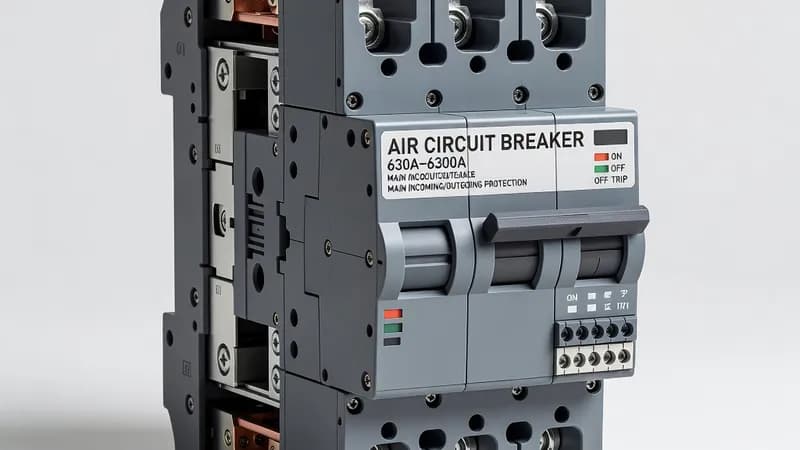
Air Circuit Breakers (ACBs) are the primary incomer and bus-tie protection devices used in high-current low-voltage switchgear and controlgear assemblies built to IEC 61439-1 and IEC 61439-2. In typical MCCP, PCC, MDB, ATS, and generator synchronizing systems, ACBs provide selective and coordinated protection for feeders in the 630 A to 6300 A range, with utilization in systems up to 1000 V AC depending on the manufacturer and construction. They are applied where high breaking capacity, maintenance-friendly withdrawal, and advanced protection logic are required. Common product families include Siemens 3WA, ABB SACE Emax 2, Schneider Electric Masterpact MTZ, Eaton IZMX, and LS Susol ACB ranges. Modern ACBs are electronically tripped devices with adjustable LSI, LSIG, or LSGI protection functions. Long-time, short-time, instantaneous, and ground-fault settings are typically configured via digital trip units, enabling precise coordination with downstream MCCBs, motor starters, VFDs, and soft starters. Many trip units also provide thermal memory, event logging, waveform capture, power metering, THD monitoring, and communications such as Modbus RTU/TCP, Profibus, PROFINET, Ethernet/IP, or IEC 61850 gateways. In power control centers and main distribution boards, this improves operational visibility and supports energy management strategies. For panel builders, the mounting style is a major design decision. Fixed-mounted ACBs are compact and suitable for less frequently maintained feeders, while draw-out ACBs are preferred in critical infrastructure because the breaker can be racked in and out of the cradle without fully isolating the entire lineup. This supports faster maintenance, safer inspection, and improved uptime. Panel design must account for form of separation, commonly Form 2, Form 3b, or Form 4, depending on compartmentalization requirements and the chosen assembly architecture under IEC 61439-2. Busbar systems, shutters, interlocks, and compartment barriers must be verified for the declared short-circuit withstand strength and internal arc performance. Short-circuit ratings are a defining selection parameter. ACBs are typically specified with rated ultimate short-circuit breaking capacity (Icu) and service breaking capacity (Ics), as well as short-time withstand current (Icw) for coordination in selective systems. In generator control panels and ATS applications, the ACB must also be matched to source characteristics, transfer logic, and potential parallel operation. For facilities with harsh environments, the assembly may require elevated ingress protection, derating for ambient temperature, or compliance with IEC 60079 for hazardous areas where applicable. For arc-risk mitigation, designers often evaluate IEC 61641 internal arc test performance at the panel level. In real-world applications, ACBs are the backbone of hospital mains, data center LV switchboards, industrial process plants, water treatment facilities, airports, commercial buildings, and utility substations. They are especially common at the incoming utility point, transformer secondary, generator incomers, and bus couplers in power control centers. Proper selection requires coordination of rated current, pole configuration, breaking capacity, network voltage, ambient conditions, and the intended protection scheme. When engineered correctly inside an IEC 61439 verified assembly, an ACB delivers dependable protection, operational continuity, and maintainable high-power distribution.
Panels Using This Component
Primary power distribution from transformer to sub-circuits. Rated up to 6300A. Houses main incoming breaker, bus-section, and outgoing feeders.
High-capacity power distribution for industrial facilities. Controls and distributes incoming power to MCC, APFC, and downstream loads.
Automatic changeover between mains and generator/UPS. Open or closed transition, with or without bypass.
Genset start/stop sequencing, synchronization, load sharing, and paralleling controls.
Bespoke panel assemblies for non-standard requirements — special ratings, unusual form factors, multi-function combinations.
Related Knowledge Articles
Choosing between air circuit breakers and moulded case circuit breakers.
Achieving full selectivity between protection devices.
Protecting personnel from arc flash hazards.
Frequently Asked Questions
Ready to Engineer Your Next Panel?
Our team of electrical engineers is ready to design, build, and deliver your custom panel solution — fully compliant with international standards.