Moulded Case Circuit Breakers (MCCB)
Branch protection 16A–1600A, thermal-magnetic or electronic trip
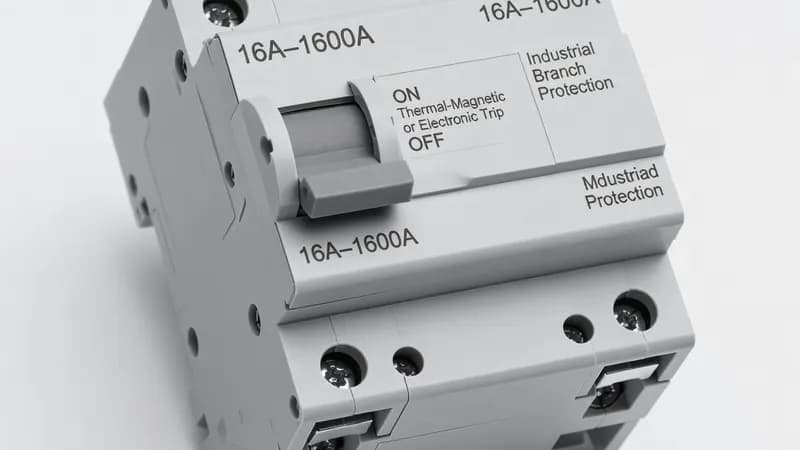
Moulded Case Circuit Breakers (MCCBs) are core protective devices in IEC 61439 low-voltage switchgear and controlgear assemblies, used to provide overload, short-circuit, and in many cases earth-fault protection for feeders, outgoing circuits, incomers, and interconnections. Typical current ratings span 16A to 1600A, with frame sizes selected to match the design current, diversity, and prospective short-circuit current of the installation. In practical panel design, MCCBs are specified in main distribution boards, power control centers, motor control centers, automatic transfer switchboards, generator control panels, capacitor bank panels, variable frequency drive feeders, soft starter panels, harmonic filter panels, and PLC automation panels. They are also widely used in busbar trunking interfaces, metering boards, lighting distribution boards, and DC distribution systems where reliable isolation and high fault withstand are required. Modern MCCBs are available with thermal-magnetic or electronic trip units. Thermal-magnetic types are common for straightforward branch protection and fixed plant loads, while electronic trip versions provide adjustable Ir, Isd, Ii, and often Ig settings, enabling coordinated protection, selective tripping, and improved discrimination with upstream ACBs. High-end electronic releases may include communication modules for Modbus, Profibus, Ethernet-based gateways, or integrated metering data. This is especially valuable in intelligent MCC panels and smart power distribution systems where energy monitoring and remote status indication are required. Breaking capacity is a key selection criterion. Depending on the manufacturer, frame size, and series, MCCBs may offer Icu and Ics values from 25kA up to 100kA or more at 400/415V AC. In IEC 61439 assembly verification, the breaker’s short-circuit performance must be coordinated with the busbar system, device mounting arrangement, and the panel’s rated conditional short-circuit current. Engineers also consider rated operational voltage, insulation voltage, frequency, ambient temperature derating, and terminal temperature rise. For 3-pole and 4-pole applications, 4-pole MCCBs are preferred in TN-S, TT, and generator changeover systems where neutral switching or isolation is required. MCCBs are manufactured by leading brands such as Schneider Electric Compact NSX and ComPacT NS ranges, ABB Tmax XT and Tmax T ranges, Siemens 3VA series, Eaton NZM series, Mitsubishi Electric NF series, and LS Electric ABS/ABN families. These product platforms support a wide range of accessories, including shunt trip coils, undervoltage releases, motor operators, rotary handles, mechanical interlocks, auxiliary contacts, and zone selective interlocking in advanced coordination schemes. For motor feeders, MCCBs are often paired with contactors, overload relays, VFDs, or soft starters to provide upstream short-circuit protection and isolation. Installation in IEC 61439 panels must respect conductor sizing, phase segregation, creepage and clearance, incoming/outgoing cable routing, and the assembly’s form of separation, typically Forms 1 to 4 depending on maintainability and continuity requirements. When installed in harsh environments, MCCBs may be selected with suitable enclosure IP ratings, vibration resistance, and compliance with IEC 60947-2. For hazardous-area-adjacent installations or dust-laden industrial sites, the overall assembly may also need consideration of IEC 60079 and, where arc containment is relevant, IEC/TR 61641. In high-availability facilities such as hospitals, data centers, process plants, and utility substations, properly selected MCCBs contribute to selective coordination, safe isolation, and long service life.
Panels Using This Component
Primary power distribution from transformer to sub-circuits. Rated up to 6300A. Houses main incoming breaker, bus-section, and outgoing feeders.
High-capacity power distribution for industrial facilities. Controls and distributes incoming power to MCC, APFC, and downstream loads.
Centralized motor control with starters, contactors, overloads, and VFDs in standardized withdrawable/fixed functional units.
Automatic capacitor switching for reactive power compensation. Thyristor or contactor-switched, detuned or standard configurations.
Automatic changeover between mains and generator/UPS. Open or closed transition, with or without bypass.
Enclosed VFD assemblies with input protection, line reactors, EMC filters, output reactors, and bypass options.
Genset start/stop sequencing, synchronization, load sharing, and paralleling controls.
Energy metering, power quality analysis, and multi-circuit monitoring with communication gateways.
Final distribution for lighting and small power. MCB/RCBO-based with DALI or KNX integration options.
Prefabricated busbar distribution per IEC 61439-6. Sandwich or air-insulated, aluminum or copper.
Process and machine control panels housing PLCs, I/O modules, relays, HMIs, and communication infrastructure.
Bespoke panel assemblies for non-standard requirements — special ratings, unusual form factors, multi-function combinations.
Enclosed soft starter assemblies for reduced voltage motor starting with torque control, ramp-up/down profiles, and bypass contactor options.
Active or passive harmonic filtering to mitigate THD from non-linear loads. Tuned LC filters, active filters, or hybrid configurations.
DC power distribution for battery systems, solar installations, telecom, and UPS applications. MCCB/fuse-based DC protection.
Fixed or automatic capacitor bank assemblies for bulk reactive power compensation in industrial and utility applications.
Related Knowledge Articles
Choosing between air circuit breakers and moulded case circuit breakers.
Achieving full selectivity between protection devices.
Testing and maintaining ACBs and MCCBs in panel assemblies.
Frequently Asked Questions
Ready to Engineer Your Next Panel?
Our team of electrical engineers is ready to design, build, and deliver your custom panel solution — fully compliant with international standards.