Metering and Power Quality Monitoring in Industrial Panels
Implementing comprehensive electrical measurement and monitoring.
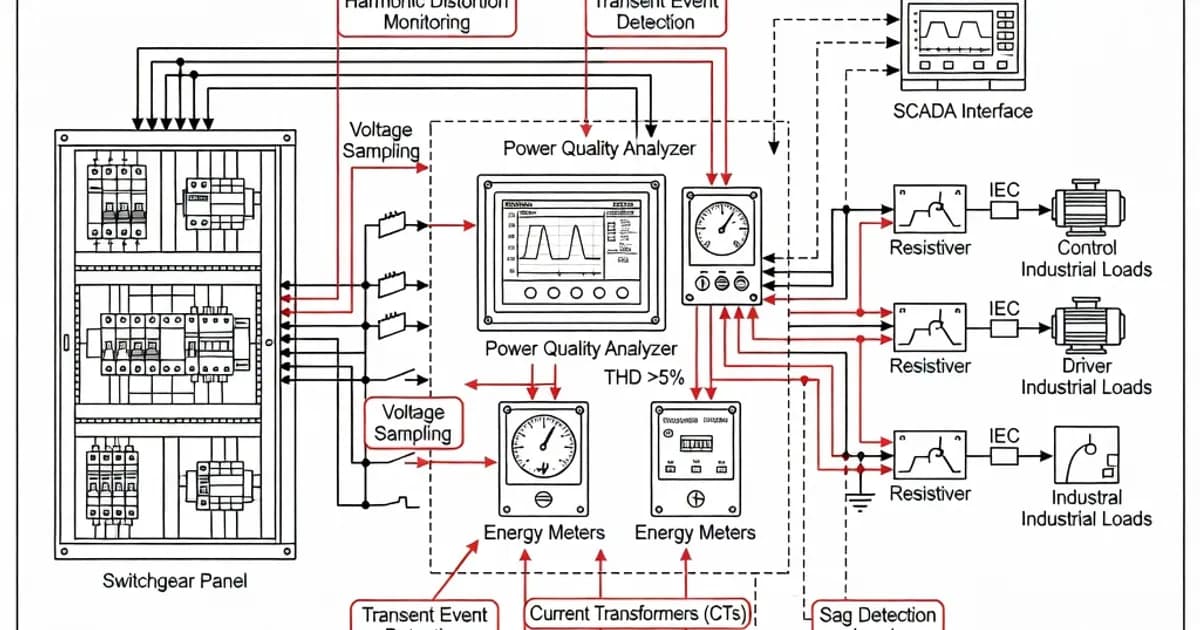
Metering and Power Quality Monitoring in Industrial Panels
Industrial low-voltage panels are no longer simple distribution points. In modern plants, they are data-rich assemblies that measure voltage, current, energy, demand, power factor, harmonics, and transient events while still meeting the safety and performance requirements of IEC 61439. As Schneider Electric notes, IEC 61439 is not merely an update to the former IEC 60439 series; it introduces a fundamentally different approach based on design verification, routine verification, and documented assembly performance rather than legacy type-testing alone. [1]
When metering and power quality monitoring devices are integrated into a panel, they become part of the verified assembly. That means their placement, wiring, heat dissipation, dielectric withstand, EMC behavior, clearances, and short-circuit contribution must be considered as part of the overall design. Per IEC 61439-1, the manufacturer must verify the assembly by design rules and routine checks before it is placed into service. This includes temperature rise verification under Clause 10.10, dielectric properties under Clause 10.9 and Clause 11.9, and protection against electric shock and ingress under Clauses 10.2 and 10.4. [8] [4]
Why metering belongs inside the IEC 61439 verification scope
Metering devices are often installed to support billing allocation, energy management, load balancing, asset protection, and power quality diagnostics. In industrial systems, they may be connected through current transformers, voltage transformers, communication gateways, and protection relays. These devices are not isolated accessories; they interact with the assembly thermally and electrically. For that reason, IEC 61439 requires the designer to verify that the panel still performs safely after the monitoring equipment is added. [5]
IEC 61439-2 applies to power switchgear and controlgear assemblies rated up to 6300 A, which covers the majority of industrial distribution and monitoring panels. The standard uses 12 design verification methods for critical performance attributes, including temperature rise, dielectric withstand, short-circuit strength, clearances and creepage distances, and compatibility of incorporated devices. That framework is especially important when harmonics, transient events, and high data-density monitoring systems are present. [3]
Metering functions commonly integrated into industrial panels
Industrial panels may include one or more of the following measurement and monitoring functions:
- Electrical metering: voltage, current, frequency, power, reactive power, apparent power, energy, demand, and power factor.
- Power quality monitoring: harmonics, total harmonic distortion, sags, swells, interruptions, unbalance, and transient capture.
- Event and alarm recording: overload conditions, phase loss, reverse power, voltage anomalies, and communication loss.
- Communication integration: Modbus RTU, Modbus TCP, Ethernet-based gateways, and integration with supervisory systems.
- Condition monitoring: busbar temperature sensing, feeder hotspot detection, and trend logging for maintenance planning.
As documented in Siemens and Schneider Electric application materials, these functions are commonly implemented with multifunction meters such as the PAC and PowerLogic families, and they are increasingly used to support plant energy dashboards and reliability programs. [1] [5]
IEC 61439 design verification requirements that directly affect metering
Metering and power quality monitoring devices affect several verification items in IEC 61439. The most important are temperature rise, dielectric properties, EMC performance, and the integrity of clearances and creepage distances. The assembly manufacturer must demonstrate that adding these devices does not compromise the declared ratings of the panel. [8]
Temperature rise: IEC 61439-1 Clause 10.10 requires the assembly to remain within permitted temperature limits under worst-case loading. For metering terminals and connections, practical design guidance commonly uses a maximum temperature rise of 70 K for terminals or 105°C absolute for connections when carrying rated current In or In multiplied by the rated diversity factor. Verification may be by test or by calculation if the method is supported by valid evidence. Schneider Electric and other industry guides recommend testing under realistic enclosure conditions, often at 35°C ambient, because heat build-up behind doors and in sealed compartments can be substantially higher than free-air assumptions. [5] [3]
Dielectric strength: Metering circuits that are connected to the main circuit must pass the required power-frequency withstand test. For systems with 300 V < Ui < 690 V, IEC 61439-1 Table 8 specifies a 1890 V AC withstand test for 1 second in the relevant verification context. This confirms that auxiliary wiring, instrument transformers, and device terminals can withstand the electrical stress expected in service. [4]
EMC: Power quality monitors are inherently sensitive to electromagnetic disturbances because they measure harmonics, transients, and waveform distortion. IEC 61439-1 Clause 10.9 requires that incorporation of devices does not impair the assembly’s immunity or create unacceptable emissions. The panel must tolerate the electrical environment of industrial plants, where contactor switching, drive operation, capacitor banks, and transient loads are common. [1] [4]
Ingress protection: Enclosures housing meters and monitors must achieve the declared IP rating in accordance with IEC 60529, verified through IEC 61439-1 Clause 10.2. Industrial monitoring compartments are commonly built to IP54 or higher, depending on dust, moisture, and washdown conditions. In practice, the IP rating must remain valid after cable entries, door-mounted displays, and communication interfaces are installed. [1] [3]
Clearances and creepage: Monitoring circuits must preserve the same insulation coordination principles as the rest of the panel. Manufacturers often specify a minimum phase-to-phase clearance such as 8 mm for pollution degree 3 applications, but the exact value depends on voltage, altitude, pollution degree, and insulation category. IEC 61439-1 Clause 10.3 requires these distances to be verified to prevent insulation failure, especially in cramped metering cubicles with CT terminal blocks and communication wiring. [1]
Rated current, diversity factor, and CT selection
One of the most common errors in metered assemblies is misunderstanding how load diversity affects panel sizing. IEC 61439 allows the use of a rated diversity factor, which reflects the probability that all outgoing circuits will operate at full load simultaneously. This is especially relevant in panels with multiple feeders, metering branches, or mixed industrial and building loads. As outlined in industry guidance, the rated current of an outgoing circuit may be reduced using RDF values such as 0.4 or 0.45 for mixed multi-load assemblies, while PV inverters and certain dedicated feeders may use RDF = 1.0 because the source can operate continuously at rated output. [7]
The practical implication is straightforward: the panel designer must match current transformer ratios, metering device input ranges, and cable sizes to the declared outgoing-circuit current Inc and the thermal limits of the busbars and terminations. For example, if five measuring units each draw 26 A equivalent load under the selected diversity assumption, the total assembly current cannot simply be treated as 130 A unless the thermal verification supports it. The actual InA must remain within the verified thermal capability of the enclosure and conductors. [7]
Power quality monitoring in industrial environments
Power quality monitoring adds significant value in facilities with variable frequency drives, welders, rectifiers, UPS systems, arc furnaces, and large motor loads. These loads generate harmonics, unbalance, and transient disturbances that can affect both process reliability and utility compliance. A properly designed monitoring system can identify high THD conditions, phase distortion, and voltage dips before they lead to nuisance trips or premature equipment aging. [1]
Industrial power quality meters frequently comply with IEC 61557-12 for measuring and monitoring equipment in low-voltage distribution systems. This is important because it defines measurement performance, class accuracy, and test methods that are relevant when the panel is used for energy accountability or diagnostic analysis. In practical terms, a Class 0.5 or Class 0.2S device may be selected depending on whether the application is internal energy management, cost allocation, or revenue-grade submetering. [4]
Specification comparison for common meter classes
| Meter class | Typical application | Accuracy | Monitoring features | Panel integration note |
|---|---|---|---|---|
| Class 1.0 | Basic energy monitoring | General-purpose billing approximation | Voltage, current, kWh | Suitable for simple load tracking where high accuracy is not required |
| Class 0.5 | Industrial energy management | Moderate precision | Energy, demand, power factor, THD | Common in plant distribution panels and submetering boards |
| Class 0.2S | Advanced monitoring and allocation | High precision | Energy, harmonics, event logs, communications | Preferred where utility allocation or performance benchmarking is required |
Vendor examples and how they map to IEC 61439 practice
Major manufacturers provide application examples that show how metering and power quality monitoring are integrated into verified low-voltage assemblies. Siemens documentation for SIVACON systems demonstrates the use of multifunction meters such as SENTRON PAC devices in assemblies designed for high-current distribution, communication, and IP-rated enclosures. Schneider Electric likewise publishes guidance on incorporating PowerLogic meters into Okken and PrismaSe systems, with attention to thermal performance and panel protection. ABB and Eaton provide similar documented approaches in their respective assembly families. [2] [5]
These examples matter because they show a key design principle: the meter cannot be treated as an afterthought. The assembly must be conceived around the meter location, wiring route, ventilation path, and communication access. As BEAMA and Hager guidance emphasize, substitution of devices or layout changes after verification can invalidate the original design evidence unless the new configuration is re-verified. [8] [4]
Best practices for engineering metering compartments
Good panel design separates sensitive monitoring electronics from hot or electrically noisy zones. Dedicated compartments improve maintainability and reduce the risk of coupling between high-current conductors and low-level communication wiring. IEC 61439-1 Clause 10.6 allows internal separation arrangements to be used as part of the verified construction, provided the compartmentalization is consistent with the declared form of separation and does not impair access, cooling, or serviceability. [3]
Recommended practices include:
- Place meters near the associated feeders or incomers to minimize CT burden and voltage drop.
- Route instrument wiring separately from power cables to reduce induced noise and EMC risk.
- Use CT and VT ratios matched to the actual load profile and verified diversity factor.
- Provide local ventilation or thermal spacing where meter clusters are densely installed.
- Use busbar temperature sensors in high-load sections to identify hotspots before they affect meter accuracy or insulation life.
- Document all substitutions, firmware changes, and communication-module changes for re-verification impact assessment.
Ready to Engineer Your Next Panel?
Our team of electrical engineers is ready to design, build, and deliver your custom panel solution — fully compliant with international standards.