Metering & Monitoring Panel
Energy metering, power quality analysis, and multi-circuit monitoring with communication gateways.
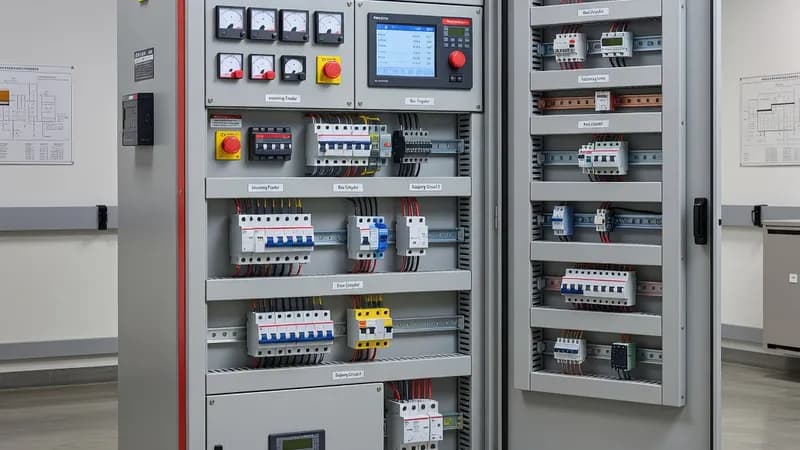
The Metering & Monitoring Panel is an IEC 61439 low-voltage assembly engineered to provide centralized energy measurement, power quality analytics, feeder status monitoring, and communications integration in one coordinated enclosure. It is widely used in commercial buildings, industrial plants, data centers, healthcare facilities, utilities, and process industries where visibility of electrical consumption and network health directly affects uptime, cost control, and compliance. Typical assemblies combine multifunction power meters, revenue-grade submeters, current transformers, voltage transformers, multichannel monitoring modules, communication gateways, and HMI/SCADA interfaces, with incoming and outgoing protection typically provided by MCCBs or ACBs depending on the system capacity and selectivity requirements. From a design perspective, these panels are usually built to IEC 61439-1 and IEC 61439-2 for type-tested or partially type-tested low-voltage switchgear assemblies, with verification covering temperature rise, dielectric properties, short-circuit withstand strength, protective circuit integrity, and clearances/creepage distances. For metering cubicles serving tenants, production lines, or critical loads, internal separation is often specified as Form 2, Form 3b, or Form 4 to improve serviceability and limit the effect of a fault to a local section. Depending on the application, rated operational voltage may be 400/415 V, 690 V, or up to 1000 V AC, while rated currents commonly range from 125 A for compact submetering systems to 3200 A and above in main distribution and utility monitoring panels. Declared short-circuit withstand ratings frequently fall between 25 kA and 100 kA, coordinated with the upstream protection device and busbar system. The panel’s metering core typically includes multifunction power analyzers capable of measuring kW, kWh, kvar, kVA, power factor, demand, phase rotation, and event logs, with power quality functions aligned to IEC 61000-4-30 Class A methods where precise harmonic and disturbance monitoring is required. In facilities with VFDs, soft starters, UPS systems, photovoltaic inverters, or EV charging stations, the design must account for harmonics, neutral current, CT saturation, EMC performance, and surge immunity. Surge protective devices should be selected and installed in accordance with IEC 61643 and coordinated with the assembly’s wiring layout and earthing system. Where the panel interfaces with building automation or energy management platforms, protocols such as Modbus RTU, Modbus TCP/IP, BACnet/IP, M-Bus, Profibus, or MQTT are commonly implemented through industrial gateways. Protection and safety elements often include MCCBs for feeder isolation, fused voltage circuits, control MCBs, terminal blocks, auxiliary relays, and door-mounted indication devices. In harsh or outdoor locations, enclosure selection must consider IP protection ratings, anti-condensation heaters, ventilation strategy, and, where applicable, IEC 60079 requirements for areas with explosive atmospheres. In industrial sites with high electromagnetic noise, the panel should also be designed with segregated CT wiring, shielded communication cabling, proper cable routing, and EMC-conscious earthing arrangements to maintain measurement accuracy and communication stability. Patrion manufactures Metering & Monitoring Panels for EPC contractors, facility managers, and panel builders who need dependable data acquisition, secure protection, and future-ready communications in a compliant IEC 61439 assembly. Each solution is engineered around the site’s load profile, utility interface, expansion needs, and maintenance philosophy, making it suitable for energy reporting, submetering, predictive maintenance, power quality troubleshooting, and operational optimization across mission-critical and industrial environments.
Components for This Panel
Metering & Power Analyzers selection, integration, and best practices for Metering & Monitoring Panel assemblies compliant with IEC 61439.
Moulded Case Circuit Breakers (MCCB) selection, integration, and best practices for Metering & Monitoring Panel assemblies compliant with IEC 61439.
Surge Protection Devices (SPD) selection, integration, and best practices for Metering & Monitoring Panel assemblies compliant with IEC 61439.
Busbar Systems selection, integration, and best practices for Metering & Monitoring Panel assemblies compliant with IEC 61439.
HMI & SCADA Systems selection, integration, and best practices for Metering & Monitoring Panel assemblies compliant with IEC 61439.
Applicable Standards
IEC 61439-2 (PSC) compliance requirements, testing procedures, and design considerations for Metering & Monitoring Panel assemblies.
EMC Compliance (IEC 61000) compliance requirements, testing procedures, and design considerations for Metering & Monitoring Panel assemblies.
IP Protection Ratings compliance requirements, testing procedures, and design considerations for Metering & Monitoring Panel assemblies.
Industries Using This Panel
Metering & Monitoring Panel assemblies engineered for Commercial Buildings applications, addressing industry-specific requirements and compliance standards.
Metering & Monitoring Panel assemblies engineered for Industrial Manufacturing applications, addressing industry-specific requirements and compliance standards.
Metering & Monitoring Panel assemblies engineered for Data Centers applications, addressing industry-specific requirements and compliance standards.
Metering & Monitoring Panel assemblies engineered for Healthcare & Hospitals applications, addressing industry-specific requirements and compliance standards.
Metering & Monitoring Panel assemblies engineered for Oil & Gas applications, addressing industry-specific requirements and compliance standards.
Metering & Monitoring Panel assemblies engineered for Water & Wastewater applications, addressing industry-specific requirements and compliance standards.
Metering & Monitoring Panel assemblies engineered for Renewable Energy applications, addressing industry-specific requirements and compliance standards.
Metering & Monitoring Panel assemblies engineered for Infrastructure & Utilities applications, addressing industry-specific requirements and compliance standards.
Metering & Monitoring Panel assemblies engineered for Food & Beverage applications, addressing industry-specific requirements and compliance standards.
Metering & Monitoring Panel assemblies engineered for Pharmaceuticals applications, addressing industry-specific requirements and compliance standards.
Related Knowledge Articles
Implementing comprehensive electrical measurement and monitoring.
Implementing intelligent panel monitoring and energy optimization.
Connecting panels to cloud and IIoT platforms.
Comprehensive overview of all IEC 61439 parts, their scope, and how they apply to different panel types.
Frequently Asked Questions
Ready to Engineer Your Next Panel?
Our team of electrical engineers is ready to design, build, and deliver your custom panel solution — fully compliant with international standards.