MCC Panels

Metering & Power Analyzers

Energy meters, power quality analyzers, CT/VT, communication gateways
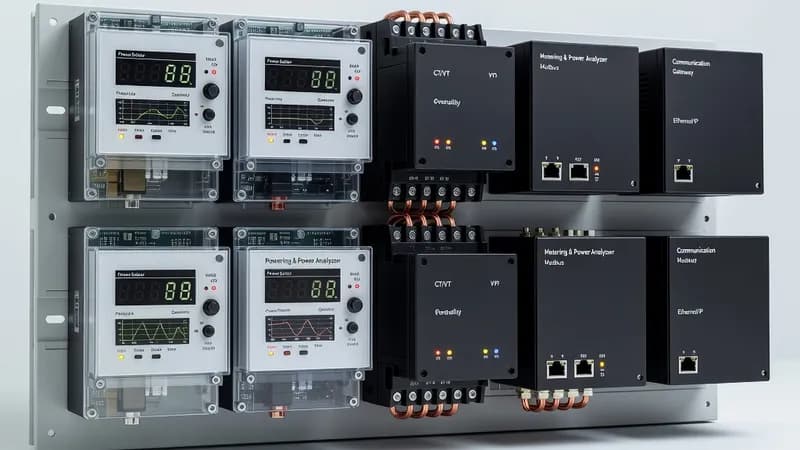
Metering & Power Analyzers

Metering and Power Analyzers are essential subassemblies in modern IEC 61439 low-voltage switchgear and controlgear assemblies, providing accurate electrical measurement, tariff allocation, and power quality diagnostics across distribution, generator, and process systems. In main-distribution-board and power-control-center applications, these devices are typically installed with Class 0.5S or Class 0.2S current transformers and, where required, voltage transformers to support revenue-grade billing and substation-level monitoring. Typical metering functions include kWh, kVArh, kVAh, demand, PF, THD, sequence, and event logging; advanced analyzers also capture waveform transients, flicker, and voltage dips/swells in accordance with IEC 61000-4-30 Class A. Product families commonly specified include Schneider Electric PowerLogic PM5000/ION9000, Siemens SENTRON PAC/7KM PAC, ABB M4M/ B-type meters, Janitza UMG 96RM/604, and Socomec DIRIS A/ Digiware solutions. In power-factor-correction and harmonic-filter-panel assemblies, metering is used not only for energy visibility but also for closed-loop control of capacitor banks, reactor stages, and active harmonic filters. Here, metering inputs are coordinated with protection and switching devices such as MCCBs, ACBs, contactors, thyristor switching units, and protection relays under IEC 60947. In generator-control-panel and automatic-transfer-switch applications, meters help verify generator loading, phase imbalance, frequency stability, and synchronization performance, while communication gateways distribute data to SCADA, BMS, and EMS platforms via Modbus RTU, Modbus TCP, BACnet/IP, SNMP, or MQTT. For lighting-distribution-board and dc-distribution-panel installations, compact DIN-rail energy meters provide circuit-level consumption data and alarms with minimal panel depth and wiring burden. Selection depends on the required accuracy class, communication protocol, display format, auxiliary supply, pulse output, and the number of monitored circuits. For compact metering-panel builds, a basic multifunction meter may be sufficient, while busbar-trunking-system applications often benefit from distributed metering nodes and gateway architectures to monitor multiple tap-off points. In custom-engineered-panel projects, metering layouts must respect creepage and clearance, segregation, and thermal constraints defined by IEC 61439-1/2, with attention to instrument fuse protection, test terminals, shorting links for CT circuits, and safe access for calibration. Where metering equipment is installed in hazardous locations or process areas, the enclosure and associated accessories may need to comply with IEC 60079. For arc-risk industrial switchrooms, coordination with arc containment practices and verification in line with IEC TR 61641 may also be required. Well-designed metering systems improve energy accountability, enable predictive maintenance through load trending and harmonic analysis, and support compliance reporting for facilities, utilities, renewable plants, data centers, and industrial plants. From capacitor-bank-panel applications to large MCC-based distribution architectures, Metering and Power Analyzers provide the data foundation for efficient operation, fault diagnosis, and long-term asset optimization.

Panels Using This Component

Main Distribution Board (MDB)

Primary power distribution from transformer to sub-circuits. Rated up to 6300A. Houses main incoming breaker, bus-section, and outgoing feeders.

Power Control Center (PCC)

High-capacity power distribution for industrial facilities. Controls and distributes incoming power to MCC, APFC, and downstream loads.

Power Factor Correction Panel (APFC)

Automatic capacitor switching for reactive power compensation. Thyristor or contactor-switched, detuned or standard configurations.

Automatic Transfer Switch (ATS) Panel

Automatic changeover between mains and generator/UPS. Open or closed transition, with or without bypass.

Generator Control Panel

Genset start/stop sequencing, synchronization, load sharing, and paralleling controls.

Metering & Monitoring Panel

Energy metering, power quality analysis, and multi-circuit monitoring with communication gateways.

Lighting Distribution Board

Final distribution for lighting and small power. MCB/RCBO-based with DALI or KNX integration options.

Busbar Trunking System (BTS)

Prefabricated busbar distribution per IEC 61439-6. Sandwich or air-insulated, aluminum or copper.

Custom Engineered Panel

Bespoke panel assemblies for non-standard requirements — special ratings, unusual form factors, multi-function combinations.

Harmonic Filter Panel

Active or passive harmonic filtering to mitigate THD from non-linear loads. Tuned LC filters, active filters, or hybrid configurations.

DC Distribution Panel

DC power distribution for battery systems, solar installations, telecom, and UPS applications. MCCB/fuse-based DC protection.

Capacitor Bank Panel

Fixed or automatic capacitor bank assemblies for bulk reactive power compensation in industrial and utility applications.

Related Knowledge Articles

Frequently Asked Questions

For panel integration, the main framework is IEC 61439-1 and IEC 61439-2, which govern design verification, temperature rise, dielectric performance, clearances, and segregation inside low-voltage assemblies. The metering device itself is often evaluated under IEC 61010 or manufacturer-specific compliance, while billing-grade accuracy is defined by IEC 62053 series for energy meters. Power quality functions should align with IEC 61000-4-30 Class A when the application requires comparable and repeatable PQ results. If the metering is installed in hazardous areas, IEC 60079 requirements may also apply to the surrounding equipment arrangement. In arc-risk installations, IEC TR 61641 can be relevant for assessing internal arc considerations around the switchboard design.
For standard energy monitoring, CTs in accuracy class 1.0 or 0.5 are commonly used, but for tariff allocation and revenue-related applications, class 0.5S or 0.2S is preferred. Class 0.2S is typically selected when the system requires high accuracy across a wide current range, especially in main-distribution-board, power-control-center, or utility interface panels. The CT burden must match the meter input rating and wiring length to avoid accuracy degradation. When revenue-grade performance is needed, the complete chain matters: CT accuracy, meter class under IEC 62053, shorting facilities for maintenance, and proper terminal design to ensure safe testing and calibration.
In capacitor-bank-panel and harmonic-filter-panel applications, power analyzers provide the feedback needed for automatic correction and harmonic mitigation. They monitor power factor, kvar demand, THD, individual harmonics, voltage imbalance, and switching events so the controller can decide when to energize capacitor stages or activate detuned reactors and active filters. Many installations use analyzers from Schneider Electric PowerLogic, Janitza UMG, or Socomec DIRIS families with alarm relays and Modbus communication. This helps avoid overcompensation, resonance, nuisance tripping, and overheating. For high-performance systems, the meter should support fast sampling and event logging to evaluate dynamic loads such as VFDs, soft starters, and welders.
Yes. Most modern metering and power analyzer products include RS-485 Modbus RTU, Ethernet Modbus TCP, BACnet/IP, or gateway-based integration options. In larger panels, a communication gateway can collect data from multiple meters and publish it to SCADA, BMS, or Energy Management Systems with timestamped trends, alarms, and event logs. Common product ecosystems include Siemens SENTRON communication modules, Schneider PowerLogic gateways, and Janitza grid visualization platforms. When designing the architecture, pay attention to address mapping, protocol conversion latency, cybersecurity segmentation, and power supply redundancy. For critical facilities, Ethernet network separation and managed switches are recommended to preserve operational visibility without exposing the control network.
A basic energy meter focuses on accumulated values such as kWh, kVArh, demand, voltage, current, and power factor. A power quality analyzer provides deeper diagnostics, including harmonic spectrum, flicker, transient capture, sag/swell recording, unbalance, and disturbance classification. In industrial panels with VFDs, UPS systems, or large motor starters, a power quality analyzer is the better choice because it helps identify nuisance trips and harmonics-related overheating. For utility interconnection, generator-control-panel, or PCC applications, Class A analyzers are often specified to support consistent power quality reporting. Examples include Schneider ION9000, Janitza UMG 604, and ABB power quality meters.
Metering devices are usually mounted on the door, instrument compartment, or a segregated low-voltage control section depending on accessibility and wiring density. Under IEC 61439-1/2, their placement must not compromise clearances, temperature rise limits, or the declared form of internal separation. CT terminal blocks, shorting links, fuse protection, and test points should be arranged for safe commissioning and maintenance. In metering-panel and main-distribution-board designs, it is common to keep voltage sensing, CT circuits, and communication wiring separated from power cables to reduce noise and improve serviceability. Door-mounted meters should also consider IP rating, display visibility, and operator access without exposing live parts.
The most common applications are main-distribution-board, power-control-center, generator-control-panel, automatic-transfer-switch, capacitor-bank-panel, harmonic-filter-panel, lighting-distribution-board, dc-distribution-panel, and dedicated metering-panel assemblies. MCCs may also include metering at feeder or incomer level for energy accountability and motor load analysis. Busbar-trunking-system installations often use distributed metering at tap-off points, while custom-engineered-panel projects may combine multiple meters, gateways, and alarm relays in one enclosure. The selection depends on whether the goal is billing, power quality monitoring, load management, or maintenance diagnostics. Facilities such as data centers, hospitals, manufacturing plants, and commercial towers benefit most from this level of visibility.
CT circuits must always be handled carefully because open-circuit secondary conditions can produce dangerous voltages. Use shorting terminal blocks, clearly labeled CT wiring, and proper test links to allow safe maintenance and meter replacement. Voltage inputs should be protected with suitable fuses or miniature circuit breakers and sized according to the meter manufacturer’s instructions. Keep CT and VT wiring segregated from power conductors, maintain proper conductor sizing, and verify polarity to avoid reversed readings. For panels built to IEC 61439, this wiring practice supports safer operation and easier verification. Major meter suppliers such as Schneider, Siemens, ABB, Socomec, and Janitza all publish detailed terminal and burden guidelines that should be followed during panel assembly and commissioning.

Ready to Engineer Your Next Panel?

Our team of electrical engineers is ready to design, build, and deliver your custom panel solution — fully compliant with international standards.