Protection Relay Coordination in Industrial Panels
Coordinating protection relays for reliable fault detection and selectivity.
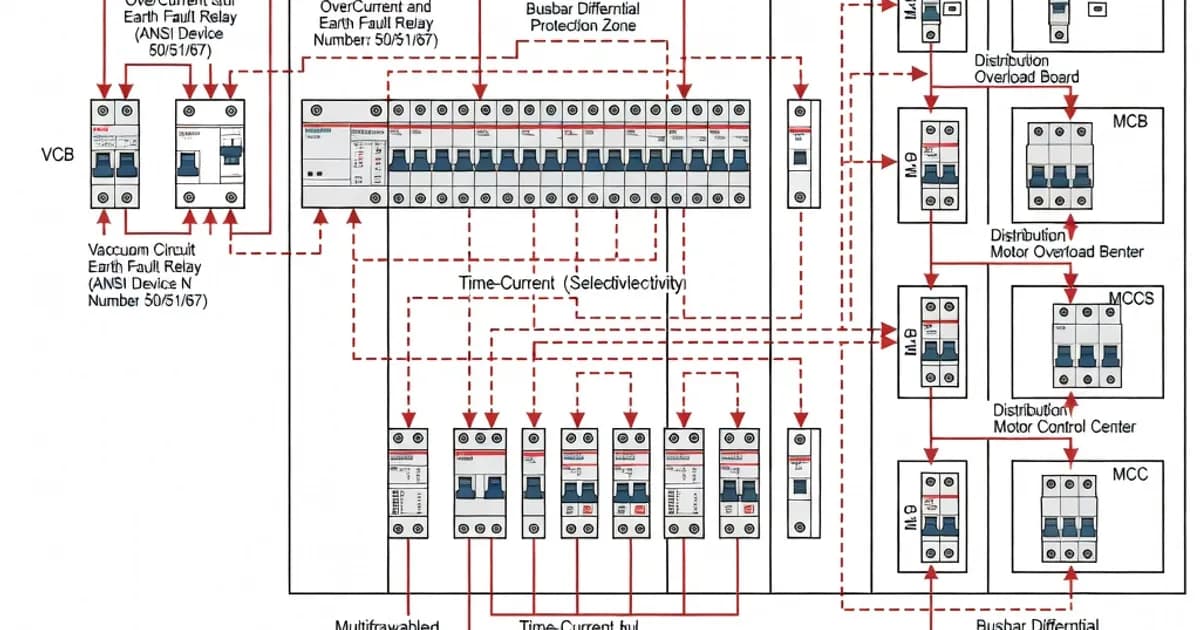
Protection Relay Coordination in Industrial Panels
Protection relay coordination is one of the most important engineering disciplines in industrial low-voltage panel design. Its purpose is simple: clear faults at the nearest possible point without unnecessarily tripping upstream devices. When coordination is correct, a downstream feeder, motor starter, or branch circuit isolates the fault while the rest of the plant continues operating. When coordination is poor, one fault can shut down an entire production line.
In IEC 61439 compliant assemblies, coordination is not just a performance preference. It is part of the assembly verification process. Per IEC 61439-1:2020, the assembly must be verified for short-circuit strength in Clause 10.10 and protection against electric shock in Clause 10.11, while temperature rise verification is addressed in Clause 10.2. These requirements ensure that a panel with relays, breakers, contactors, and busbars remains safe and functional under expected operating and fault conditions.
In modern industrial panels, protection relay coordination combines time-current curve analysis, short-circuit withstand assessment, selective tripping logic, and increasingly, digital communication via IEC 61850. The result is a coordinated protection scheme that protects personnel, equipment, and process continuity.
What Protection Relay Coordination Means
Protection relay coordination is the process of setting and arranging protective devices so that the device closest to a fault operates first, and upstream devices remain stable long enough to provide backup only if the downstream device fails. This is commonly achieved through time-current coordination, where downstream devices have faster operating times or lower pickup values than upstream devices.
In industrial panels, coordination typically involves:
- Phase overcurrent protection
- Earth-fault or ground-fault protection
- Motor overload protection
- Short-circuit instantaneous protection
- Differential protection for critical assets
- Arc-flash mitigation functions in advanced relays
The practical objective is selectivity. Selectivity means the protective device nearest the fault clears it first. As documented in industry guidance aligned with IEC 61439 and IEC 60947, selectivity minimizes outage scope and helps maintain availability in manufacturing, utilities, oil and gas, and process plants.
Why Coordination Matters in Low-Voltage Assemblies
Industrial low-voltage panels often operate near the boundary between safe continuity and high-energy fault exposure. A fault on a motor feeder can produce very high short-circuit currents, and without proper coordination, the upstream incomer may trip before the downstream feeder device acts. This creates unnecessary downtime and can complicate fault diagnosis.
Well-coordinated panels also reduce thermal and mechanical stress on busbars, contactors, and cable terminations. IEC 61439-1 requires the assembler to demonstrate that the assembly can withstand specified stresses, including short-circuit forces and temperature rise. Coordination therefore supports not only operational selectivity but also the physical integrity of the assembly.
IEC 61439 Requirements That Affect Coordination
IEC 61439 is the core standard family for low-voltage switchgear and controlgear assemblies up to 1000 V AC or 1500 V DC. It superseded IEC 60439-1. Under the IEC 61439 framework, the original manufacturer establishes the design rules, while the assembly manufacturer is responsible for final conformity of the built panel.
For protection relay coordination, the most relevant verification requirements are:
- Clause 10.2 — Temperature rise limits
- Clause 10.10 — Short-circuit withstand strength
- Clause 10.11 — Protection against electric shock and continuity of protective circuits
- Clause 10.9 — EMC considerations, especially for digital relays and communication-based protection
Per IEC 61439-1, terminal temperature rise limits are a major design constraint. The commonly referenced maximum rise for terminals is 70 K, which matters because relay coordination and device loading influence the thermal profile inside the enclosure. If devices are clustered too tightly or coordination settings create sustained overload conditions, temperature rise may exceed acceptable limits.
IEC 61439-2 applies these principles specifically to power switchgear and controlgear assemblies. This is where most industrial relay panels fall: motor control centers, distribution boards, feeder panels, and process control switchboards.
How Coordination Is Engineered
Coordination starts with a complete study of the electrical network. Engineers collect source impedance data, transformer sizes, cable lengths, motor starting currents, and expected fault levels. They then model the system using time-current curves and fault calculations.
The goal is to ensure that protective devices remain selectively graded across the full range of expected fault currents. In practice, this means adjusting relay pickup thresholds, long-time and short-time delays, instantaneous elements, and earth-fault settings so that downstream devices act first.
Time-Current Curve Selectivity
Time-current curves, or TCCs, are the fundamental tool for coordination. A downstream relay should have a curve that sits below and to the left of the upstream relay curve for the relevant fault region. The separation between the curves creates a grading margin.
Industry practice often uses grading intervals of about 0.3 to 0.4 seconds between protective devices, depending on breaker technology, relay speed, and system requirements. Digital protection platforms can reduce the need for large grading margins because they offer more stable and repeatable operating characteristics than electromechanical devices.
For motor feeders, separate coordination is often required for overload, locked rotor, and short-circuit protection. Earth-fault coordination is usually set with its own time-delay structure to prevent nuisance tripping from transient leakage while still clearing genuine ground faults quickly.
Short-Circuit Coordination and Type 1 / Type 2 Performance
Coordination is not only about selectivity; it also concerns the behavior of components after a fault. IEC 60947-4-1 and IEC 60947-2 define coordination concepts commonly referred to as Type 1 and Type 2.
- Type 1 coordination: after a short-circuit, components may be damaged and require replacement, but no danger to personnel occurs.
- Type 2 coordination: after a short-circuit, the equipment remains suitable for further service, with only minor contact welding permitted if separation is still possible and functionality is preserved.
Type 2 coordination is often preferred in critical industrial panels because it reduces downtime after a fault. However, it requires careful selection of contactors, overload relays, and upstream protection devices. As described in manufacturer documentation such as ABB coordination guides and application manuals, coordination must be validated against the actual short-circuit current rating and the tested device combination.
Verification Under IEC 61439
Coordination must be validated as part of the assembly verification process. IEC 61439 offers two principal approaches: direct verification by testing and verification by design rules or comparison with a reference design. For short-circuit performance, direct test evidence is often the most robust method, especially for higher current assemblies.
Per IEC 61439-1 Clause 10.10, the assembly must withstand specified short-circuit stresses without unacceptable damage. This includes the busbar system, mounting arrangements, protective circuits, and enclosure structure. Verification must demonstrate that the assembly can tolerate the fault energy for the required duration.
For panels using digital relays and intelligent electronic devices, verification must also consider electromagnetic compatibility. IEC 61439-1 Clause 10.9 is relevant because relay communication, signaling, and trip logic can be disturbed by electromagnetic interference if wiring, shielding, and segregation are inadequate.
Direct Testing versus Reference Design Comparison
Direct testing is used when the panel configuration, current rating, or fault level is too specific to rely on generic design rules alone. This is especially important for assemblies above 1600 A or panels with complex busbar arrangements.
Reference design comparison is useful when the assembly is a close match to a previously tested configuration. In this case, the manufacturer can justify the new design by demonstrating equivalence in conductor size, support spacing, enclosure structure, and component arrangement.
As noted in IEC 61439 guidance from ABB, Hager, and CESI KEMA Labs, the verification route must be defensible and documented. The panel builder must retain evidence showing that the selected protective devices and their settings remain compatible with the verified assembly design.
Mechanical and Environmental Factors
Relay coordination does not occur in isolation. The physical environment inside the panel affects whether the protection scheme remains reliable throughout the life of the assembly.
IEC 61439 incorporates protection against electric shock, enclosure integrity, and component arrangement. For live parts, the enclosure often needs to satisfy IP2X or IPXXB requirements depending on the access conditions. IEC 60529 defines the IP code system, and many industrial panels are specified at IP4X or higher for better ingress protection.
Impact resistance is also relevant. IEC 62262 defines the IK rating system, and industrial panels are commonly designed to at least IK08 where mechanical robustness is needed. This matters because vibration, impact, and enclosure deformation can affect wiring integrity and relay operation.
Temperature rise is particularly important for relays and trip units. Digital relays are generally efficient, but panel density, ambient temperature, and poor airflow can still degrade performance. Excessive heat can alter pickup characteristics, reduce display visibility, and shorten electronic component life.
Digital Relays and IEC 61850
Protection relay coordination has advanced significantly with the adoption of digital relays and communication-based protection. Modern intelligent electronic devices can exchange status, trip, interlock, and synchro-check information over industrial communication networks. IEC 61850 is the key standard for this environment.
IEC 61850 enables fast signaling using GOOSE messages, which can support very rapid interlocking and selectivity logic. In coordinated schemes, this can reduce trip times to milliseconds in some applications and can improve the discrimination between upstream and downstream devices. In well-engineered schemes, digital communication reduces reliance on wide time margins and allows more precise coordination than traditional hardwired systems alone.
However, communication-based coordination must still be verified carefully. Network latency, switch configuration, redundancy, and EMC conditions all affect actual performance. Digital functionality does not replace the need for fundamental short-circuit rating, thermal verification, and safe protective circuit design.
Comparison of Coordination and Verification Requirements
| Item | What It Controls | Relevant Standard | Design Impact |
|---|---|---|---|
| Time-current selectivity | Which device trips first | IEC 60947-2, IEC 60947-4-1 | Prevents unnecessary upstream outages |
| Short-circuit withstand | Assembly survival under fault current | IEC 61439-1 Clause 10.10 | Determines busbar and enclosure robustness |
| Temperature rise | Thermal stress during normal and abnormal loading | IEC 61439-1 Clause 10.2 | Influences spacing, ventilation, and loading |
| Electric shock protection | Access to live parts and PE continuity | IEC 61439-1 Clause 10.11, IEC 60529 | Drives IP2X/IPXXB and bonding design |
| Communication selectivity | Digital trip logic and interlocking | IEC 61850 | Enables fast and flexible protection schemes |
| Mechanical durability | Resistance to impact and environmental stress | IEC 62262, IEC 61439-2 | Supports long-term field reliability |
Examples from Major Manufacturers
Major OEMs supply relay-integrated assemblies that are designed around IEC 61439 verification principles. These systems show how coordination is implemented in real industrial panels.
Siemens uses SIPROTEC 5 relays, including the 7SJ8x series, in systems such as NXPLUS C. According to Siemens application documentation, these relays support advanced selectivity, fault recording, and IEC 61850 communication, with software tools such as DIGSI 5 used to analyze and tune the protection curves.
ABB offers Relion devices such as REX640 and REF615 in UniGear assemblies. ABB coordination guidance describes tested combinations that support high short-circuit withstand levels and Type 2 coordination when used with compatible breakers and contactors. These systems are widely used where high availability is required.
Schneider Electric integrates Sepam and MiCOM protection into Okken and PrismaSeT assemblies. Schneider’s documentation emphasizes modularity, digital settings management, and fault discrimination across feeder and motor applications. IEC 61439 compliance is central to the panel architecture.
Eaton uses digital relays and coordination studies in Power Xpert assemblies. Eaton’s technical material highlights the value of integrated arc-flash mitigation and software-assisted selectivity studies for industrial switchgear.
Rittal provides enclosure and panel platforms that can host relay systems from multiple OEMs. In these cases, the assembly manufacturer must still verify the completed system under IEC 61439, including thermal performance, IP rating, and short-circuit strength.
Best Practices for Industrial Panel Design
Effective coordination depends on disciplined engineering practice. The following design methods are widely recommended in industry guidance and align with IEC 61439 verification expectations:
- Build a complete fault study before finalizing relay settings.
- Use software such as ETAP, DIGSI, or vendor coordination tools to plot TCCs accurately.
- Maintain clear grading margins between upstream and downstream devices.
- Separate phase, earth-fault, and motor protection logic where process continuity matters.
- Avoid oversizing upstream devices, which can destroy selectivity.
- Document the maximum allowable fuse or breaker rating for each Type 2 coordination combination.
- Verify protective conductor continuity and bonding resistance, with PE continuity kept very low; industry practice often targets well below 0.1 Ω.
- Consider arc-flash detection and rapid trip functions for critical process panels.
In high-value installations, arc-flash mitigation is often paired with relay coordination. Light and pressure sensors can trigger trip commands within milliseconds, reducing incident energy and limiting damage. Eaton and other manufacturers publish application notes showing how fast-trip logic can complement conventional time-current coordination.
Common Coordination Errors
Many coordination failures are avoidable. The most common problems include:
- Using generic relay settings instead of calculated settings based on actual source impedance
- Over-fusing downstream circuits, which can eliminate discrimination
- Ignoring motor starting current when setting instantaneous pickup thresholds
- Failing to coordinate earth-fault and phase-fault protection separately
- Neglecting thermal rise inside tightly packed enclosures
- Assuming communication-based protection will work without verifying network performance
- Reusing settings after system modifications without re-running the study
These errors can produce nuisance tripping, equipment stress, or failure to clear faults in time. A coordinated panel must be reviewed whenever transformers, feeders, motors, or protective devices are changed.
Lifecycle Maintenance and Periodic Review
Protection relay coordination is not a one-time exercise. Industrial systems change over time, and relay settings should be reviewed whenever the network is modified. Utility supply strength, transformer replacement, cable rerouting, and motor additions can all alter fault levels and discrimination margins.
Industry practice is to review coordination periodically, often on a biennial basis or whenever a significant change occurs. Digital relays simplify this process because settings files can be backed up, versioned, and compared, but the underlying study must still be updated against the actual installation.
As IEC 61439 guidance emphasizes, the final responsibility for conformity lies with the assembly manufacturer and the integrator who delivers the completed panel. A relay setting sheet alone is not enough; it must match the verified assembly design and the actual operating conditions.
Conclusion
Protection relay coordination in industrial panels is a core requirement for safe, reliable, and selective fault clearing. In an IEC 61439 compliant assembly, coordination must be considered alongside short-circuit withstand, temperature rise, electric shock protection, and enclosure integrity. The best systems combine properly graded time-current curves, validated short-circuit ratings, robust mechanical design, and modern digital protection logic.
As industrial panels become more intelligent and more densely integrated, coordination is increasingly a multidisciplinary task. It requires electrical engineering, standards compliance, thermal design, and communication engineering to work together. When done correctly, coordination protects equipment, limits downtime, and preserves process continuity in demanding industrial environments.
References and Further Reading
Related Panel Types
Related Components
Frequently Asked Questions
Ready to Engineer Your Next Panel?
Our team of electrical engineers is ready to design, build, and deliver your custom panel solution — fully compliant with international standards.