MCC Panels

Protection Relays

Overcurrent, earth fault, differential, generator protection relays
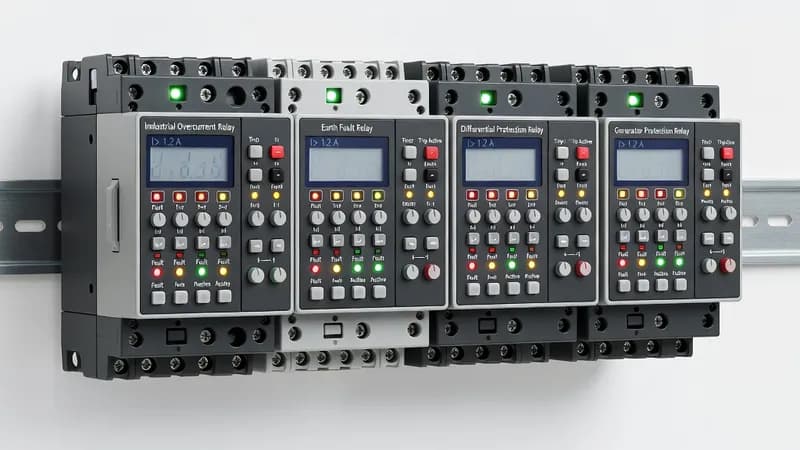
Protection Relays

Protection Relays are intelligent microprocessor-based devices used to detect abnormal electrical conditions and command circuit breakers, contactors, or tripping coils to isolate faults before equipment damage, fire, or plant downtime occurs. In IEC 61439 low-voltage assemblies, they are commonly integrated with ACBs and MCCBs from Schneider Electric (Micrologic / Sepam-compatible architectures), ABB (REF/REJ/REM families), Siemens (SIPROTEC Compact), Eaton (Easergy and xEnergy ecosystem), and SEL relays for critical power and utility interfaces. Typical functions include overcurrent (ANSI 50/51), earth fault and sensitive earth fault (50N/51N, 50Ns/51Ns), short-time and instantaneous protection, thermal overload, phase loss, negative sequence, under/over voltage (27/59), under/over frequency (81), reverse power (32), sync-check (25), breaker failure (50BF), and differential protection (87) for transformers, generators, and busbars. Motor applications often use relays with start supervision, locked rotor, stall, RTD inputs, and thermal models aligned with IEC 60947-4-1 motor control duties. These relays are selected according to system topology, earthing arrangement, prospective short-circuit current, required selectivity, and coordination with upstream and downstream devices. In practice, they support rated operational currents from low-voltage feeder protection up to interface protection for transformers and generator incomers, with tripping logic coordinated to withstand and interrupt faults in assemblies rated for high short-circuit levels, typically 25 kA, 36 kA, 50 kA, 65 kA, or higher depending on the panel design and incoming device rating. For main-distribution-board, power-control-center, and generator-control-panel applications, relays are often paired with ACBs, motorized MCCBs, and protection class current transformers, while motor-control-center, soft-starter-panel, and VFD line-up panels may use them for feeder selectivity, process interlocks, and equipment protection. In capacitor-bank-panel and harmonic-filter-panel applications, relays supervise detuned reactor banks, harmonic overcurrent, capacitor unbalance, overtemperature, and step switching logic. A compliant implementation must consider IEC 61439-1 general rules and IEC 61439-2 power switchgear and controlgear assemblies, while specific function requirements may also involve IEC 61439-3 for distribution boards and IEC 61439-6 for busbar trunking interface and distribution assemblies. Equipment used for measuring and protective functions should align with IEC 60255 relay performance principles, with interface devices and switching components compliant with IEC 60947. Where panels are installed in hazardous atmospheres, additional assessment against IEC 60079 is required; for arc flash risk reduction and internal fault containment in certain applications, IEC 61641 is relevant to internal arc testing of low-voltage assemblies. For digital communication, modern relays often support Modbus RTU/TCP, Profibus, Profinet, IEC 61850, and DNP3, enabling integration with PLC-automation-panel architectures and SCADA systems. Selection should also account for CT ratio, burden, auxiliary supply voltage, trip contact capacity, time-current curve flexibility, HMI visibility, disturbance recording, event logs, cyber/communications needs, and maintainability. Proper wiring, segregation, and test facilities are essential for reliable operation in custom-engineered-panel, automatic-transfer-switch, dc-distribution-panel, and power-factor-correction installations. Well-specified protection relays improve system availability by enabling selective tripping, reducing nuisance outages, and documenting the cause of every trip for commissioning, troubleshooting, and long-term asset management.

Panels Using This Component

Main Distribution Board (MDB)

Primary power distribution from transformer to sub-circuits. Rated up to 6300A. Houses main incoming breaker, bus-section, and outgoing feeders.

Power Control Center (PCC)

High-capacity power distribution for industrial facilities. Controls and distributes incoming power to MCC, APFC, and downstream loads.

Motor Control Center (MCC)

Centralized motor control with starters, contactors, overloads, and VFDs in standardized withdrawable/fixed functional units.

Power Factor Correction Panel (APFC)

Automatic capacitor switching for reactive power compensation. Thyristor or contactor-switched, detuned or standard configurations.

Automatic Transfer Switch (ATS) Panel

Automatic changeover between mains and generator/UPS. Open or closed transition, with or without bypass.

Generator Control Panel

Genset start/stop sequencing, synchronization, load sharing, and paralleling controls.

PLC & Automation Control Panel

Process and machine control panels housing PLCs, I/O modules, relays, HMIs, and communication infrastructure.

Custom Engineered Panel

Bespoke panel assemblies for non-standard requirements — special ratings, unusual form factors, multi-function combinations.

Soft Starter Panel

Enclosed soft starter assemblies for reduced voltage motor starting with torque control, ramp-up/down profiles, and bypass contactor options.

Harmonic Filter Panel

Active or passive harmonic filtering to mitigate THD from non-linear loads. Tuned LC filters, active filters, or hybrid configurations.

DC Distribution Panel

DC power distribution for battery systems, solar installations, telecom, and UPS applications. MCCB/fuse-based DC protection.

Capacitor Bank Panel

Fixed or automatic capacitor bank assemblies for bulk reactive power compensation in industrial and utility applications.

Related Knowledge Articles

Frequently Asked Questions

The most common functions in IEC 61439 assemblies are overcurrent (50/51), earth fault (50N/51N), sensitive earth fault (50Ns/51Ns), under/over voltage (27/59), under/over frequency (81), reverse power (32), and differential protection (87). In motor-control-center and generator-control-panel applications, relays may also include thermal models, locked-rotor, stall, and start supervision. For transformer incomers and bus couplers, breaker failure (50BF), sync-check (25), and directional earth fault are often specified. The relay must be coordinated with ACB or MCCB tripping, CT ratios, and the assembly short-circuit rating under IEC 61439-1/2. Modern relays from Schneider Electric, ABB, Siemens, Eaton, and SEL are commonly used in these roles.
Selection starts with the system one-line diagram, earthing arrangement, prospective fault current, and required selectivity. For a power-control-center, you typically match the relay to the incoming ACB, feeder MCCBs, and CT accuracy class, then define time-current curves for discrimination. In motor-control-center panels, choose a relay that supports motor thermal capacity, start time, and stall/locked-rotor protection. In PCC and main-distribution-board applications, look for adjustable long-time, short-time, instantaneous, and earth fault functions. Also verify auxiliary supply voltage, output contact rating, communications protocol, and whether the relay integrates with PLC or SCADA. Compliance should be checked against IEC 61439 and IEC 60947 device coordination rules.
Protection relays are most common in main-distribution-board, power-control-center, motor-control-center, generator-control-panel, automatic-transfer-switch, and custom-engineered-panel assemblies. They are also widely used in soft-starter-panel and harmonic-filter-panel systems where feeder supervision, overload protection, or capacitor/reactor unbalance detection is required. In power-factor-correction and capacitor-bank-panel applications, relays often control step switching and protect against overcurrent, overtemperature, and harmonics. For dc-distribution-panel and plc-automation-panel designs, relays may be used for feeder protection, battery charger interfaces, and critical load shedding. The exact function set depends on whether the panel is built to IEC 61439-2, -3, or -6 and on the connected loads.
Breaker trip units are integrated into the ACB or MCCB and provide local protection, while external protection relays offer much broader functionality and better selectivity. A Micrologic-type trip unit or equivalent can handle feeder protection efficiently, but a separate relay adds differential protection, directional elements, breaker failure logic, disturbance records, and communication with IEC 61850, Modbus, or DNP3 systems. External relays are preferred for generators, transformers, utility incomers, and critical motor feeders where precise coordination and event data are essential. In IEC 61439 panels, the relay must still be integrated with the assembly’s rated short-circuit withstand and coordinated with IEC 60947 switching devices.
Modern numerical relays commonly support Modbus RTU, Modbus TCP, Profibus, Profinet, IEC 61850, and DNP3. Higher-end units from Siemens SIPROTEC, ABB Relion, Schneider Electric Easergy/Sepam families, Eaton, and SEL may also include Ethernet redundancy, time synchronization, and extensive event logging. For PLC-automation-panel or SCADA integration, the relay should provide measurable analog values, status points, SOE event timestamps, and configurable alarms. In critical infrastructure, IEC 61850 is often preferred because it enables fast peer-to-peer messaging and standardized substation integration. Cybersecurity and network architecture should be considered during design, especially where the panel communicates with plant-wide systems.
Coordination is based on the relay’s pickup settings, time delays, and the trip unit characteristics of the ACB or MCCB. The goal is selectivity: the nearest downstream protective device should clear the fault without tripping upstream feeders. This requires matching CT ratios, curve shaping, and short-time delay coordination, especially in main-distribution-board and power-control-center assemblies. For high fault levels, confirm that the panel’s short-circuit rating under IEC 61439 is higher than the available fault current and that the breaker interrupting capacity is sufficient. In generator and transformer systems, the relay may also communicate with the breaker through a trip coil, interposing relay, or shunt trip module.
Yes. Protection relays should be installed with attention to segregation, CT wiring quality, electromagnetic compatibility, and maintainability. CT secondary circuits must be shorted or protected during maintenance, and wiring should be routed separately from noisy VFD, soft-starter, and capacitor switching circuits. In IEC 61439 assemblies, the relay compartment should support clear labeling, test access, auxiliary supply protection, and adequate ventilation. If the panel is intended for harsh or hazardous areas, additional requirements may apply under IEC 60079; if arc containment is a concern, IEC 61641 testing may be relevant. Good practice also includes terminal ferrules, correct torqueing, shield termination where needed, and visible indication of alarm/trip status.
Yes. In power-factor-correction and harmonic-filter-panel applications, protection relays are used to monitor step currents, unbalance, overtemperature, and abnormal harmonic loading. They can also supervise detuned reactor banks and prevent capacitor overcurrent or overvoltage conditions. This is especially important in plants with VFDs, welders, or high non-linear loads where harmonics can overstress capacitors and reactors. The relay may be integrated with contactors, discharge resistors, fuse supervision, and controller logic. For IEC 61439 compliance, the panel’s thermal design, short-circuit rating, and component coordination must be verified so that capacitor switching and filter inrush do not compromise safety or service life.

Ready to Engineer Your Next Panel?

Our team of electrical engineers is ready to design, build, and deliver your custom panel solution — fully compliant with international standards.