Generator Control Panel
Genset start/stop sequencing, synchronization, load sharing, and paralleling controls.
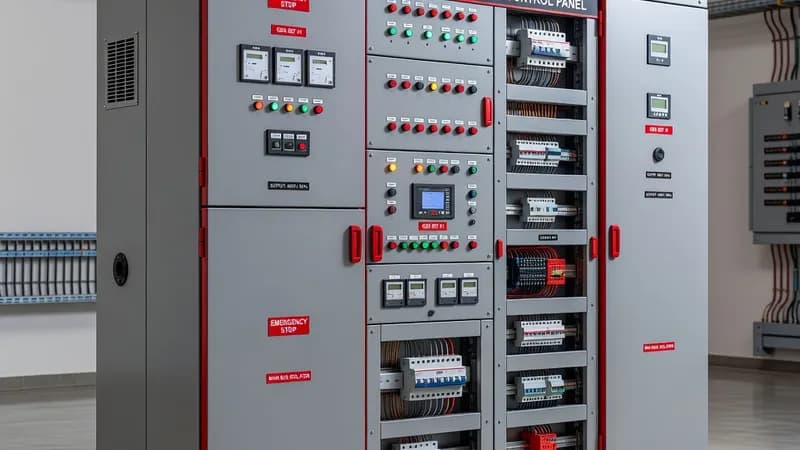
A Generator Control Panel is a low-voltage switchgear and control assembly designed to start, stop, supervise, protect, synchronize, and parallel one or more diesel or gas generator sets with a utility source or other generators. For IEC 61439 projects, the panel is typically engineered as a Type-2 assembly under IEC 61439-2, with verification of temperature rise, dielectric properties, short-circuit withstand, protective circuit continuity, and clearances/creepage. In practice, generator control panels are built with PLC I/O modules, dedicated genset controllers, protection relays, metering power analyzers, synchronizing check relays, and power switching devices such as MCCBs and ACBs selected under IEC 60947-2, with contactors and auxiliaries to IEC 60947-4-1 and -5-1 where applicable. Typical applications include emergency standby for hospitals, data centers, and wastewater plants; prime power systems for mining camps and remote oil-and-gas installations; and marine and offshore paralleling systems where classification requirements and high availability drive redundant controls. Panels may be configured for single-unit standby, open-transition transfer, closed-transition transfer, load sharing, or full paralleling switchboards with automatic mains failure (AMF), auto-synchronization, dead bus closing, peak shaving, and base load control. Depending on the project, continuous currents can range from 100 A for small standby sets to 6,300 A or more for multi-generator switchboards, with short-circuit ratings commonly specified from 25 kA to 100 kA at 415 V or 690 V, subject to verified assembly design and upstream source contribution. The internal architecture is strongly influenced by form of separation requirements, often Form 2, Form 3b, or Form 4b, to isolate functional units, busbars, and terminals and improve maintainability during operation. Busbar systems are generally copper, sized for thermal performance and electrodynamic forces, and may be segregated into main, generator, and essential load sections. ACBs are preferred for large frame ratings and selective coordination, while MCCBs are common for feeder and generator incomers. VFDs and soft starters may be integrated for auxiliary pumps, cooling fans, fuel transfer systems, or process loads, but these are usually segregated from critical synchronizing and protection circuits to reduce harmonic and EMC impacts. In demanding installations, harmonic filtering, surge protection devices, and monitored battery chargers are added to improve reliability. Generator control panels may also need compliance verification beyond IEC 61439, including IEC 60079 for hazardous-area interfaces where applicable, IEC 61641 for internal arc fault considerations in enclosed assemblies, and marine classification rules from societies such as DNV, ABS, or Lloyd’s Register. Seismic qualification is often required for critical infrastructure and can affect enclosure anchoring, component bracing, and cable retention. A well-designed panel from Patrion integrates these requirements into a single engineered solution, balancing operational continuity, selective protection, operator safety, and maintainability across standby, prime, and paralleling duty applications.
Components for This Panel
Protection Relays selection, integration, and best practices for Generator Control Panel assemblies compliant with IEC 61439.
Moulded Case Circuit Breakers (MCCB) selection, integration, and best practices for Generator Control Panel assemblies compliant with IEC 61439.
Air Circuit Breakers (ACB) selection, integration, and best practices for Generator Control Panel assemblies compliant with IEC 61439.
Metering & Power Analyzers selection, integration, and best practices for Generator Control Panel assemblies compliant with IEC 61439.
PLCs & I/O Modules selection, integration, and best practices for Generator Control Panel assemblies compliant with IEC 61439.
Applicable Standards
IEC 61439-2 (PSC) compliance requirements, testing procedures, and design considerations for Generator Control Panel assemblies.
Marine Classification (DNV/Lloyd's/BV) compliance requirements, testing procedures, and design considerations for Generator Control Panel assemblies.
Seismic Qualification (IEEE 693/IBC) compliance requirements, testing procedures, and design considerations for Generator Control Panel assemblies.
UL 891 / CSA C22.2 compliance requirements, testing procedures, and design considerations for Generator Control Panel assemblies.
Industries Using This Panel
Generator Control Panel assemblies engineered for Oil & Gas applications, addressing industry-specific requirements and compliance standards.
Generator Control Panel assemblies engineered for Water & Wastewater applications, addressing industry-specific requirements and compliance standards.
Generator Control Panel assemblies engineered for Mining & Metals applications, addressing industry-specific requirements and compliance standards.
Generator Control Panel assemblies engineered for Marine & Offshore applications, addressing industry-specific requirements and compliance standards.
Generator Control Panel assemblies engineered for Healthcare & Hospitals applications, addressing industry-specific requirements and compliance standards.
Related Knowledge Articles
Implementing generator paralleling and load sharing systems.
Comprehensive overview of all IEC 61439 parts, their scope, and how they apply to different panel types.
Coordinating protection relays for reliable fault detection and selectivity.
Frequently Asked Questions
Ready to Engineer Your Next Panel?
Our team of electrical engineers is ready to design, build, and deliver your custom panel solution — fully compliant with international standards.