Type 2 Coordination for Motor Starters
Selecting coordinated MCCB-contactor-overload combinations.
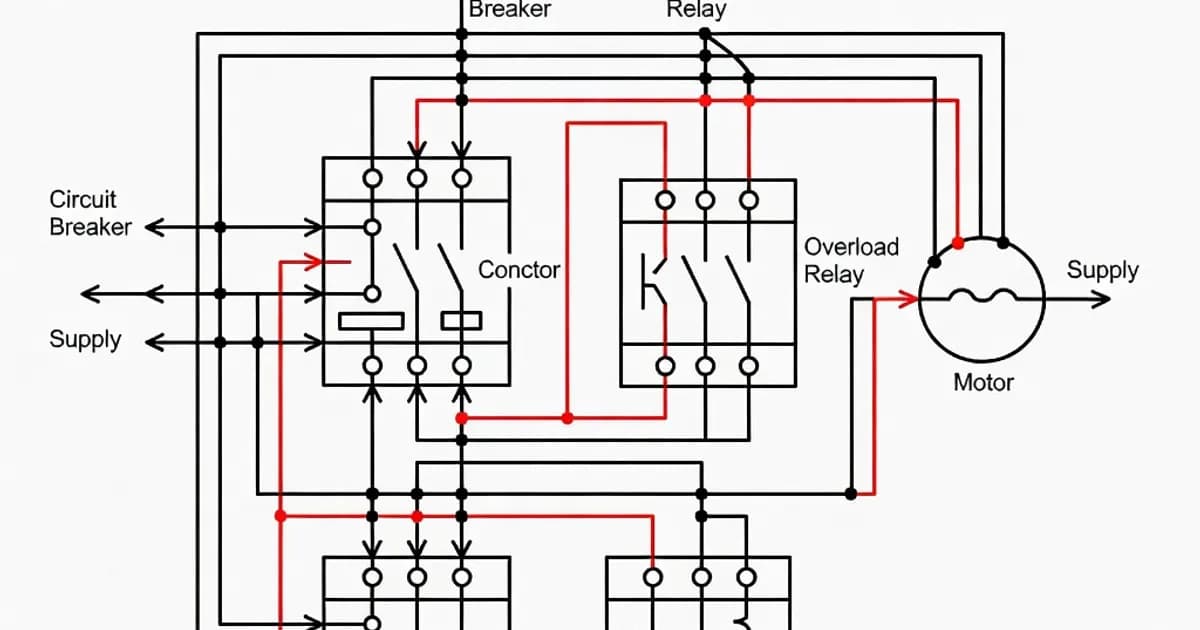
Type 2 Coordination for Motor Starters
Type 2 coordination is the preferred level of short-circuit coordination for many industrial motor starters because it is designed to preserve operational continuity after a fault. In practical terms, a properly coordinated Type 2 combination allows the starter to remain suitable for further use after a short-circuit event, although some contact welding may occur and manufacturer-specified maintenance or part replacement may still be required. This concept is defined in IEC 60947-4-1 for electromechanical contactors and motor-starters, and it is fundamentally different from Type 1 coordination, which permits damage and replacement of parts but not burnout or danger to personnel. Per IEC 60947-4-1, the coordination objective is safety first, then continued serviceability where possible.
For low-voltage panel builders, Type 2 coordination is especially important in motor control centers, pump panels, HVAC systems, conveyors, and process equipment where downtime is costly. In these applications, the starter must survive a fault long enough for the protective device to clear it without creating a hazard. The combination is not selected device-by-device in isolation; it is verified as a tested system comprising the protective device, contactor, and overload relay, usually with a manufacturer-published coordination table. As documented in Eaton’s IEC coordination guide, the final selection must be made from pre-verified combinations rather than from arithmetic assumptions alone. Eaton Type 1 and Type 2 Coordination Guide
What Type 2 coordination means in practice
Under IEC 60947-4-1, Type 2 coordination requires that after a short-circuit fault the starter shall not present a danger to persons or installation, and it shall remain suitable for further use. The key nuance is that minor damage may be accepted if it does not compromise safety or future operation. Contact welding can occur, but the contactor must be able to be returned to service following the manufacturer’s inspection or maintenance instructions. This is a stricter and more desirable outcome than Type 1, where the protective device is allowed to clear the fault but the starter can be damaged beyond immediate reuse.
The standard also ties Type 2 performance to the device’s short-circuit withstand and conditional short-circuit performance. In many manufacturer tables, you will see the prospective short-circuit current expressed as Iq or as a test value at a stated voltage, such as 50 kA at 415 V, 50 Hz. The combination is validated at that level, and the published table becomes the design reference for the panel builder. In the context of motor starters, this means the choice of MCCB or fuse cannot be separated from the choice of contactor and overload relay.
Why Type 2 coordination matters for panel assemblies
For IEC 61439 assemblies, the motor starter is only one part of the larger low-voltage switchboard or control panel. IEC 61439-2 requires the assembly itself to be verified for short-circuit withstand and other design criteria. Clause 10.2 addresses short-circuit withstand verification, and the assembly must endure the prospective short-circuit current without dangerous mechanical or thermal damage. In other words, even a perfectly coordinated starter is not enough if the panel enclosure, busbars, wiring, or mounting system cannot survive the fault level. IEC 61439-2:2020 makes this system-level requirement explicit, and the original manufacturer must provide a verified design basis while the assembly manufacturer ensures correct application and construction. IEC 61439-2:2020
This is a major shift from the older IEC 60439 approach. The IEC 61439 series places much greater emphasis on design verification, documentation, and the split between original manufacturer and assembly manufacturer responsibilities. Schneider Electric explains that IEC 61439 changed how low-voltage equipment specifications are written and verified, especially for temperature rise, short-circuit withstand, and routine testing. Schneider Electric overview of IEC 61439
Type 1 versus Type 2 coordination
| Coordination type | Fault outcome | Safety requirement | Post-fault usability | Typical application |
|---|---|---|---|---|
| Type 1 | Protective device clears the fault; starter may be damaged | No danger to persons or installation | Parts may need replacement | Lower criticality loads |
| Type 2 | Protective device clears the fault; starter may show limited contact welding | No danger to persons or installation | Starter remains suitable for further use after inspection or maintenance | Process, utility, and uptime-sensitive motor circuits |
The practical difference is reliability after a fault. Type 2 is not simply “more robust” in a generic sense; it is a defined coordination outcome proven by testing. That is why the selection table from the manufacturer matters more than theoretical compatibility between individual catalog numbers.
How Type 2 coordination is verified
Type 2 coordination is not established by visual inspection or by matching current ratings alone. Manufacturers verify the combination by testing the starter assembly at specified prospective short-circuit currents and supply conditions. The test confirms that the protective device interrupts the fault, the contactor does not present a hazard, and the overload relay remains fit for function or can be returned to service in accordance with the manufacturer’s instructions. In many published tables, the test current is tied to a defined voltage and frequency, such as 415 V, 50 Hz, with prospective short-circuit currents up to 50 kA for selected combinations.
The contactor must withstand the short-circuit current without endangering personnel or the installation. In IEC terminology and related manufacturer literature, the withstand requirement may be expressed using rated conditional short-circuit current or related short-circuit terms depending on the product standard. For motor-starter assemblies, the key point is that the tested combination governs the final application. IEC 61439-2 then adds the assembly-level requirement, ensuring the entire panel structure and its internal separation, conductors, and mounting system are suitable for the stated fault level. Per IEC 61439-2 Clause 10.2, this short-circuit verification is mandatory for the completed assembly. IEC 61439-2:2011 sample
For switchboard and panel manufacturers, the practical workflow is straightforward: determine the prospective short-circuit current at the point of installation, select only manufacturer-approved Type 2 combinations at or above that level, and ensure the assembly’s busbars, enclosure, and wiring are also verified accordingly. This prevents a common design error where the starter is rated for the fault but the overall assembly is not.
Core components of a Type 2 motor-starter combination
A typical Type 2 motor-starter combination includes an MCCB or fuse, a contactor, and an overload relay. Each component serves a distinct role in the coordination system.
- MCCB or fuse: Provides short-circuit protection and clears the fault. In IEC practice, HRC aM or gG/gM fuse solutions are often used where high fault levels are expected. Eaton and IOGP guidance both emphasize the use of high-rupturing-capacity devices for robust motor protection.
- Contactor: Operates the motor under normal load and starting conditions. For squirrel-cage motors, the usual utilization category is AC-3, which covers starting, switching off during running, and intermittent service under motor duty conditions.
- Overload relay: Protects against sustained overload and phase loss. Class 10 thermal overload relays are common for general-purpose motor starting, while longer acceleration or high-inertia loads may require Class 20 or higher depending on the motor’s starting profile.
IEC 60947-4-1 places contactors used for motor starting in utilization categories such as AC-3 and AC-23A, with AC-3 being the standard category for squirrel-cage motor starting and stopping. Contactors selected for Type 2 coordination must be suitable for the motor’s duty cycle and inrush conditions. A starter used for 12 cycles per hour at Class 12 duty must still remain within the contactor’s permissible thermal and mechanical limits. If the startup current exceeds the expected overload withstand, the coordination table is no longer valid.
Typical selection parameters
| Parameter | Typical requirement | Design note |
|---|---|---|
| Contactor utilization category | AC-3 | Standard for squirrel-cage motor starting and stopping |
| Overload relay class | Class 10 | Common for standard acceleration times |
| Prospective short-circuit current | Up to manufacturer table value, e.g. 50 kA at 415 V | Must be verified at the installation point |
| MCCB instantaneous setting | About 12 × FLC for standard motors; up to 14 × FLC for high-efficiency motors | Must accommodate starting current without nuisance tripping |
| Coordination basis | Pre-tested manufacturer combination | Do not mix components outside approved tables |
How to select a Type 2 coordinated motor starter
The first step is to identify the motor full-load current, voltage, starting method, and duty cycle. From there, the protective device and contactor must be chosen as a tested pair or trio. Manufacturer tables usually list the motor kW or horsepower rating at a given voltage, along with the maximum prospective short-circuit current and the compatible contactor frame size. For example, some published charts show Type 2 combinations at 415 V with fault ratings up to 50 kA and specific contactor sizes determined by motor power. Always use the latest manufacturer data sheet or coordination chart for the exact product family.
For standard motors with a starting current around 6 × FLC, an MCCB instantaneous setting around 12 × FLC is often used to avoid nuisance tripping while still providing fast fault clearance. For high-efficiency motors with starting currents nearer 8 × FLC, the instantaneous setting may need to rise toward 14 × FLC, subject to the manufacturer’s validated coordination data. This is one reason why a starter that works on paper may fail in the field if the starting characteristics were underestimated.
Coordination tables also account for motor speed, inertia, and starting time. When acceleration exceeds the normal assumptions, the overload relay class and protection strategy may need adjustment. In some applications, a star-delta starter or soft starter is used to limit inrush current, but even then the Type 2 coordination of the final contactor and protective device must still be verified.
Selection checklist
- Determine motor rated current, starting current, and duty cycle.
- Measure or calculate prospective short-circuit current at the panel location.
- Select only manufacturer-published Type 2 combinations.
- Confirm contactor utilization category is suitable, typically AC-3.
- Check overload relay class and reset characteristics.
- Verify the assembly’s IEC 61439 short-circuit withstand, temperature rise, and enclosure suitability.
- Ensure the final panel documentation includes the exact tested combination.
Interaction with IEC 61439 panel design
Type 2 coordination does not exist in isolation. In a compliant low-voltage panel assembly, the starter must be integrated into a system that satisfies IEC 61439 verification requirements. These include temperature rise, dielectric properties, clearances and creepage, short-circuit withstand, mechanical operation, and degree of protection. For assemblies rated up to and above 1600 A, IEC 61439 also allows verification by calculation or comparison with a reference design in some cases, but short-circuit withstand still requires rigorous evidence. The panel builder cannot simply assume that a tested starter combination guarantees the entire assembly is safe.
IOGP S-560, which supplements IEC 61439, reinforces good practice by specifying robust protective devices, such as HRC fuses, for motor circuits and by emphasizing application discipline in low-voltage assemblies. It also reflects common industry expectations for enclosure performance, protection against contact, and environmental robustness. Where panel access or location demands it, protection classes such as IP and mechanical impact rating such as IK should be considered as part of the overall assembly specification. IOGP cites the relevance of IEC 60529 for ingress protection and mechanical impact requirements for certain assemblies. IOGP S-560
In practice, a Type 2 starter panel intended for harsh industrial service should not be treated as a collection of separate catalog items. It is an engineered assembly in which the protection device, starter, enclosure, wiring, mounting arrangement, and thermal management all contribute to safe performance after a fault.
Manufacturer examples and typical product families
Major manufacturers publish detailed coordination tables for their motor control product families. These tables are essential because Type 2 performance depends on the exact combination of breaker, contactor, overload relay, operating voltage, and sometimes even coil code or accessory package.
| Manufacturer | Typical product family | Coordination information published | Design note |
|---|---|---|---|
| Eaton | Freedom Series MCCB, contactor, overload relay | Type 2 tables by voltage and motor size | Strong reference for IEC Type 1/2 coordination selection |
| Siemens | 3VA MCCB, SIRIUS 3RT contactor, 3RU overload relay | Fault current and motor rating charts | Common in IEC control panels and motor control centers |
| ABB | Tmax XT MCCB, AF contactor, TF overload relay | Type 2 tables up to higher voltage classes | Useful for industrial and process applications |
| Schneider Electric | ComPact NSX, TeSys contactor, overload relay | Type 2 coordination charts for standard and high-efficiency motors | Often includes star-delta and motor duty references |
These published tables are not interchangeable. A Type 2 rating for one breaker-contactor-overload combination does not transfer automatically to another family, even if the current ratings look similar. As the Eaton guide emphasizes, the correct combination is the one that has been tested and approved by the manufacturer for the exact configuration being used.
Best practices for panel builders and specifiers
Panel builders should specify Type 2 coordination whenever motor uptime, safety, or maintenance efficiency are important. The specification should define not only the starter and overload class, but also the prospective short-circuit current at the installation point, the enclosure rating, the duty cycle, and any environmental constraints. This is especially important in MCC panels, water treatment systems, HVAC plants, and process lines where a fault should not lead to extended downtime.
Several practical rules improve reliability:
- Use only pre-verified manufacturer combinations for Type 2 coordination.
- Do not substitute contactors, overload relays, or breakers without rechecking the coordination table.
- Confirm the instantaneous setting of the MCCB or the fuse characteristic will not interfere with motor starting.
- Ensure overload relay settings match the motor nameplate current and service factor.
- Account for high-efficiency motors, which often draw higher inrush current and may require a higher instantaneous trip setting.
- Verify the completed assembly to IEC 61439, not just the components.
- Specify enclosure protection and mechanical robustness, including IP and IK performance where the installation environment requires it.
Specifiers should also consider the maintenance implications of Type 2 coordination. While the starter is intended to remain suitable for further use, post-fault inspection is still necessary. Contact welding, pitting
Related Panel Types
Related Components
Frequently Asked Questions
Ready to Engineer Your Next Panel?
Our team of electrical engineers is ready to design, build, and deliver your custom panel solution — fully compliant with international standards.