Contactors & Motor Starters
DOL/star-delta/reversing starters, overload relays, Type 2 coordination
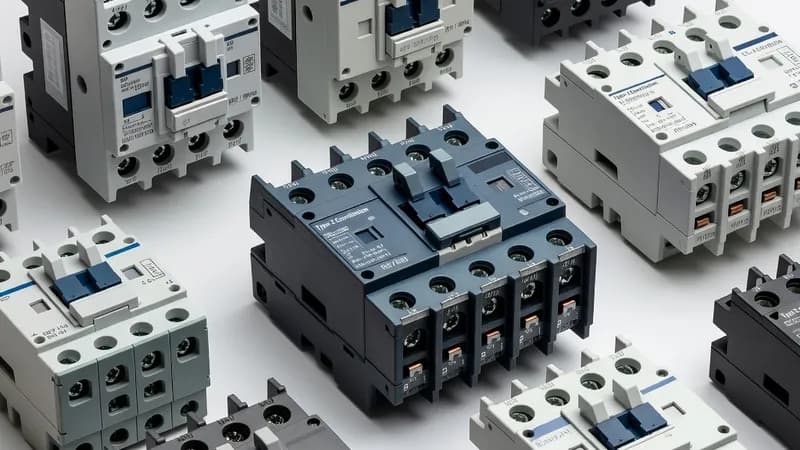
Contactors and motor starters are core control components in IEC 61439 low-voltage switchgear and controlgear assemblies, providing reliable switching, isolation-by-function, and overload protection for three-phase motors and auxiliary loads. In practical panel applications, these devices are selected by utilization category under IEC 60947-4-1: AC-3 for squirrel-cage motor starting and stopping, AC-4 for inching, plugging, and reversing duties, and AC-1 for resistive or lightly inductive loads. Typical assemblies range from compact 9 A to 95 A starters for small pumps and fans up to 250 A or higher in feeder-controlled motor control centers, with coordination to upstream MCCBs or fuses to achieve Type 1 or Type 2 coordination per IEC 60947-4-1. Type 2 coordination is preferred in critical processes because the contactor and overload relay must remain suitable for continued service after a short-circuit event, subject to manufacturer test data. A complete motor starter typically includes a power contactor, a thermal bimetal or electronic overload relay, auxiliary contacts, terminal blocks, and a short-circuit protective device. Common product families include Schneider Electric TeSys D and TeSys F, Siemens SIRIUS 3RT and 3RU/3RB overload relays, ABB AF contactors with electronic coil technology, Eaton DILM contactors and ZB overload relays, and Lovato Electric BF and RF series. For demanding applications, electronic overload relays offer phase-loss sensitivity, adjustable trip classes such as Class 10, 20, or 30, thermal memory, and communication options for PLC integration. Starter topologies are chosen according to motor size and process requirements. Direct-on-line (DOL) starters are used where the supply network can tolerate inrush current, commonly on small conveyors, exhaust fans, and packaged pumps. Star-delta starters reduce starting current and mechanical stress, but require motors with six accessible terminals and are best suited to moderate inertia loads. Reversing starters are used on hoists, gates, and directional conveyors and require electrical and mechanical interlocking. Soft-starter panels use controlled voltage ramping and current limiting, often with bypass contactors, while variable-frequency-drive panels may retain contactors only for isolation or bypass duty. In power-factor-correction panels, contactors must be capacitor-duty types with inrush-limiting contact design, while harmonic-filter or capacitor-bank panels often use heavy-duty switching contactors rated for high repetitive capacitor currents. In IEC 61439 assemblies, the thermal and dielectric performance of starters must be verified within the panel’s design envelope, including spacing, busbar loading, wiring cross-section, enclosure temperature rise, and short-circuit withstand ratings. Typical panel ratings may include 400 A, 630 A, 800 A, 1600 A, or higher main busbars, with starter feeders coordinated to prospective short-circuit currents such as 25 kA, 36 kA, 50 kA, or 65 kA for 1 second or the declared peak withstand value. For hazardous areas or dust-exposed installations, the overall system may also need evaluation against IEC 60079 requirements, while arc containment and internal fault behavior may be addressed under IEC 61641 for certain low-voltage assemblies. Contactors and motor starters are widely used in motor control centers, soft-starter panels, PLC automation panels, custom engineered panels, automatic transfer-related auxiliaries, and process skids across water treatment, HVAC, mining, food processing, material handling, and utilities. Correct selection depends on motor FLC, duty cycle, ambient temperature, coordination class, enclosure ventilation, and the available fault level at the installation point. For EPC contractors and panel builders, the most reliable designs pair a manufacturer-verified starter combination with documented SCCR, coordinated protection settings, and clear wiring diagrams that comply with IEC 61439 and IEC 60947 requirements.
Panels Using This Component
Centralized motor control with starters, contactors, overloads, and VFDs in standardized withdrawable/fixed functional units.
Automatic capacitor switching for reactive power compensation. Thyristor or contactor-switched, detuned or standard configurations.
Automatic changeover between mains and generator/UPS. Open or closed transition, with or without bypass.
Enclosed VFD assemblies with input protection, line reactors, EMC filters, output reactors, and bypass options.
Process and machine control panels housing PLCs, I/O modules, relays, HMIs, and communication infrastructure.
Bespoke panel assemblies for non-standard requirements — special ratings, unusual form factors, multi-function combinations.
Enclosed soft starter assemblies for reduced voltage motor starting with torque control, ramp-up/down profiles, and bypass contactor options.
Active or passive harmonic filtering to mitigate THD from non-linear loads. Tuned LC filters, active filters, or hybrid configurations.
Fixed or automatic capacitor bank assemblies for bulk reactive power compensation in industrial and utility applications.
Related Knowledge Articles
Selecting coordinated MCCB-contactor-overload combinations.
Comprehensive guide to MCC design and engineering.
Choosing between air circuit breakers and moulded case circuit breakers.
Frequently Asked Questions
Ready to Engineer Your Next Panel?
Our team of electrical engineers is ready to design, build, and deliver your custom panel solution — fully compliant with international standards.