Arc Flash Protection in Low-Voltage Panels
Protecting personnel from arc flash hazards.
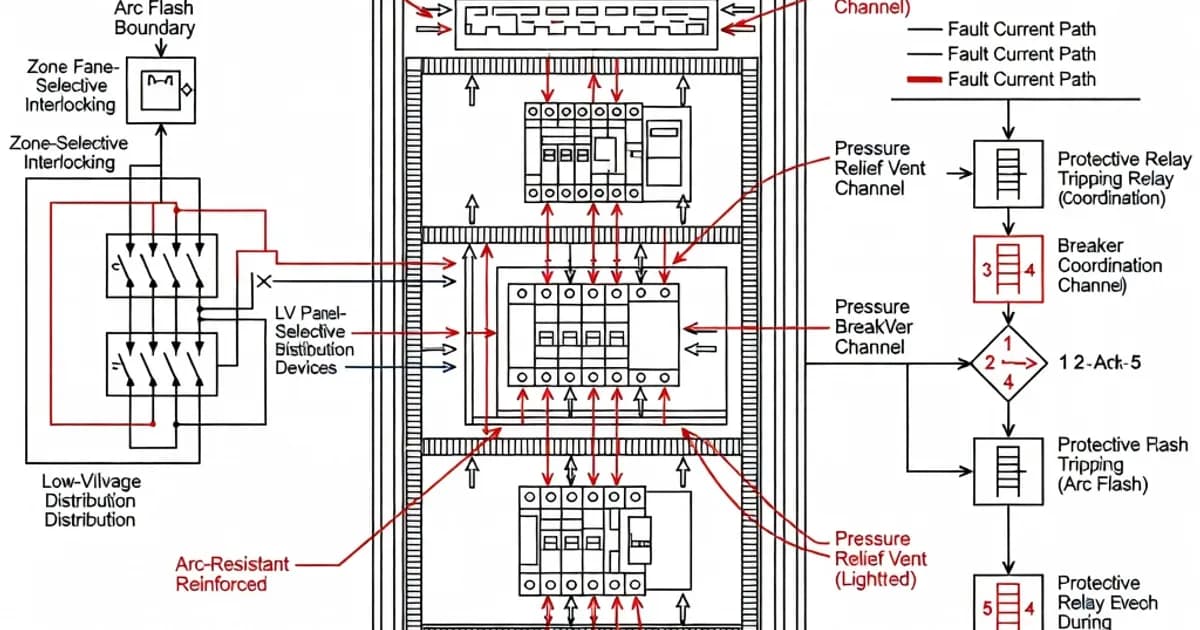
Arc Flash Protection in Low-Voltage Panels
Arc flash protection in low-voltage panels is about controlling one of the most violent failure modes in electrical assemblies: the internal arc fault. When an arc forms between live conductors, or between a conductor and earth, it can release extreme thermal energy, intense pressure, molten metal, ionized gases, and sound levels capable of causing severe injury or death. In practical terms, arc flash protection combines good design, verified enclosure performance, fault-clearing strategies, and disciplined maintenance. For IEC-based panel assemblies, this is not a single-standards issue. IEC 61439 defines the core safety and verification framework for low-voltage switchgear and controlgear assemblies, while internal arc performance is addressed more directly by IEC/TR 61641 and active mitigation systems are covered by IEC TS 63107.
For IEC 61439 assemblies, the key point is that compliance does not automatically mean arc-resistant behavior. Per IEC 61439-1 and IEC 61439-2, the assembly must pass the required design verifications for temperature rise, dielectric properties, short-circuit withstand, protective circuits, and mechanical strength. However, internal arc containment requires additional evidence, typically test-based, because arc faults create pressure and thermal effects beyond standard normal-operation verification. As documented in the BEAMA guide and IEC-related industry guidance, the most robust approach is to combine passive containment, active arc detection and quenching, and strict design verification of the assembly itself.[6][3]
How Arc Flash Risk Develops in LV Assemblies
An arc flash event usually starts with insulation failure, loose terminations, contamination, conductive dust, incorrect creepage/clearance, damaged components, or incorrect maintenance work. Once an arc is established, fault current can persist until protective devices clear the circuit. In a compact LV panel, even a short-duration arc can produce a rapidly rising internal pressure wave. If the enclosure cannot withstand or relieve that pressure safely, doors, covers, or panels may open violently, and hot gases or fragments can be expelled toward nearby personnel.
This is why arc risk must be addressed at three levels. First, the probability of arc initiation must be minimized through good design and workmanship. Second, the energy released must be limited by rapid fault clearing. Third, if a fault does occur, the enclosure must either contain or safely direct the effects. The IEC framework supports all three layers, but with different standards and test methods.
IEC Standards That Govern Arc Flash Protection
IEC 61439 is the principal standard family for low-voltage assemblies. It sets out general requirements and the design verification process, but it does not by itself define internal arc test criteria. That gap is filled by IEC/TR 61641, which provides a method for testing assemblies under internal arc fault conditions. In addition, IEC TS 63107 addresses active arc mitigation systems, especially those using optical detection and high-speed quenching or interruption. IEC 60529 and IEC 62262 also matter because ingress protection and mechanical impact resistance affect enclosure resilience and contamination control.
| Standard | Main focus | Relevance to arc flash protection |
|---|---|---|
| IEC 61439-1 / IEC 61439-2 | Low-voltage switchgear and controlgear assemblies | Defines design verification for temperature rise, dielectric strength, short-circuit withstand, shock protection, and mechanical integrity |
| IEC/TR 61641 | Internal arc faults in LV assemblies | Test method and acceptance criteria for internal arc containment, pressure release, and accessibility classes |
| IEC TS 63107 | Active arc mitigation systems | Verification of arc detection and quenching systems, including nuisance trip and recovery checks |
| IEC 60947-9-1 / IEC 60947-9-2 | Arc quenching and light detection devices | Component standards used in active mitigation architectures |
| IEC 60529 | IP ratings | Ingress protection against dust and water, helping to reduce contamination-related faults |
| IEC 62262 | IK ratings | Mechanical impact resistance of the enclosure |
Per IEC 61439-1, the assembly must undergo 13 design verifications, and the ones most relevant to arc prevention are temperature rise, dielectric properties, short-circuit withstand strength, protective circuits, and mechanical strength. As referenced in IEC 61439-2:2020, temperature rise verification under Clause 10.10 is especially important because excessive heating can damage insulation, weaken joints, and create the preconditions for an arc fault.[5]
Design Verification Requirements in IEC 61439
IEC 61439 requires a structured design verification process before an assembly is released for manufacture. This is not optional. The Original Manufacturer must verify the design of the assembly, while the Assembler must ensure the built product remains compliant through routine verification. In practice, arc flash protection depends heavily on the success of these verifications.
Temperature Rise Verification
Temperature rise verification, addressed in IEC 61439-2 Clause 10.10, checks that components, busbars, conductors, and terminals remain within their permitted temperature limits at rated current under worst-case conditions. Enclosures are tested closed, because in real service a panel must remain safe with doors shut. High temperature accelerates insulation aging, reduces contact pressure, and can initiate tracking or local hot spots. Schneider Electric notes that the panel’s rated current and thermal performance must be matched carefully to the application, especially when ambient conditions are severe or ventilation is restricted.[4]
A practical design implication is that busbar sizing, spacing, enclosure ventilation, and internal segregation all affect temperature rise. A panel that runs too hot does not just lose efficiency; it becomes more vulnerable to insulation damage and arc initiation.
Dielectric Properties and Insulation Coordination
Per IEC 61439-1 Clause 10.9, dielectric verification ensures that the assembly can withstand the required power-frequency and impulse voltages. IEC 61439 references Table 102 for power-frequency withstand levels, while impulse withstand is coordinated with IEC 60664-1. This matters because insulation breakdown is a common precursor to internal arcing. ABB’s technical guidance emphasizes that dielectric testing and insulation coordination must be treated as core verification steps, not afterthoughts.[7]
Short-Circuit Withstand Strength
Clause 10.11 addresses short-circuit withstand strength. If an assembly cannot endure the prospective fault current for the clearing time of the upstream protective device, conductors can separate, enclosures can deform, and an internal arc can be sustained or worsened. Strong mechanical design, verified busbar supports, and properly rated protective devices reduce this risk. IEC 61439 requires proof that the assembly can tolerate the relevant short-circuit current under defined conditions.
Protection Against Electric Shock
IEC 61439-1 Clause 8 covers protection against electric shock. Basic protection is provided by insulation or barriers, while fault protection can be achieved by automatic disconnection of supply under Clause 4.41 or by reinforced insulation under Clause 4.42. For Class I assemblies, earth continuity must also be verified, including protective conductor connections and bonding. Good shock protection does not eliminate arc flash risk, but it reduces the chance that a fault escalates into an uncontrolled event.
Mechanical Strength, IP, and IK
Mechanical strength is verified under IEC 61439-1 Clause 10.7. External impact resistance is commonly expressed using the IK code defined in IEC 62262. In industrial practice, an IK08 level is often treated as a sensible minimum for robust enclosed installations, while higher values may be required in harsh environments. Likewise, IP ratings under IEC 60529 help prevent dust and moisture ingress that can cause tracking, corrosion, or insulation degradation. ABB’s IEC 61439 workbook highlights the practical role of both IP and IK ratings in durable assembly design.[1]
Internal Arc Fault Testing and IEC/TR 61641
IEC/TR 61641 is the key reference for internal arc fault behavior in low-voltage assemblies. It defines how assemblies are tested, how test arrangements are set up, and what acceptance criteria must be met. The test evaluates whether the enclosure contains or safely relieves the arc effects without presenting unacceptable danger to persons in the intended accessibility zones.
Typical evaluation criteria include no ignition of indicators placed around the enclosure, no holes in the enclosure walls, no ejection of parts beyond acceptable limits, and no sustained burning outside the enclosure. The standard also considers accessibility from the front, lateral, and rear sides. Testing is typically carried out at high prospective fault currents, commonly in the 25 kA to 100 kA range, with durations from 0.1 s to 1 s depending on the declared performance class and test configuration.[6][8]
It is important to understand the limitation of these tests. As noted in industry guidance, internal arc tests are highly valuable but cannot represent every possible fault location, cable arrangement, or installation condition. Annex material and application notes commonly emphasize that test validity depends on the exact construction, accessories, and accessibility configuration. For that reason, a test report should be read as evidence for a specific assembly design, not as a universal guarantee for any modification of that design.
Active Arc Mitigation Systems
Passive containment alone may not be enough for high-energy applications. Active arc mitigation systems aim to detect an arc in milliseconds and either interrupt the fault or quench the arc before major damage develops. IEC TS 63107, issued in 2020, provides a framework for verifying these systems. The approach typically combines light sensors, current detection, and a fast acting interruption or quenching mechanism.
Arc detection often uses optical sensors conforming to the principles of IEC 60947-9-2. Quenching devices are associated with IEC 60947-9-1. The advantage is speed: if an arc can be extinguished in a few milliseconds, the released energy may be reduced dramatically. BEAMA’s guide notes that verification must include sensitivity testing, high-energy arc tests, nuisance trip evaluation, and re-powering checks to confirm that the system behaves correctly after operation.[6]
Active systems are especially useful where uptime matters and where a single arc fault would have unacceptable business or safety consequences. However, they must be designed carefully to avoid blind spots, false trips, and poor integration with the panel’s protection hierarchy. A fast system that nuisance-trips repeatedly is not fit for purpose.
Comparison of Arc Flash Protection Approaches
| Approach | Typical mechanism | Strengths | Limitations |
|---|---|---|---|
| Passive containment | Arc-rated enclosure, pressure relief, segregation, strong mechanical design | No electronics required; robust and simple; supports safer fault direction | Does not prevent the arc; relies on enclosure integrity and test validity |
| Preventive design | Proper clearances, torque control, temperature rise control, insulation coordination | Reduces arc initiation probability; improves long-term reliability | Cannot eliminate all fault causes |
| Active mitigation | Light detection plus ultra-fast quenching or tripping | Can sharply reduce incident energy; valuable for critical systems | Requires correct sensor placement, verification, and maintenance |
| Overcurrent protection alone | Fuse or breaker clearing | Widely available and standardized | Often too slow to prevent severe arc flash energy in high-fault systems |
Manufacturer Practices and Commercial Implementations
Major manufacturers integrate these principles in different ways. Siemens SIVACON assemblies, for example, are documented as type-tested under IEC 61439 and internal arc-tested under IEC/TR 61641, with arc resistance claims reaching up to 100 kA for 1 second in appropriate configurations. ABB emphasizes reinforced insulation, IP/IK performance, and verified construction methods in its IEC 61439 workbook and technical application papers.[3][1][7]
Schneider Electric’s guidance places strong emphasis on rated current selection and thermal behavior under IEC 61439-2. Eaton’s white paper on EN 61439 points to arc flash mitigation as a system-level design concern, not merely a product feature. In practice, reputable manufacturers use a combination of verified busbar systems, compartmentalization, pressure relief paths, and optional active arc detection to raise the overall safety level of the assembly.[4][2]
Best Practices for Arc Flash Risk Reduction
Good arc flash protection starts before the panel is energized. The following measures are consistently recommended across IEC guidance and manufacturer practice:
- Use verified assemblies and components. Ensure the assembly design has been verified under IEC 61439 and, where required, tested for internal arc behavior under IEC/TR 61641.
- Control temperature rise. Size conductors, busbars, and terminals so that thermal limits are respected at rated load and worst-case ambient conditions.
- Maintain insulation integrity. Apply correct clearances, creepage distances, and insulation coordination per IEC 60664-1.
- Improve segregation. Compartmentalization and form of separation reduce fault propagation between functional units.
- Specify robust enclosure performance. Use appropriate IP and IK ratings to reduce contamination and mechanical damage.
- Torque and inspect connections. Loose joints are a major arc initiation source. Tightening procedures and periodic inspection matter.
- Consider active mitigation for high-risk sites. Use verified arc detection and quenching where rapid energy reduction is needed.
- Plan for maintenance and access. Safe isolation, clear labeling, and disciplined work procedures reduce human error.
Industry practice also recognizes that panel design alone cannot solve arc flash risk. Site procedures, maintenance intervals, protection settings, and operator training remain essential. The best design is
Related Panel Types
Primary power distribution from transformer to sub-circuits. Rated up to 6300A. Houses main incoming breaker, bus-section, and outgoing feeders.
High-capacity power distribution for industrial facilities. Controls and distributes incoming power to MCC, APFC, and downstream loads.
Centralized motor control with starters, contactors, overloads, and VFDs in standardized withdrawable/fixed functional units.
Related Components
Related Standards
Frequently Asked Questions
Ready to Engineer Your Next Panel?
Our team of electrical engineers is ready to design, build, and deliver your custom panel solution — fully compliant with international standards.