Arc Flash Protection (IEC 61641)
Internal arc classification and containment
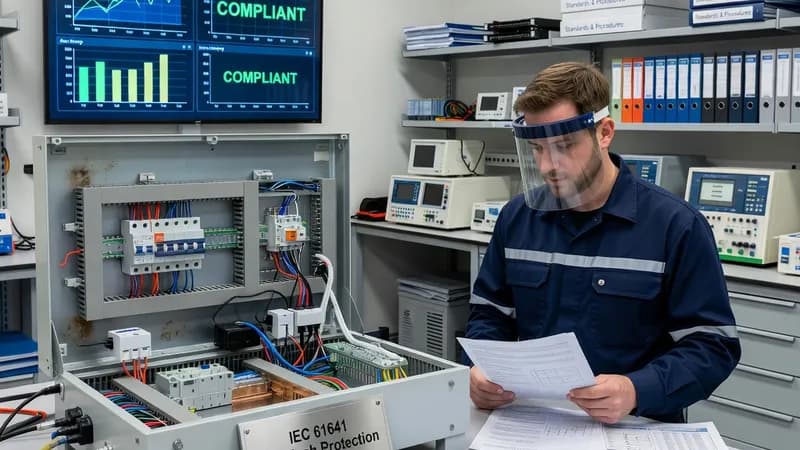
Arc Flash Protection (IEC 61641) defines how a low-voltage switchgear and controlgear assembly performs under an internal arc fault and whether it can contain the event without endangering personnel or damaging adjacent installations beyond the specified limits. It is an internal arc classification and verification method commonly applied to IEC 61439 panel assemblies, particularly where high fault levels, dense busbar arrangements, or continuous operation requirements elevate risk. The standard is frequently referenced for main distribution boards, power control centers, motor control centers, automatic transfer switch panels, busbar trunking terminations, and custom-engineered switchboards used in mission-critical environments. In practical terms, an arc fault may be initiated by loose terminations, insulation failure, tracking, contamination, conductive dust, vermin, mechanical damage, or incorrect switching under load. IEC 61641 testing subjects the complete assembly to the thermal, mechanical, and pressure effects of the arc using defined electrodes, fault durations, and accessibility conditions. The event can generate extreme temperatures, intense radiant energy, molten metal, and a rapid rise in internal pressure. The verification is not based on a theoretical calculation alone; it is a type-tested or design-verified outcome for the exact enclosure construction, compartment layout, cable entry concept, and pressure relief strategy. For panel builders and EPC contractors, the most relevant assemblies are those with ACB incomers, high-capacity MCCB feeders, bus couplers, vertical distribution busbars, and outgoing feeders with VFDs, soft starters, contactors, overload relays, and protection relays. In motor control centers, withdrawable drawers and fixed-form feeders may be assessed to confirm that the arc does not propagate between compartments. In main distribution boards and power control centers, the design often combines reinforced doors, pressure-exhaust channels, insulated or segregated busbar chambers, and interlocking arrangements to reduce the likelihood of operator exposure. Depending on the project, tested short-circuit performance may range from 50 kA to 100 kA or more, coordinated with the assembly’s IEC 61439 rated current, rated peak withstand current, and conditional short-circuit current. IEC 61641 is used together with IEC 61439-1 and IEC 61439-2 for assembly design verification, while the installed switching and protection devices must comply with IEC 60947. In specialized applications, adjacent requirements may also involve IEC 61439-3 for distribution boards intended for ordinary persons, IEC 61439-6 for busbar trunking systems, IEC 60079 for explosive atmospheres, and IEC 61641 considerations for severe industrial duty. The acceptance criteria focus on whether accessible surfaces remain safe, doors and covers stay closed, no fragments are ejected into the operator zone, and hot gases and flames are directed away from personnel. This certification is especially important in industrial-manufacturing plants, data centers, oil-and-gas facilities, mining and metals operations, and utility or infrastructure projects where service continuity and personnel protection are both critical. For facilities with limited shutdown windows, arc-resistant assemblies help reduce the severity of incidents and support safer maintenance planning. Patrion manufactures IEC 61439-compliant low-voltage assemblies with internal arc mitigation features such as reinforced sheet steel enclosures, segregated compartments, arc venting paths, interlocked access doors, pressure-relief plenums, and coordinated component selection using ACBs, MCCBs, relays, and automation devices. For engineers, this creates a defensible compliance pathway that improves safety, supports specification approval, and strengthens resilience in demanding power distribution systems.
Panels Certified to This Standard
Primary power distribution from transformer to sub-circuits. Rated up to 6300A. Houses main incoming breaker, bus-section, and outgoing feeders.
High-capacity power distribution for industrial facilities. Controls and distributes incoming power to MCC, APFC, and downstream loads.
Centralized motor control with starters, contactors, overloads, and VFDs in standardized withdrawable/fixed functional units.
Automatic changeover between mains and generator/UPS. Open or closed transition, with or without bypass.
Prefabricated busbar distribution per IEC 61439-6. Sandwich or air-insulated, aluminum or copper.
Bespoke panel assemblies for non-standard requirements — special ratings, unusual form factors, multi-function combinations.
Related Industries
MCC, PCC, VFD panels, MDB, APFC, automation panels, soft starters, harmonic filters, capacitor banks — full range
High-reliability MDB, PCC, ATS (STS), metering, APFC, BTS, DC distribution
Ex-rated panels, MCC, PCC, VFD, generator control, soft starters, ATEX/IECEx compliance
Rugged MCC, PCC, VFD panels, generator panels, soft starters, harmonic filters
Related Knowledge Articles
Frequently Asked Questions
Ready to Engineer Your Next Panel?
Our team of electrical engineers is ready to design, build, and deliver your custom panel solution — fully compliant with international standards.