Busbar Trunking System Selection and Installation
Selecting and installing BTS for efficient power distribution.
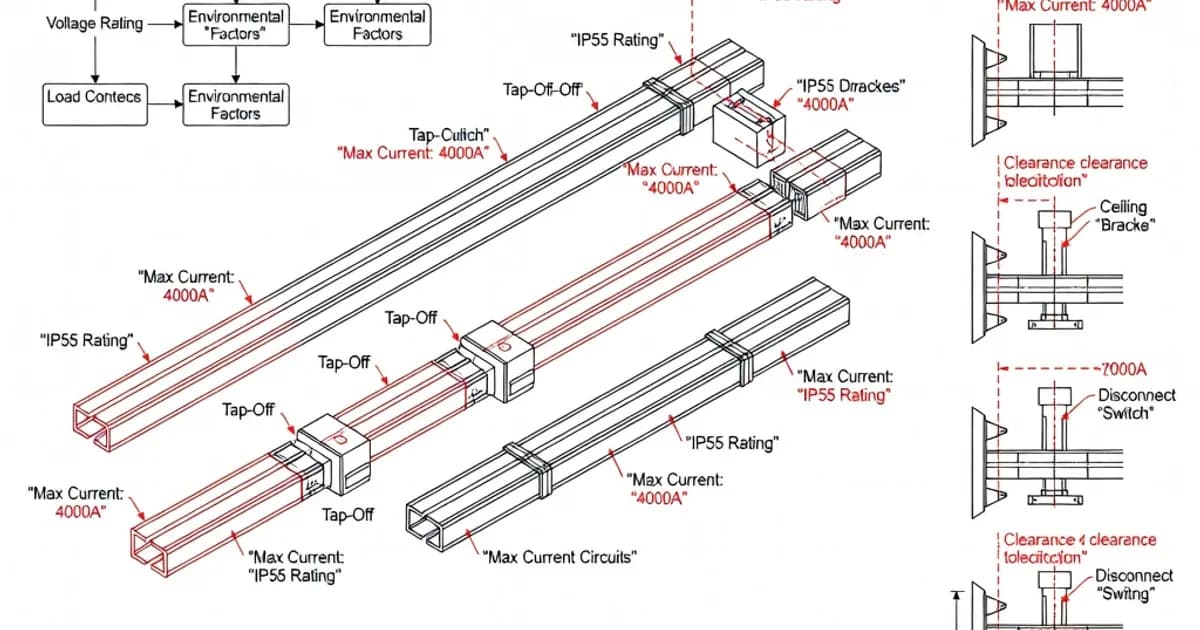
Busbar Trunking System Selection and Installation
Busbar trunking systems, also called busways or BTS, are a compact and highly engineered method of low-voltage power distribution. Instead of distributing power through long runs of cable, a busbar trunking system uses prefabricated busbar trunking units to carry current through straight sections, bends, tap-off points, feeder interfaces, and special-purpose accessories. Per IEC 61439-6, these assemblies are designed for systems up to 1000 V AC or 1500 V DC, and they are intended for safe, modular, and repeatable distribution in industrial plants, commercial buildings, data centers, hospitals, and high-rise developments.
The attraction of busbar trunking is not only current capacity. It is also the consistency of performance. A correctly specified system offers predictable impedance, verified short-circuit withstand, controlled temperature rise, standardized tap-off access, and a much cleaner installation than a large cable network. That said, these benefits depend on selecting the correct rated system and installing it in accordance with the manufacturer’s instructions and the verification requirements of IEC 61439-1 and IEC 61439-6.
What IEC 61439-6 Covers
IEC 61439-6:2012 is the dedicated standard for busbar trunking systems. It defines a BTS as an assembly of busbar trunking units, including straight lengths, elbows, feeders, fire barriers, and other accessories used for power distribution. The standard builds on the general requirements of IEC 61439-1, which covers low-voltage switchgear and controlgear assemblies as a whole. In practice, this means that a busbar system must be designed as a coordinated assembly, not as a collection of individual parts.
IEC 61439-6 distinguishes between the busbar trunking units in the run and the various interfaces that connect the system to the rest of the installation. These include feeder units, tap-off units, adapters, movement accommodation units, and fire barrier components. The standard also clarifies that tap-off units may be fixed or trolley-type depending on the application and maintenance strategy, a point that is particularly important in live-load environments such as factories and logistics facilities. Per the IEC 61439-6 definitions, the system must maintain electrical and mechanical integrity throughout the complete distribution path.
Why Selection Matters
Selecting a busbar trunking system is not a simple matter of choosing a current rating. A proper selection must account for rated current, voltage, frequency, ambient temperature, short-circuit level, harmonic loading, ingress protection, space constraints, building movement, and future expansion. If any of those factors are ignored, the system may run hotter than expected, lose efficiency, fail verification, or become difficult to maintain.
In particular, temperature rise and short-circuit withstand are critical. IEC 61439-1 limits temperature rise for busbars under full load, with a commonly applied maximum conductor temperature rise of 140°C, corresponding to 105 K above a 35°C ambient reference. Short-circuit performance must also be verified, including short-time withstand current Icw, peak withstand current Ip, and related thermal and mechanical effects. As documented in UL’s summary of IEC 61439 testing considerations, the design must account for fault conditions at tap-offs, ends of run, and interfaces where fault energy may be highest.
Key Technical Parameters for Selection
The following table summarizes the principal criteria that should be reviewed before specifying a busbar trunking system.
| Parameter | Typical Requirement | Why It Matters |
|---|---|---|
| Rated voltage | Up to 1000 V AC or 1500 V DC | Defines the system’s electrical application per IEC 61439-6 |
| Rated current | Commonly 25 A to 6300 A depending on product range | Must exceed maximum continuous load with appropriate derating |
| Frequency | Typically 50/60 Hz; IEC reference range 98-102% of nominal | Special assessment may be needed for low frequency or DC systems |
| Short-circuit withstand | Verified Icw and Ip values per design | Ensures the run can survive fault currents without dangerous damage |
| Ingress protection | Often IP54, IP55, or higher depending on environment | Protects against dust, moisture, and contamination per IEC 60529 |
| Temperature rise | Conductor limits verified under full load | Directly affects efficiency, reliability, and service life |
| Tap-off arrangement | Fixed or trolley tap-off units | Determines flexibility, maintenance access, and load management |
| Fire performance | Fire barriers and movement allowances where required | Essential for shafts, high-rise risers, and compartmented buildings |
Current Rating, Derating, and Conductor Material
For most projects, current rating is the first technical filter. Manufacturers commonly offer busbar trunking systems in ranges from a few hundred amps to several thousand amps. Siemens SIVACON busbar trunking, for example, is documented up to 5400 A, while other leading systems offer ranges extending to 5000 A or more. ABB and Schneider Electric both provide families that cover a broad span of distribution needs, with copper and aluminum options available across many ratings.
Material choice affects both performance and logistics. Copper busbars provide lower resistance and compact size, which is advantageous in high-current applications and where voltage drop must be minimized. Aluminum busbars reduce weight and cost, which can be valuable in longer runs or projects with structural limitations. However, aluminum systems demand careful attention to jointing, thermal expansion, and manufacturer-approved installation practices. Per IEC 61439 design principles, the selected conductor material must still meet the verified thermal and short-circuit characteristics of the complete assembly.
Derating is essential when ambient temperature exceeds 35°C, when multiple systems are grouped closely together, or when harmonic currents increase losses. Designers should also review whether the system is expected to operate near full load for long periods. Continuous loading near the top of the rating reduces thermal margin and increases the importance of enclosure ventilation, joint quality, and installation spacing.
Short-Circuit Withstand and Fault Coordination
Short-circuit performance is one of the most important verification points in IEC 61439-6. The busbar trunking system must withstand the mechanical and thermal stresses produced by a fault current without loss of safety. This includes the busbars themselves, the joints, the enclosures, support points, and the tap-off interfaces. Verification may be based on type testing, calculation, or comparison with a verified design, but the result must demonstrate compliance for the specific assembly configuration.
In practical terms, the system must be coordinated with upstream protective devices so that the prospective fault current at the point of installation does not exceed the declared withstand ratings. Designers should check both Icw and Ip, and they should confirm whether the manufacturer’s stated ratings apply to the complete run, specific joint spacings, or only certain end conditions. As outlined in BEAMA’s guide to busbar trunking systems verified to BS EN 61439-6, short-circuit compliance is not a generic product characteristic; it is a configuration-specific performance claim.
When a system includes tap-off points, the fault path can become more complex. A tap-off unit must not compromise the integrity of the trunking run, and the protection arrangement must ensure safe disconnection or containment under fault conditions. For this reason, it is good practice to confirm short-circuit performance at the far end of the run, at each tap-off location, and at every interface where a branch circuit is introduced.
Ingress Protection, Environment, and Mechanical Design
IEC 60529 defines ingress protection ratings, and these ratings are especially important for busbar trunking installed in industrial, dusty, humid, or externally exposed environments. IP54 is common for indoor distribution systems, while IP55 and higher are often specified where washdown, dust exposure, or outdoor sections are expected. The enclosure must not only prevent harmful ingress; it must also maintain the mechanical integrity of joints, supports, and tap-off access points.
Mechanical robustness matters because busbar trunking is often installed at height, across building joints, or through risers where movement and vibration are unavoidable. IEC 61439-6 includes provisions for units designed to accommodate building movement and for components such as fire barriers. In a multi-story building, the system may need to cross expansion joints, penetrate fire-rated floors, or transition through shafts. These points must be planned in advance, because the system geometry and accessory set will affect both compliance and installation time.
Comparison of Common Busbar Trunking Product Families
| Manufacturer | Example Product Line | Typical Range | Notable Features |
|---|---|---|---|
| Siemens | SIVACON 8BU | Up to 5400 A | Modular trunking, tap-off flexibility, documented short-circuit performance up to 150 kA/1 s in selected configurations |
| ABB | Busway solutions | 25-5000 A | Copper and aluminum options, trolley and fixed tap-offs, strong design-tool support |
| Schneider Electric | Canalis | 25-5000 A | Multiple conductor options, fire-resistant variants, broad accessory ecosystem |
| Eaton | Bussmann series busway | 225-5000 A | High short-circuit ratings in selected models, IP54 to IP66 options |
| Rittal | Ri4Power integrated busbar systems | Up to 4000 A | Compact modular architecture for panel extensions and distribution integration |
Tap-Off Units and Future Flexibility
Tap-off units are one of the main reasons engineers choose busbar trunking. They allow loads to be connected along the run without cutting into fixed cable routes or installing additional distribution panels. IEC 61439-6 recognizes fixed and trolley-type tap-off arrangements, and the choice between them has significant operational consequences.
Fixed tap-offs are often suitable for stable loads where the branch circuit is unlikely to change. Trolley tap-offs offer more operational flexibility and are especially useful in maintenance-heavy or reconfigurable environments such as warehouses, production lines, and commercial facilities with frequent tenant changes. If future expansion is likely, the busbar layout should reserve physical space and electrical capacity for additional tap-off points. This is usually far easier than retrofitting a cable network later.
Good selection practice also means checking the available accessories. Some systems include end feeds, center feeds, elbows, expansion sections, crossovers, fire barriers, and vertical riser elements. A system that appears adequate on current rating alone may still be unsuitable if it cannot accommodate the route geometry or building movement requirements.
Installation Principles
Installation quality has a direct impact on performance. Busbar trunking must be supported, aligned, and torqued exactly as instructed by the manufacturer. Joints should be made using the specified sequence and tightening values, because poor contact pressure can create hotspots, increase resistance, and degrade the temperature profile. Installers should never assume that busbar systems tolerate the same on-site flexibility as cable systems.
Straightness and alignment are particularly important. Excessive mechanical stress during installation can distort joints or enclosures and reduce the effectiveness of sealing or insulation barriers. Where the run passes through a building structure, the installer must allow for thermal expansion and building movement using the manufacturer’s movement accommodation parts. Fire barriers must be installed wherever the system penetrates a fire-rated compartment, and the fire strategy should be confirmed with the project fire engineer before installation begins.
Earthing and bonding must also be addressed carefully. Per IEC 61439-1, protective conductor arrangements are part of the verified assembly design. The system’s earthing path must be continuous, correctly sized, and tested during commissioning. Since the busbar enclosure often forms part of the protective arrangement, every joint and accessory needs to be installed with the same attention as the live conductors.
Commissioning and Verification
Before energization, the installation should be checked for conformity with the manufacturer’s instructions and with the verified design documentation. A proper commissioning process normally includes visual inspection, torque verification, continuity checks, insulation resistance testing, and functional checks of tap-off units and protection devices. Where the design includes special ingress or fire performance requirements, these should be confirmed against the installed configuration.
As noted by UL and other technical guidance sources, verification under IEC 61439 is not limited to factory testing. The assembler and installer must ensure that the final assembly matches the tested or otherwise verified configuration. This is especially important when mixing accessories, changing tap-off locations, or modifying the route after procurement. A busbar trunking system that was compliant on paper may no longer be compliant if unsupported accessories or unapproved alterations are introduced during installation.
Common Selection Mistakes
Several recurring mistakes lead to underperformance or non-compliance. One common error is specifying the busbar only by current rating without checking ambient temperature, grouping, or harmonic content. Another is assuming that all tap-off positions are equivalent, when in fact the far end of a run may be subject to different thermal or fault conditions. A third mistake is overlooking mechanical interface details such as expansion joints, structural movement, or fire compartment boundaries.
Designers also sometimes underestimate the importance of manufacturer-specific data. IEC 61439-6 gives the framework, but actual suitability depends on the tested product family. Product brochures should therefore be read together with the manufacturer’s technical manual, dimensioning data, installation guide, and verification statement. This is especially true for systems with high short-circuit ratings, special IP enclosures, or fire-rated construction.
Best Practice for Engineers and Specifiers
A robust busbar selection process starts with a full load study and a route assessment. From there, the engineer should define voltage, current, short-circuit level, operating ambient, IP target, fire requirements, and the number and type of tap-offs. The next step is to select a product family with published verification for the intended configuration. After that, the installation method, support spacing, and connection details should be confirmed against the manufacturer’s instructions.
For high-load or critical facilities, it is wise to use manufacturer design tools where available. ABB and other major vendors provide software and design guides to help verify thermal performance, voltage drop, and fault ratings. These tools do not replace engineering judgment, but they reduce the risk of mismatched components and simplify coordination with upstream protection.
In general, copper systems suit applications that prioritize compactness and efficiency, while aluminum systems suit projects that value lower weight and cost. Trolley tap-offs suit reconfigurable plants, while fixed tap-offs suit stable branch loads. Fire-rated and movement-accommodating sections are essential where the route passes through shafts, compartments, or expansion joints. The best installations are the ones that are planned as complete systems from the outset.
Conclusion
Busbar trunking systems deliver clear advantages in compactness, flexibility, and electrical performance, but those advantages depend on disciplined selection and correct installation. IEC 61439-6 gives the governing framework for busbar trunking assemblies, while IEC 61439-1 provides the general verification requirements that underpin safety and reliability. By matching the rated data to the real site conditions, checking short-circuit and thermal performance, and installing the system exactly as specified, engineers can create a distribution network that is efficient, maintainable, and ready for future growth.
References and Further Reading
IEC 61439-6:2012 Busbar trunking systems
UL: IEC 61439-1 and IEC 61439-6 testing procedure and key considerations
ABB: IEC 61439 in practice workbook
BEAMA: Guide to LV Busbar Trunking Systems Verified to BS EN 61439-6
Ready to Engineer Your Next Panel?
Our team of electrical engineers is ready to design, build, and deliver your custom panel solution — fully compliant with international standards.