IEC 61439-6 (BTS)
Busbar trunking systems
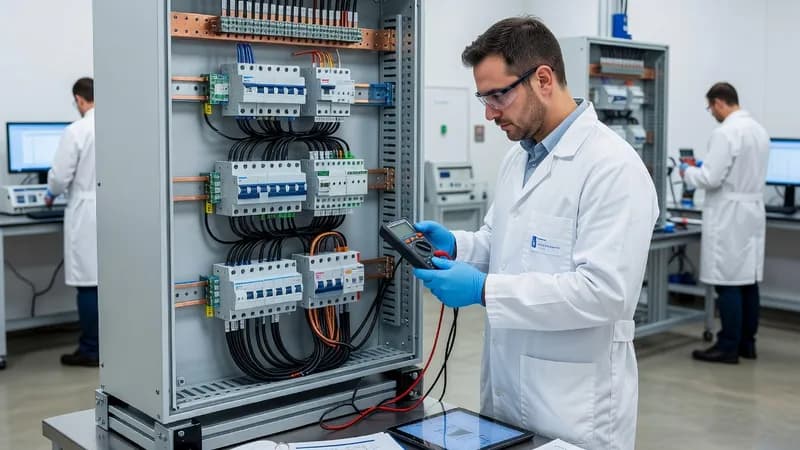
IEC 61439-6 is the dedicated product standard for busbar trunking systems (BTS), covering prefabricated low-voltage power distribution assemblies designed to replace conventional cable runs with a compact, modular, and thermally managed conductor system. It applies to sandwich and air-insulated trunking, rising mains, feeder trunking, and lighting trunking used in commercial buildings, industrial plants, data centers, utilities, and transport infrastructure. In practice, BTS is selected where high current density, rapid installation, low maintenance, and flexible tap-off capability are required, particularly for distribution from transformer secondary boards, main LV switchboards, and large motor/control centers. Compliance with IEC 61439-6 is not limited to the trunking enclosure alone; it extends to busbar conductors, joints, tap-off boxes, supports, end feed units, expansion joints, and protective accessories. Design verification under IEC 61439-1 and IEC 61439-6 covers temperature-rise performance, dielectric properties, short-circuit withstand strength, mechanical strength of joints, clearance and creepage distances, degree of protection, and the effectiveness of internal separation where applicable. Typical systems range from 25 A lighting trunking to 6300 A feeder busduct, with verified short-circuit ratings often specified in the range of 35 kA, 50 kA, 65 kA, or higher for 1 s or 3 s depending on the project fault level. For IEC 61439 panel assemblies, BTS interfaces directly with ACBs, MCCBs, protection relays, metering devices, and downstream switchboards. In generator-backed or mission-critical installations, busbar trunking may feed ATS panels, UPS systems, VFD-driven process loads, soft starters, and modular distribution boards. Tap-off units are commonly equipped with MCCBs, fuses, or switch-disconnectors compliant with IEC 60947-2 and IEC 60947-3, allowing safe load branching while maintaining enclosure integrity and operational continuity. Where the installation is exposed to dust, moisture, or washdown conditions, the trunking and tap-off assemblies must demonstrate suitable IP ratings, often IP54, IP55, or higher depending on the environment. The standard is particularly important for multi-tenant commercial buildings, hospital campuses, airport terminals, tunnels, data halls, and industrial manufacturing lines where scalability and maintainability are critical. In data centers, BTS supports high-density rack distribution and rapid reconfiguration; in manufacturing, it simplifies line extensions and machine relocations; in infrastructure and utilities, it provides robust risers and distribution corridors. For hazardous areas, interface with IEC 60079 requirements may be necessary, while fire-resistance or smoke-containment expectations may trigger additional project criteria such as IEC 61641 for arc fault containment in certain assemblies. A compliant IEC 61439-6 solution should be supported by documented design verification, routine verification, type-tested or partially type-tested evidence where applicable, clear nameplate data, rated operational current, rated insulation voltage, frequency, short-circuit rating, and ambient conditions. For EPC contractors and panel builders, the key advantage is predictable performance and standardized interface geometry, reducing site labor and increasing quality control across repetitive distribution routes.
Panels Certified to This Standard
Related Industries
MDB, lighting distribution, APFC, ATS, metering, BTS, capacitor bank, BMS integration
MCC, PCC, VFD panels, MDB, APFC, automation panels, soft starters, harmonic filters, capacitor banks — full range
High-reliability MDB, PCC, ATS (STS), metering, APFC, BTS, DC distribution
MDB, ATS, metering, BTS, lighting distribution, DC distribution
Related Knowledge Articles
Selecting and installing BTS for efficient power distribution.
Comprehensive guide to busbar sizing, material selection, and installation.
Comprehensive overview of all IEC 61439 parts, their scope, and how they apply to different panel types.
Frequently Asked Questions
Ready to Engineer Your Next Panel?
Our team of electrical engineers is ready to design, build, and deliver your custom panel solution — fully compliant with international standards.