Busbar Trunking System (BTS)
Prefabricated busbar distribution per IEC 61439-6. Sandwich or air-insulated, aluminum or copper.
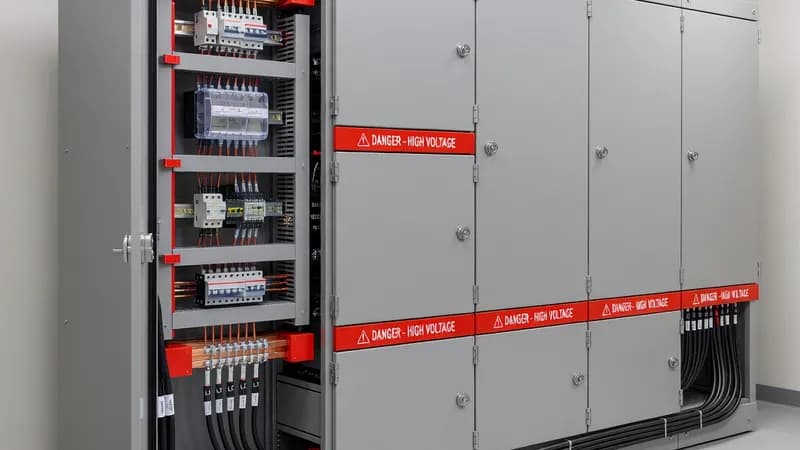
Busbar Trunking System (BTS) is a prefabricated low-voltage power distribution architecture designed in accordance with IEC 61439-6 for busbar trunking systems and in coordination with IEC 61439-1/2 where the assembly includes associated switchgear and controlgear functions at the origin or at tap-off points. It replaces large cross-section cable runs with factory-built conductor sections, offering predictable performance, reduced voltage drop, faster installation, and easier expansion in commercial and industrial facilities. Typical conductor materials are copper or aluminum, with enclosure options in galvanized steel, aluminum, or high-strength polymer, and protection classes commonly ranging from IP42 to IP65 depending on the route environment. Air-insulated systems are often selected for cost efficiency and visual inspection, while sandwich-type systems provide a compact profile, lower impedance, and better resistance to dust accumulation in high-load corridors and process areas. BTS assemblies are used as feeder trunking, rising mains, and distribution backbones in office towers, shopping centers, hospitals, airports, manufacturing plants, and data centers. Standard tap-off units may include MCCBs, switch-disconnectors, fused load-break switches, metering modules, SPD modules, or outgoing feeders to DBs, UPS systems, chillers, and mechanical plant. When the system is integrated with metering power analyzers, demand monitoring and energy management become straightforward, supporting facility KPI tracking and load balancing. In motor-heavy plants, BTS can feed local MCC panels with VFDs, soft starters, and protection relays, minimizing cable congestion and simplifying future line expansion. Design attention should focus on rated current, diversity, permissible temperature rise, short-circuit withstand rating, and voltage drop over the full route. Common current ratings range from 25 A lighting trunking to 6300 A main distribution busbar systems, with short-circuit ratings determined by the system design verification and the protective device coordination at the source, often using ACBs or high-rupturing MCCBs. Internal arrangements and functional separation are defined by the associated equipment architecture; where tap-off enclosures incorporate protective devices, segregation must support safe maintenance, clear isolation, and arc fault containment. For indoor risers and dense plant rooms, forms of separation and accessibility planning are essential to reduce outage impact and improve maintainability. IEC 61439 requires verified design performance for temperature rise, dielectric properties, short-circuit withstand, clearances and creepage distances, and mechanical strength. For harsh environments, IP protection and corrosion resistance must be matched to ambient conditions, while seismic qualification may be required in utilities, hospitals, and critical infrastructure. Where the route crosses hazardous locations or adjacent to combustible atmospheres, coordination with IEC 60079 is necessary, and for arc safety in energized equipment rooms, IEC 61641 guidance should be considered. In practice, a well-engineered BTS provides a scalable, low-loss backbone that integrates cleanly with protective devices, metering, and downstream distribution boards, making it one of the most efficient solutions for modern electrical power distribution by Patrion.
Components for This Panel
Busbar Systems selection, integration, and best practices for Busbar Trunking System (BTS) assemblies compliant with IEC 61439.
Moulded Case Circuit Breakers (MCCB) selection, integration, and best practices for Busbar Trunking System (BTS) assemblies compliant with IEC 61439.
Surge Protection Devices (SPD) selection, integration, and best practices for Busbar Trunking System (BTS) assemblies compliant with IEC 61439.
Metering & Power Analyzers selection, integration, and best practices for Busbar Trunking System (BTS) assemblies compliant with IEC 61439.
Applicable Standards
IEC 61439-6 (BTS) compliance requirements, testing procedures, and design considerations for Busbar Trunking System (BTS) assemblies.
IP Protection Ratings compliance requirements, testing procedures, and design considerations for Busbar Trunking System (BTS) assemblies.
Arc Flash Protection (IEC 61641) compliance requirements, testing procedures, and design considerations for Busbar Trunking System (BTS) assemblies.
Seismic Qualification (IEEE 693/IBC) compliance requirements, testing procedures, and design considerations for Busbar Trunking System (BTS) assemblies.
Industries Using This Panel
Busbar Trunking System (BTS) assemblies engineered for Commercial Buildings applications, addressing industry-specific requirements and compliance standards.
Busbar Trunking System (BTS) assemblies engineered for Industrial Manufacturing applications, addressing industry-specific requirements and compliance standards.
Busbar Trunking System (BTS) assemblies engineered for Data Centers applications, addressing industry-specific requirements and compliance standards.
Busbar Trunking System (BTS) assemblies engineered for Infrastructure & Utilities applications, addressing industry-specific requirements and compliance standards.
Related Knowledge Articles
Selecting and installing BTS for efficient power distribution.
Comprehensive guide to busbar sizing, material selection, and installation.
Technical comparison for busbar material selection.
Comprehensive overview of all IEC 61439 parts, their scope, and how they apply to different panel types.
Frequently Asked Questions
Ready to Engineer Your Next Panel?
Our team of electrical engineers is ready to design, build, and deliver your custom panel solution — fully compliant with international standards.